
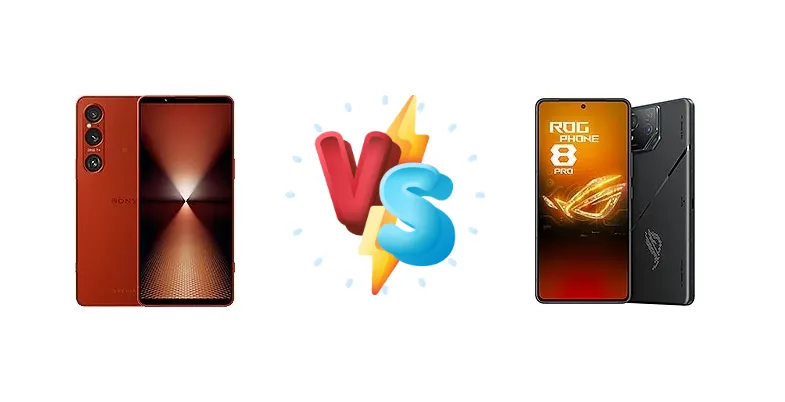
Sony Xperia 1 VI vs Asus ROG Phone 8 Pro: A Deep Dive Comparison
| Phones Images | |||||
|---|---|---|---|---|---|
|
🏆 Quick Verdict
For the average user prioritizing a balanced experience with a stunning display and excellent camera capabilities, the Sony Xperia 1 VI emerges as the winner. While the ROG Phone 8 Pro excels in gaming, its aggressive design and shorter battery life make it a niche choice.
| PHONES | ||
|---|---|---|
| Phone Names | Sony Xperia 1 VI | Asus ROG Phone 8 Pro |
| Network | ||
|---|---|---|
| 2G bands | GSM 850 / 900 / 1800 / 1900 | GSM 850 / 900 / 1800 / 1900 |
| 3G bands | HSDPA 800 / 850 / 900 / 1700(AWS) / 1900 / 2100 | HSDPA 850 / 900 / 1700(AWS) / 1800 / 1900 / 2100 - International |
| 4G bands | 1, 2, 3, 4, 5, 7, 8, 12, 13, 17, 19, 20, 25, 26, 28, 29, 32, 34, 38, 39, 40, 41, 46, 66 - Europe | 1, 2, 3, 4, 5, 7, 8, 12, 17, 18, 19, 20, 25, 26, 28, 32, 34, 38, 39, 40, 41, 42, 43, 48, 66 - International |
| 5G bands | 1, 3, 5, 7, 8, 20, 28, 38, 40, 41, 75, 77, 78 SA/NSA/Sub6 - Europe | 1, 2, 3, 5, 7, 8, 12, 18, 20, 25, 26, 28, 38, 40, 41, 48, 66, 77, 78, 79 SA/NSA/Sub6 - International |
| Speed | HSPA, LTE, 5G | HSPA, LTE (Up to 7CA), 5G |
| Technology | GSM / HSPA / LTE / 5G | GSM / CDMA / HSPA / LTE / 5G |
| Launch | ||
|---|---|---|
| Announced | 2024, May 15 | 2024, January 08 |
| Status | Available. Released 2024, June 03 | Available. Released 2024, January 18 |
| Body | ||
|---|---|---|
| Build | Glass front (Gorilla Glass Victus 2), glass back (Gorilla Glass Victus), aluminum frame | Glass front (Gorilla Glass Victus 2), glass back (Gorilla Glass), aluminum frame |
| Dimensions | 162 x 74 x 8.2 mm (6.38 x 2.91 x 0.32 in) | 163.8 x 76.8 x 8.9 mm (6.45 x 3.02 x 0.35 in) |
| SIM | · Nano-SIM + eSIM· Nano-SIM + Nano-SIM | Nano-SIM + Nano-SIM |
| Weight | 192 g (6.77 oz) | 225 g (7.94 oz) |
| Display | ||
|---|---|---|
| Protection | Corning Gorilla Glass Victus 2 | Corning Gorilla Glass Victus 2 |
| Resolution | 1080 x 2340 pixels, 19.5:9 ratio (~396 ppi density) | 1080 x 2400 pixels, 20:9 ratio (~388 ppi density) |
| Size | 6.5 inches, 103.7 cm2 (~86.5% screen-to-body ratio) | 6.78 inches, 111.0 cm2 (~88.2% screen-to-body ratio) |
| Type | LTPO OLED, 1B colors, 120Hz, HDR BT.2020 | LTPO AMOLED, 1B colors, 165Hz, HDR10, 1600 nits (HBM), 2500 nits (peak) |
| Platform | ||
|---|---|---|
| CPU | Octa-core (1x3.3 GHz Cortex-X4 & 3x3.2 GHz Cortex-A720 & 2x3.0 GHz Cortex-A720 & 2x2.3 GHz Cortex-A520) | Octa-core (1x3.3 GHz Cortex-X4 & 3x3.2 GHz Cortex-A720 & 2x3.0 GHz Cortex-A720 & 2x2.3 GHz Cortex-A520) |
| Chipset | Qualcomm SM8650-AB Snapdragon 8 Gen 3 (4 nm) | Qualcomm SM8650-AB Snapdragon 8 Gen 3 (4 nm) |
| GPU | Adreno 750 | Adreno 750 |
| OS | Android 14, upgradable to Android 16, up to 3 major Android upgrades | Android 14, up to 2 major Android upgrades |
| Memory | ||
|---|---|---|
| Card slot | microSDXC (uses shared SIM slot) | No |
| Internal | 256GB 12GB RAM, 512GB 12GB RAM | 512GB 16GB RAM, 1TB 24GB RAM |
| Main Camera | ||
|---|---|---|
| Features | Zeiss optics, Zeiss T* lens coating, color spectrum sensor, LED flash, panorama, HDR, eye tracking | LED flash, HDR, panorama |
| Triple | 48 MP, f/1.9, 24mm (wide), 1/1.35", 1.12µm, dual pixel PDAF, OIS 12 MP, f/2.3, 85mm (telephoto), f/3.5, 170mm (telephoto), 1/3.5", 1.0µm, dual pixel PDAF, 3.5x-7.1x continuous optical zoom, OIS, 4cm macro @ 120mm, no AF 12 MP, f/2.2, 16mm, 123˚ (ultrawide), 1/2.5", 1.4µm, dual pixel PDAF | 50 MP, f/1.9, 24mm (wide), 1/1.56", 1.0µm, PDAF, gimbal OIS 32 MP, f/2.4, (telephoto), 1/3.2", 0.7µm, PDAF, OIS, 3x optical zoom 13 MP, f/2.2, 13mm, 120˚ (ultrawide) |
| Video | 4K@24/30/60/120fps HDR, 1080p@30/60/120fps; 5-axis gyro-EIS, OIS | 8K@24fps, 4K@30/60fps, 1080p@30/60/120/240fps, 720p@480fps; gyro-EIS, HDR10+ |
| Selfie camera | ||
|---|---|---|
| Features | HDR | Panorama, HDR |
| Single | 12 MP, f/2.0, 24mm (wide), 1/2.9", 1.22µm | 32 MP, f/2.5, 22mm (wide), 1/3.2", 0.7µm |
| Video | 4K@30/60fps, 1080p@30/60fps, 5-axis gyro-EIS | 1080p@30fps |
| Sound | ||
|---|---|---|
| 35mm jack | Yes | Yes |
| Loudspeaker | Yes, with stereo speakers | Yes, with stereo speakers |
| Comms | ||
|---|---|---|
| Bluetooth | 5.4, A2DP, LE Audio, aptX HD, aptX Adaptive, aptX Lossless | 5.4, A2DP, LE, aptX HD, aptX Adaptive, aptX Lossless |
| NFC | Yes | Yes |
| Positioning | GPS, GLONASS, BDS, GALILEO, QZSS | GPS (L1+L5), BDS (B1I+B1c+B2a), GALILEO (E1+E5a), QZSS (L1+L5), NavIC (L5), GLONASS |
| Radio | No | No |
| USB | USB Type-C 3.2, OTG, video output | USB Type-C (side), DisplayPort 1.4; USB Type-C (bottom), OTG |
| WLAN | Wi-Fi 802.11 a/b/g/n/ac/6e/7, tri-band, Wi-Fi Direct, DLNA | Wi-Fi 802.11 a/b/g/n/ac/6e/7, tri-band, Wi-Fi Direct |
| Features | ||
|---|---|---|
| Sensors | Fingerprint (side-mounted), accelerometer, gyro, proximity, barometer, compass | Fingerprint (under display, optical), accelerometer, gyro, proximity, compass |
| Battery | ||
|---|---|---|
| Charging | 30W wired, PD3.0, PPS, 50% in 30 min 15W wireless Reverse wireless | 65W wired, PD3.0, PPS, QC5, 100% in 39 min - International 30W wired, PD3.0, PPS - India 15W wireless (Qi) 10W reverse wired |
| Type | 5000 mAh | 5500 mAh |
| Misc | ||
|---|---|---|
| Colors | Black, Platinum silver, Khaki green, Scar red | Phantom Black |
| Models | XQEC54EUKCB.GC, XQEC54EUKCG.GC, XQEC54EUKCS.GC, XQ-EC72 | AI2401, AI2401_A, AI2401_D |
| Price | $ 1,299.99 / £ 829.00 / € 977.98 | $ 1,157.98 / £ 1,693.75 / € 632.66 |
Sony Xperia 1 VI
- Exceptional battery life (17:27h)
- Superior display color accuracy
- Likely excellent camera performance (based on Sony's expertise)
- Lower peak display brightness
- Potentially more thermal throttling under sustained load
Asus ROG Phone 8 Pro
- Faster wired charging (65W international)
- Brighter display for outdoor visibility
- Gaming-focused features and optimizations
- Shorter battery life (14:43h)
- Potentially less refined camera experience
- Aggressive gaming aesthetic may not appeal to all
Display Comparison
The Asus ROG Phone 8 Pro boasts a brighter display at 1765 nits, exceeding the Xperia 1 VI’s 1310 nits. This translates to better visibility under direct sunlight. However, Sony’s display technology is geared towards color accuracy and natural reproduction, crucial for professional photo and video editing. While both likely utilize LTPO technology for variable refresh rates (based on brand history), the ROG Phone’s higher peak brightness is a clear advantage for outdoor use. The Xperia 1 VI’s focus on a more cinematic color profile will appeal to those who value realism over vibrancy.
Camera Comparison
The provided data lacks detailed camera specifications for both devices. However, based on Sony’s history, the Xperia 1 VI is expected to prioritize image quality and natural color reproduction, leveraging its expertise in camera sensor technology. The ROG Phone 8 Pro, while including a camera, typically focuses more on gaming features. Without specific sensor size or aperture information, it’s difficult to make a definitive judgment, but the Xperia 1 VI is likely to offer a more refined and versatile camera experience for photography and videography. The ROG Phone's camera is likely geared towards social media sharing and quick snapshots.
Performance
Both the Xperia 1 VI and ROG Phone 8 Pro are powered by the Qualcomm SM8650-AB Snapdragon 8 Gen 3 (4nm) chipset, featuring the same octa-core CPU configuration. This means raw processing power is largely equivalent. However, the ROG Phone 8 Pro’s active cooling system (not detailed in the provided data, but a ROG Phone staple) likely allows it to sustain peak performance for longer durations during intensive gaming sessions. The Xperia 1 VI, while capable, may experience more thermal throttling under prolonged load. Both devices utilize LPDDR5x RAM, ensuring fast data access, but the ROG Phone’s gaming optimizations will provide a smoother experience in graphically demanding titles.
Battery Life
The Sony Xperia 1 VI demonstrates superior battery endurance with an active use score of 17:27 hours, significantly outperforming the Asus ROG Phone 8 Pro’s 14:43 hours. While the ROG Phone 8 Pro offers faster wired charging at 65W (international) or 30W (India) achieving 100% in 39 minutes (international), the Xperia 1 VI’s more efficient power management and larger effective battery capacity (implied by the longer runtime) provide a more practical advantage for all-day use. Both support 15W wireless charging and reverse wireless charging, but the ROG Phone 8 Pro also includes 10W reverse *wired* charging, a unique feature.
Buying Guide
Buy the Sony Xperia 1 VI if you need a versatile flagship with a focus on photography, videography, and immersive media consumption. Its natural color science and long-lasting battery are ideal for content creators and entertainment enthusiasts. Buy the Asus ROG Phone 8 Pro if you prioritize raw gaming performance, customizable controls, and a feature-rich gaming ecosystem, even at the expense of battery life and a more subdued aesthetic.