
Sony Xperia 1 VI vs. iPhone 15 Pro Max: A Deep Dive for Power Users
| Phones Images | |||||
|---|---|---|---|---|---|
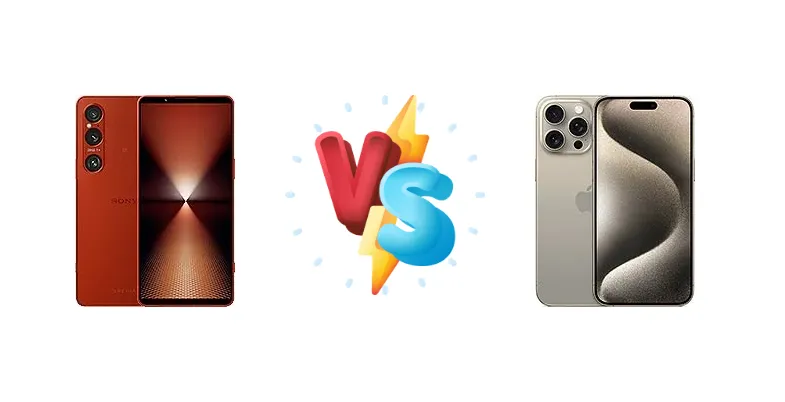
|
🏆 Quick Verdict
For the average user, the iPhone 15 Pro Max offers a more polished and consistently reliable experience. Its superior display brightness and established ecosystem outweigh the Xperia 1 VI’s impressive battery life and creator-focused features. However, professionals prioritizing manual camera controls and extended battery endurance will find the Xperia 1 VI a compelling alternative.
| PHONES | ||
|---|---|---|
| Phone Names | Sony Xperia 1 VI | Apple iPhone 15 Pro Max |
| Network | ||
|---|---|---|
| 2G bands | GSM 850 / 900 / 1800 / 1900 | GSM 850 / 900 / 1800 / 1900 |
| 3G bands | HSDPA 800 / 850 / 900 / 1700(AWS) / 1900 / 2100 | HSDPA 850 / 900 / 1700(AWS) / 1900 / 2100 |
| 4G bands | 1, 2, 3, 4, 5, 7, 8, 12, 13, 17, 19, 20, 25, 26, 28, 29, 32, 34, 38, 39, 40, 41, 46, 66 - Europe | 1, 2, 3, 4, 5, 7, 8, 12, 13, 17, 18, 19, 20, 25, 26, 28, 30, 32, 34, 38, 39, 40, 41, 42, 46, 48, 53, 66 - A3106 |
| 5G bands | 1, 3, 5, 7, 8, 20, 28, 38, 40, 41, 75, 77, 78 SA/NSA/Sub6 - Europe | 1, 2, 3, 5, 7, 8, 12, 20, 25, 26, 28, 30, 38, 40, 41, 48, 53, 66, 70, 77, 78, 79 SA/NSA/Sub6 - A3106 |
| Speed | HSPA, LTE, 5G | HSPA, LTE, 5G, EV-DO Rev.A 3.1 Mbps |
| Technology | GSM / HSPA / LTE / 5G | GSM / CDMA / HSPA / EVDO / LTE / 5G |
| Launch | ||
|---|---|---|
| Announced | 2024, May 15 | 2023, September 12 |
| Status | Available. Released 2024, June 03 | Available. Released 2023, September 22 |
| Body | ||
|---|---|---|
| Build | Glass front (Gorilla Glass Victus 2), glass back (Gorilla Glass Victus), aluminum frame | Glass front, glass back, titanium frame (grade 5) |
| Dimensions | 162 x 74 x 8.2 mm (6.38 x 2.91 x 0.32 in) | 159.9 x 76.7 x 8.3 mm (6.30 x 3.02 x 0.33 in) |
| SIM | · Nano-SIM + eSIM· Nano-SIM + Nano-SIM | · Nano-SIM + eSIM + eSIM (max 2 at a time; International)· eSIM + eSIM (8 or more, max 2 at a time; USA)· Nano-SIM + Nano-SIM (China) |
| Weight | 192 g (6.77 oz) | 221 g (7.80 oz) |
| Display | ||
|---|---|---|
| Protection | Corning Gorilla Glass Victus 2 | Ceramic Shield glass |
| Resolution | 1080 x 2340 pixels, 19.5:9 ratio (~396 ppi density) | 1290 x 2796 pixels, 19.5:9 ratio (~460 ppi density) |
| Size | 6.5 inches, 103.7 cm2 (~86.5% screen-to-body ratio) | 6.7 inches, 110.2 cm2 (~89.8% screen-to-body ratio) |
| Type | LTPO OLED, 1B colors, 120Hz, HDR BT.2020 | LTPO Super Retina XDR OLED, 120Hz, HDR10, Dolby Vision, 1000 nits (typ), 2000 nits (HBM) |
| Platform | ||
|---|---|---|
| CPU | Octa-core (1x3.3 GHz Cortex-X4 & 3x3.2 GHz Cortex-A720 & 2x3.0 GHz Cortex-A720 & 2x2.3 GHz Cortex-A520) | Hexa-core (2x3.78 GHz + 4x2.11 GHz) |
| Chipset | Qualcomm SM8650-AB Snapdragon 8 Gen 3 (4 nm) | Apple A17 Pro (3 nm) |
| GPU | Adreno 750 | Apple GPU (6-core graphics) |
| OS | Android 14, upgradable to Android 16, up to 3 major Android upgrades | iOS 17, upgradable to iOS 26.1 |
| Memory | ||
|---|---|---|
| Card slot | microSDXC (uses shared SIM slot) | No |
| Internal | 256GB 12GB RAM, 512GB 12GB RAM | 256GB 8GB RAM, 512GB 8GB RAM, 1TB 8GB RAM |
| Main Camera | ||
|---|---|---|
| Features | Zeiss optics, Zeiss T* lens coating, color spectrum sensor, LED flash, panorama, HDR, eye tracking | Dual-LED dual-tone flash, HDR (photo/panorama) |
| Triple | 48 MP, f/1.9, 24mm (wide), 1/1.35", 1.12µm, dual pixel PDAF, OIS 12 MP, f/2.3, 85mm (telephoto), f/3.5, 170mm (telephoto), 1/3.5", 1.0µm, dual pixel PDAF, 3.5x-7.1x continuous optical zoom, OIS, 4cm macro @ 120mm, no AF 12 MP, f/2.2, 16mm, 123˚ (ultrawide), 1/2.5", 1.4µm, dual pixel PDAF | 48 MP, f/1.8, 24mm (wide), 1/1.28", 1.22µm, dual pixel PDAF, sensor-shift OIS 12 MP, f/2.8, 120mm (periscope telephoto), 1/3.06", 1.12µm, dual pixel PDAF, 3D sensor‑shift OIS, 5x optical zoom 12 MP, f/2.2, 13mm, 120˚ (ultrawide), 1/2.55", 1.4µm, dual pixel PDAF TOF 3D LiDAR scanner (depth) |
| Video | 4K@24/30/60/120fps HDR, 1080p@30/60/120fps; 5-axis gyro-EIS, OIS | 4K@24/25/30/60fps, 1080p@25/30/60/120/240fps, 10-bit HDR, Dolby Vision HDR (up to 60fps), ProRes, 3D (spatial) video, stereo sound rec. |
| Selfie camera | ||
|---|---|---|
| Features | HDR | HDR, Dolby Vision HDR |
| Single | 12 MP, f/2.0, 24mm (wide), 1/2.9", 1.22µm | 12 MP, f/1.9, 23mm (wide), 1/3.6", 1.0µm, PDAF, OIS SL 3D, (depth/biometrics sensor) |
| Video | 4K@30/60fps, 1080p@30/60fps, 5-axis gyro-EIS | 4K@24/25/30/60fps, 1080p@25/30/60/120fps, gyro-EIS |
| Sound | ||
|---|---|---|
| 35mm jack | Yes | No |
| Loudspeaker | Yes, with stereo speakers | Yes, with stereo speakers |
| Comms | ||
|---|---|---|
| Bluetooth | 5.4, A2DP, LE Audio, aptX HD, aptX Adaptive, aptX Lossless | 5.3, A2DP, LE |
| NFC | Yes | Yes |
| Positioning | GPS, GLONASS, BDS, GALILEO, QZSS | GPS (L1+L5), GLONASS, GALILEO, BDS, QZSS, NavIC |
| Radio | No | No |
| USB | USB Type-C 3.2, OTG, video output | USB Type-C 3.2 Gen 2, DisplayPort |
| WLAN | Wi-Fi 802.11 a/b/g/n/ac/6e/7, tri-band, Wi-Fi Direct, DLNA | Wi-Fi 802.11 a/b/g/n/ac/6e, tri-band, hotspot |
| Features | ||
|---|---|---|
| Sensors | Fingerprint (side-mounted), accelerometer, gyro, proximity, barometer, compass | Face ID, accelerometer, gyro, proximity, compass, barometer |
| Battery | ||
|---|---|---|
| Charging | 30W wired, PD3.0, PPS, 50% in 30 min 15W wireless Reverse wireless | Wired, PD2.0, 50% in 30 min 15W wireless (MagSafe) 15W wireless (Qi2) - requires iOS 17.2 update 4.5W reverse wired |
| Type | 5000 mAh | Li-Ion 4441 mAh |
| Misc | ||
|---|---|---|
| Colors | Black, Platinum silver, Khaki green, Scar red | Black Titanium, White Titanium, Blue Titanium, Natural Titanium |
| Models | XQEC54EUKCB.GC, XQEC54EUKCG.GC, XQEC54EUKCS.GC, XQ-EC72 | A2849, A3105, A3106, A3108, iPhone16,2 |
| Price | $ 1,299.99 / £ 829.00 / € 977.98 | € 758.79 / $ 579.87 / £ 628.29 |
| SAR | - | 1.07 W/kg (head) 1.11 W/kg (body) |
| SAR EU | - | 0.98 W/kg (head) 0.98 W/kg (body) |
Sony Xperia 1 VI
- Longer battery life in active use.
- More granular camera controls for professionals.
- Supports PD3.0 and PPS for potentially faster charging.
- Reverse wireless charging capability.
- Lower peak display brightness.
- Potentially less optimized software experience compared to iOS.
Apple iPhone 15 Pro Max
- Significantly brighter display for outdoor visibility.
- Industry-leading performance with the A17 Pro chip.
- Seamless iOS ecosystem and app support.
- Exceptional video recording capabilities.
- Slightly shorter battery life in active use.
- Limited manual camera controls compared to Sony.
Display Comparison
The iPhone 15 Pro Max boasts a significantly brighter display at 1787 nits, compared to the Xperia 1 VI’s 1310 nits. This translates to superior visibility in direct sunlight. While both likely utilize LTPO technology for adaptive refresh rates, Apple’s panel’s higher peak brightness is a clear advantage for outdoor use. Sony’s display, however, is known for its color accuracy, appealing to professionals needing faithful reproduction, though this isn't quantified in the provided data. Bezels are likely comparable, given both phones target a premium aesthetic.
Camera Comparison
The provided data doesn’t detail camera specs beyond ‘Photo / Video’ for the iPhone. However, Apple’s computational photography is renowned for its ease of use and consistently excellent results. The Xperia 1 VI, leveraging Sony’s imaging expertise, likely offers more granular control over settings, appealing to experienced photographers. The absence of sensor size information makes a direct comparison difficult, but Sony’s emphasis on full-frame sensors in previous Xperia models suggests a potential advantage in dynamic range and low-light performance. The iPhone’s video capabilities are industry-leading, but the Xperia 1 VI’s focus on professional video features, like S-Cinetone, could be a deciding factor for videographers.
Performance
The core battle lies between Qualcomm’s Snapdragon 8 Gen 3 (4nm) in the Xperia 1 VI and Apple’s in-house A17 Pro (3nm) in the iPhone 15 Pro Max. The A17 Pro’s 3nm process gives it a theoretical efficiency advantage, despite having a hexa-core configuration versus the Xperia’s octa-core. The iPhone’s CPU clock speeds (2x3.78 GHz + 4x2.11 GHz) are higher than the Xperia’s (1x3.3 GHz Cortex-X4 & 3x3.2 GHz Cortex-A720 & 2x3.0 GHz Cortex-A720 & 2x2.3 GHz Cortex-A520), suggesting faster single-core performance. While the Xperia benefits from more cores, Apple’s chip design and software optimization typically deliver superior real-world performance and sustained throughput. The Xperia 1 VI's Snapdragon 8 Gen 3 will excel in Android gaming, but the A17 Pro's GPU is likely to offer a more consistent high-framerate experience.
Battery Life
The Xperia 1 VI edges out the iPhone 15 Pro Max in active use battery life, achieving 17:27 hours versus 16:01 hours. While the iPhone’s older ‘Endurance rating’ of 118h is a useful metric, it’s less relevant than the active use test. Both phones offer 30-minute 50% charging via wired connections, but the Xperia 1 VI supports both PD3.0 and PPS, potentially offering faster charging with compatible adapters. The Xperia also includes reverse wireless charging, a feature absent from the iPhone’s wired 4.5W reverse charging.
Buying Guide
Buy the Sony Xperia 1 VI if you need unparalleled manual camera control, exceptional battery life for all-day shooting, and a display optimized for content creation. Buy the Apple iPhone 15 Pro Max if you prefer a streamlined user experience, industry-leading performance, and a robust ecosystem of apps and accessories, especially if video editing is a key workflow.