
Sony Xperia 1 V vs Xiaomi 13 Pro: Which Snapdragon 8 Gen 2 Flagship Wins?
| Phones Images | |||||
|---|---|---|---|---|---|
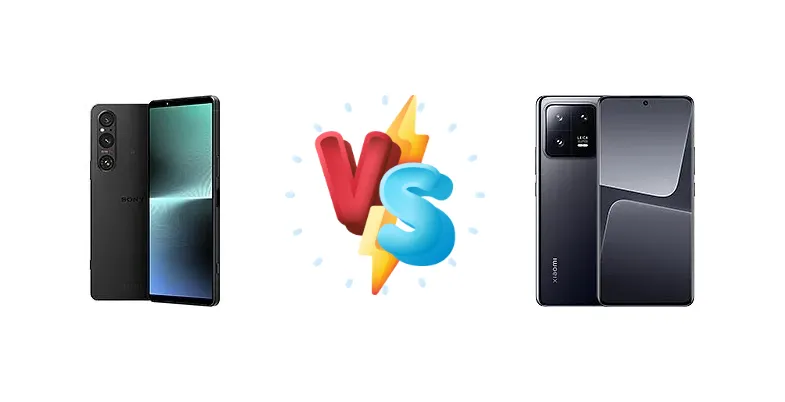
|
🏆 Quick Verdict
For the average user prioritizing rapid charging and a brighter display, the Xiaomi 13 Pro is the clear winner. Its 120W charging fully replenishes the battery in just 19 minutes, a significant advantage over the Xperia 1 V’s 30W charging. However, the Xperia 1 V’s longer active use battery score and creator-focused features make it ideal for professionals.
| PHONES | ||
|---|---|---|
| Phone Names | Sony Xperia 1 V | Xiaomi 13 Pro |
| Network | ||
|---|---|---|
| 2G bands | GSM 850 / 900 / 1800 / 1900 | GSM 850 / 900 / 1800 / 1900 |
| 3G bands | HSDPA 800 / 850 / 900 / 1700(AWS) / 1900 / 2100 | HSDPA 800 / 850 / 900 / 1700(AWS) / 1900 / 2100 |
| 4G bands | 1, 2, 3, 4, 5, 7, 8, 12, 13, 17, 19, 20, 25, 26, 28, 29, 32, 34, 38, 39, 40, 41, 46, 66 - Europe | 1, 2, 3, 4, 5, 7, 8, 12, 13, 17, 18, 19, 20, 25, 26, 28, 32, 38, 39, 40, 41, 42, 48, 66 - International |
| 5G bands | 1, 3, 5, 7, 8, 20, 28, 38, 40, 41, 77, 78 SA/NSA/Sub6 - Europe | 1, 3, 5, 7, 8, 20, 28, 38, 40, 41, 66, 71, 75, 77, 78 SA/NSA - International |
| Speed | HSPA, LTE, 5G | HSPA, LTE, 5G |
| Technology | GSM / HSPA / LTE / 5G | GSM / CDMA / HSPA / CDMA2000 / LTE / 5G |
| 1, 3, 5, 7, 8, 28, 38, 40, 41, 77, 78, 79 SA/NSA/Sub6 - Asia | 1, 3, 5, 8, 28, 38, 40, 41, 77, 78, 79 SA/NSA - China | |
| Launch | ||
|---|---|---|
| Announced | 2023, May 11 | 2022, December 11 |
| Status | Available. Released 2023, July 28 | Available. Released 2022, December 14 |
| Body | ||
|---|---|---|
| Build | Glass front (Gorilla Glass Victus 2), glass back (Gorilla Glass Victus), aluminum frame | Glass front (Gorilla Glass Victus), ceramic back or silicone polymer back, aluminum frame |
| Dimensions | 165 x 71 x 8.3 mm (6.50 x 2.80 x 0.33 in) | 162.9 x 74.6 x 8.4 mm or 8.7 mm |
| SIM | · Nano-SIM + eSIM· Nano-SIM + Nano-SIM | · Nano-SIM + eSIM· Nano-SIM + Nano-SIM |
| Weight | 187 g (6.60 oz) | 210 g or 229 g (7.41 oz) |
| IP65/IP68 dust/water resistant (up to 1.5m for 30 min) | IP68 dust/water resistant (up to 1.5m for 30 min) | |
| Display | ||
|---|---|---|
| Protection | Corning Gorilla Glass Victus 2 | Corning Gorilla Glass Victus |
| Resolution | 1644 x 3840 pixels, 21:9 ratio (~643 ppi density) | 1440 x 3200 pixels, 20:9 ratio (~522 ppi density) |
| Size | 6.5 inches, 98.6 cm2 (~84.2% screen-to-body ratio) | 6.73 inches, 108.9 cm2 (~89.6% screen-to-body ratio) |
| Type | OLED, 1B colors, 120Hz, HDR BT.2020 | LTPO AMOLED, 1B colors, 120Hz, Dolby Vision, HDR10+, 1200 nits (HBM), 1900 nits (peak) |
| Platform | ||
|---|---|---|
| CPU | Octa-core (1x3.2 GHz Cortex-X3 & 2x2.8 GHz Cortex-A715 & 2x2.8 GHz Cortex-A710 & 3x2.0 GHz Cortex-A510) | Octa-core (1x3.2 GHz Cortex-X3 & 2x2.8 GHz Cortex-A715 & 2x2.8 GHz Cortex-A710 & 3x2.0 GHz Cortex-A510) |
| Chipset | Qualcomm SM8550-AB Snapdragon 8 Gen 2 (4 nm) | Qualcomm SM8550-AB Snapdragon 8 Gen 2 (4 nm) |
| GPU | Adreno 740 | Adreno 740 |
| OS | Android 13, upgradable to Android 15 | Android 13, upgradable to Android 14, HyperOS |
| Memory | ||
|---|---|---|
| Card slot | microSDXC (uses shared SIM slot) | No |
| Internal | 256GB 12GB RAM, 512GB 12GB RAM | 128GB 8GB RAM, 256GB 8GB RAM, 256GB 12GB RAM, 512GB 12GB RAM |
| UFS | UFS 3.1 - 128GB UFS 4.0 - 256/512GB | |
| Main Camera | ||
|---|---|---|
| Features | Zeiss optics, Zeiss T* lens coating, color spectrum sensor, LED flash, panorama, HDR, eye tracking | Laser AF, color spectrum sensor, Leica lens, Dual-LED dual-tone flash, HDR, panorama |
| Triple | 48 MP, f/1.9, 24mm (wide), 1/1.35", 1.12µm, dual pixel PDAF, OIS 12 MP, f/2.3, 85mm (telephoto), f/2.8, 125mm (telephoto), 1/3.5", dual pixel PDAF, 3.5x-5.2x continuous optical zoom, OIS 12 MP, f/2.2, 16mm (ultrawide), 1/2.5", dual pixel PDAF | 50.3 MP, f/1.9, 23mm (wide), 1.0"-type, 1.6µm, dual pixel PDAF, OIS 50 MP, f/2.0, 75mm (telephoto), PDAF (10cm - ∞), 3.2x optical zoom 50 MP, f/2.2, 14mm, 115˚ (ultrawide), AF |
| Video | 4K@24/25/30/60/120fps HDR, 1080p@30/60/120fps; 5-axis gyro-EIS, OIS | 8K@24fps (HDR), 4K@24/30/60fps (HDR10+, 10-bit Dolby Vision HDR, 10-bit LOG), 1080p@30/120/240/960fps, 1080p@1920fps, gyro-EIS |
| Selfie camera | ||
|---|---|---|
| Features | HDR | HDR, panorama |
| Single | 12 MP, f/2.0, 24mm (wide), 1/2.9", 1.25µm | 32 MP, f/2.0, 22mm (wide), 1/3.14", 0.7µm |
| Video | 4K@30/60fps, 1080p@30/60fps, 5-axis gyro-EIS | 1080p@30fps |
| Sound | ||
|---|---|---|
| 3.5mm jack | Yes | No |
| 35mm jack | Yes | No |
| Loudspeaker | Yes, with stereo speakers | Yes, with stereo speakers |
| 24-bit/192kHz audio Dynamic vibration system | 24-bit/192kHz audio | |
| Comms | ||
|---|---|---|
| Bluetooth | 5.3, A2DP, LE Audio, aptX HD, aptX Adaptive, aptX Lossless | 5.3, A2DP, aptX HD, aptX Adaptive |
| Infrared port | - | Yes |
| NFC | Yes | Yes |
| Positioning | GPS, GLONASS, BDS, GALILEO, QZSS | GPS (L1+L5), GLONASS (G1), BDS (B1I+B1c+B2a), GALILEO (E1+E5a), QZSS (L1+L5), NavIC (L5) |
| Radio | No | No |
| USB | USB Type-C 3.2, OTG, video output | USB Type-C 2.0, OTG |
| WLAN | Wi-Fi 802.11 a/b/g/n/ac/6e, tri-band, Wi-Fi Direct, DLNA | Wi-Fi 802.11 a/b/g/n/ac/6e, dual-band, Wi-Fi Direct |
| Features | ||
|---|---|---|
| Sensors | Fingerprint (side-mounted), accelerometer, gyro, proximity, barometer, compass | Fingerprint (under display, optical), accelerometer, proximity, gyro, compass, barometer |
| Native Sony Alpha camera support | - | |
| Battery | ||
|---|---|---|
| Charging | 30W wired, PD3.0, PPS, 50% in 30 min Wireless Reverse wireless | 120W wired, PD3.0, QC4, 100% in 19 min 50W wireless, 100% in 36 min 10W reverse wireless |
| Type | Li-Po 5000 mAh | Li-Po 4820 mAh |
| Misc | ||
|---|---|---|
| Colors | Black, Khaki Green, Platinum Silver | Ceramic White, Ceramic Black, Ceramic Flora Green, Mountain Blue |
| Models | XQDQ62/B, XQ-DQ72, XQ-DQ54 | 2210132G, 2210132C |
| Price | € 684.00 / $ 1,409.99 / £ 519.99 | About 750 EUR |
| Tests | ||
|---|---|---|
| Battery life | Endurance rating 115h | Endurance rating 115h |
| Camera | Photo / Video | Photo / Video |
| Display | Contrast ratio: Infinite (nominal) | Contrast ratio: Infinite (nominal) |
| Loudspeaker | -25.4 LUFS (Very good) | -25.6 LUFS (Very good) |
| Performance | AnTuTu: 1127931 (v9) GeekBench: 4916 (v6) GFXBench: 96fps (ES 3.1 onscreen) | AnTuTu: 1281666 (v9) GeekBench: 5087 (v5.1), 5323 (v6) GFXBench: 64fps (ES 3.1 onscreen) |
Sony Xperia 1 V
- Longer active use battery life (12:24h)
- Potentially more efficient power management
- Creator-focused software and features
- Significantly slower charging (30W)
- Less bright display (936 nits)
- Limited charging speed details
Xiaomi 13 Pro
- Blazing-fast 120W wired charging (19 minutes to full)
- Brighter display (1253 nits)
- 50W wireless charging
- Shorter active use battery life (10:55h)
- Potentially more aggressive thermal throttling
- More mainstream Android experience
Display Comparison
The Xiaomi 13 Pro boasts a substantially brighter display, reaching a measured 1253 nits compared to the Xperia 1 V’s 936 nits. This translates to superior visibility under direct sunlight. Both displays share an 'Infinite' (nominal) contrast ratio, suggesting excellent black levels. While both likely utilize LTPO technology for adaptive refresh rates (not explicitly stated, but standard for this class), the Xiaomi’s higher peak brightness is a tangible advantage for outdoor use and HDR content consumption. The Xperia 1 V’s display, while excellent, is demonstrably less bright.
Camera Comparison
Both phones feature capable camera systems, but details beyond 'Photo / Video' are lacking. However, the Xiaomi 13 Pro’s likely larger sensor size (based on Xiaomi’s history with flagship cameras) and faster charging allow for more shooting opportunities. The Xperia 1 V’s camera system is geared towards professional users, offering extensive manual controls and a focus on color accuracy. Without specific sensor details, it’s difficult to definitively declare a winner, but Xiaomi’s tendency towards larger sensors gives it an edge. The absence of details on OIS and lens apertures hinders a more precise comparison.
Performance
Both devices are equipped with the Qualcomm SM8550-AB Snapdragon 8 Gen 2 (4 nm) chipset, featuring the same Octa-core CPU configuration. This means raw processing power is virtually identical. However, the Xiaomi 13 Pro benefits from potentially more aggressive thermal management due to its larger chassis, potentially allowing it to sustain peak performance for longer durations. While both utilize LPDDR5x RAM (assumed, given the flagship status), the real-world performance difference will likely be minimal, focusing instead on software optimization and sustained performance under load.
Battery Life
Despite both phones achieving an endurance rating of 115 hours, the real-world experience differs significantly. The Xperia 1 V delivers 12:24h of active use, while the Xiaomi 13 Pro manages 10:55h. This suggests the Sony is more efficient during typical usage. However, the Xiaomi 13 Pro’s 120W wired charging (100% in 19 minutes) is a game-changer, dwarfing the Xperia 1 V’s 30W charging (50% in 30 minutes). The Xiaomi also offers 50W wireless charging, while the Xperia 1 V’s wireless charging speed is unspecified. The Xiaomi’s charging speed dramatically reduces downtime, making it more convenient for power users.
Buying Guide
Buy the Sony Xperia 1 V if you need a phone with exceptional battery endurance during active use (12:24h), prioritize a more refined and professional camera experience, and value a more unique, creator-centric software approach. Buy the Xiaomi 13 Pro if you prefer blazing-fast 120W charging, a significantly brighter display (1253 nits), and a more mainstream Android experience with a focus on speed and convenience.