
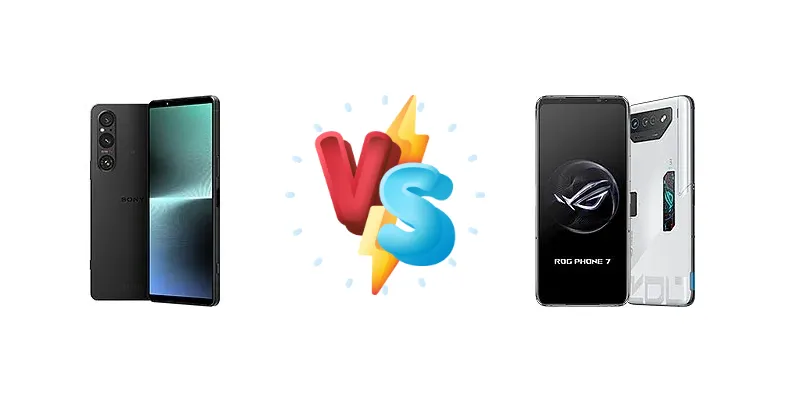
Sony Xperia 1 V vs Asus ROG Phone 7 Ultimate: A Deep Dive Comparison
| Phones Images | |||||
|---|---|---|---|---|---|
|
🏆 Quick Verdict
For the average user prioritizing a balanced experience with excellent camera capabilities and a more refined design, the Sony Xperia 1 V emerges as the winner. However, gamers and power users will find the Asus ROG Phone 7 Ultimate’s superior charging speed and gaming-centric features more compelling.
| PHONES | ||
|---|---|---|
| Phone Names | Sony Xperia 1 V | Asus ROG Phone 7 Ultimate |
| Network | ||
|---|---|---|
| 2G bands | GSM 850 / 900 / 1800 / 1900 | GSM 850 / 900 / 1800 / 1900 |
| 3G bands | HSDPA 800 / 850 / 900 / 1700(AWS) / 1900 / 2100 | HSDPA 800 / 850 / 900 / 1700(AWS) / 1900 / 2100 |
| 4G bands | 1, 2, 3, 4, 5, 7, 8, 12, 13, 17, 19, 20, 25, 26, 28, 29, 32, 34, 38, 39, 40, 41, 46, 66 - Europe | 1, 2, 3, 4, 5, 7, 8, 12, 17, 18, 19, 20, 25, 26, 28, 32, 34, 38, 39, 40, 41, 42, 43, 48, 66 - International |
| 5G bands | 1, 3, 5, 7, 8, 20, 28, 38, 40, 41, 77, 78 SA/NSA/Sub6 - Europe | 1, 2, 3, 5, 7, 8, 12, 18, 20, 25, 26, 28, 38, 40, 41, 48, 66, 77, 78, 79 SA/NSA/Sub6 - International |
| Speed | HSPA, LTE, 5G | HSPA, LTE (Up to 7CA), 5G |
| Technology | GSM / HSPA / LTE / 5G | GSM / CDMA / HSPA / LTE / 5G |
| 1, 3, 5, 7, 8, 28, 38, 40, 41, 77, 78, 79 SA/NSA/Sub6 - Asia | 1, 3, 5, 8, 28, 41, 77, 78, 79 SA/NSA/Sub6 - China | |
| Launch | ||
|---|---|---|
| Announced | 2023, May 11 | 2023, April 13 |
| Status | Available. Released 2023, July 28 | Available. Released 2023, May |
| Body | ||
|---|---|---|
| Build | Glass front (Gorilla Glass Victus 2), glass back (Gorilla Glass Victus), aluminum frame | Glass front (Gorilla Glass Victus), glass back (Gorilla Glass 3), aluminum frame |
| Dimensions | 165 x 71 x 8.3 mm (6.50 x 2.80 x 0.33 in) | 173 x 77 x 10.3 mm (6.81 x 3.03 x 0.41 in) |
| SIM | · Nano-SIM + eSIM· Nano-SIM + Nano-SIM | Nano-SIM + Nano-SIM |
| Weight | 187 g (6.60 oz) | 239 g (8.43 oz) |
| IP65/IP68 dust/water resistant (up to 1.5m for 30 min) | Built-in motorized cooling air vent (AeroActive Portal) IP54 water resistant 2" OLED display (on the back) Pressure sensitive zones (Gaming triggers) | |
| Display | ||
|---|---|---|
| Protection | Corning Gorilla Glass Victus 2 | Corning Gorilla Glass Victus |
| Resolution | 1644 x 3840 pixels, 21:9 ratio (~643 ppi density) | 1080 x 2448 pixels (~395 ppi density) |
| Size | 6.5 inches, 98.6 cm2 (~84.2% screen-to-body ratio) | 6.78 inches, 109.5 cm2 (~82.2% screen-to-body ratio) |
| Type | OLED, 1B colors, 120Hz, HDR BT.2020 | AMOLED, 1B colors, 165Hz, HDR10+, 1000 nits (HBM), 1500 nits (peak) |
| Platform | ||
|---|---|---|
| CPU | Octa-core (1x3.2 GHz Cortex-X3 & 2x2.8 GHz Cortex-A715 & 2x2.8 GHz Cortex-A710 & 3x2.0 GHz Cortex-A510) | Octa-core (1x3.2 GHz Cortex-X3 & 2x2.8 GHz Cortex-A715 & 2x2.8 GHz Cortex-A710 & 3x2.0 GHz Cortex-A510) |
| Chipset | Qualcomm SM8550-AB Snapdragon 8 Gen 2 (4 nm) | Qualcomm SM8550-AB Snapdragon 8 Gen 2 (4 nm) |
| GPU | Adreno 740 | Adreno 740 |
| OS | Android 13, upgradable to Android 15 | Android 13, up to 2 major Android upgrades |
| Memory | ||
|---|---|---|
| Card slot | microSDXC (uses shared SIM slot) | No |
| Internal | 256GB 12GB RAM, 512GB 12GB RAM | 512GB 16GB RAM |
| UFS | UFS 4.0 NTFS support for external storage | |
| Main Camera | ||
|---|---|---|
| Features | Zeiss optics, Zeiss T* lens coating, color spectrum sensor, LED flash, panorama, HDR, eye tracking | LED flash, HDR, panorama |
| Triple | 48 MP, f/1.9, 24mm (wide), 1/1.35", 1.12µm, dual pixel PDAF, OIS 12 MP, f/2.3, 85mm (telephoto), f/2.8, 125mm (telephoto), 1/3.5", dual pixel PDAF, 3.5x-5.2x continuous optical zoom, OIS 12 MP, f/2.2, 16mm (ultrawide), 1/2.5", dual pixel PDAF | 50 MP, f/1.9, 24mm (wide), 1/1.56", 1.0µm, PDAF 13 MP, f/2.2, 13mm, 120˚ (ultrawide) 5 MP (macro) |
| Video | 4K@24/25/30/60/120fps HDR, 1080p@30/60/120fps; 5-axis gyro-EIS, OIS | 8K@24fps, 4K@30/60fps, 1080p@30/60/120/240fps, 720p@480fps; gyro-EIS, HDR10+ |
| Selfie camera | ||
|---|---|---|
| Features | HDR | Panorama, HDR |
| Single | 12 MP, f/2.0, 24mm (wide), 1/2.9", 1.25µm | 32 MP, f/2.5, 29mm (wide), 1/3.2", 0.7µm |
| Video | 4K@30/60fps, 1080p@30/60fps, 5-axis gyro-EIS | 1080p@30fps |
| Sound | ||
|---|---|---|
| 3.5mm jack | Yes | Yes |
| 35mm jack | Yes | Yes |
| Loudspeaker | Yes, with stereo speakers | Yes, with stereo speakers (2 amplifiers) |
| 24-bit/192kHz audio Dynamic vibration system | 32-bit/384kHz audio | |
| Comms | ||
|---|---|---|
| Bluetooth | 5.3, A2DP, LE Audio, aptX HD, aptX Adaptive, aptX Lossless | 5.3, A2DP, LE, aptX HD, aptX Adaptive, aptX Lossless |
| NFC | Yes | Yes |
| Positioning | GPS, GLONASS, BDS, GALILEO, QZSS | GPS (L1+L5), GLONASS (L1), BDS (B1I+B1c+B2a), GALILEO (E1+E5a), QZSS (L1+L5), NavIC (L5) |
| Radio | No | No |
| USB | USB Type-C 3.2, OTG, video output | USB Type-C 3.1 (side), DisplayPort 1.4; USB Type-C 2.0 (bottom), OTG, accessory connector |
| WLAN | Wi-Fi 802.11 a/b/g/n/ac/6e, tri-band, Wi-Fi Direct, DLNA | Wi-Fi 802.11 a/b/g/n/ac/6e/7, tri-band, Wi-Fi Direct |
| Features | ||
|---|---|---|
| Sensors | Fingerprint (side-mounted), accelerometer, gyro, proximity, barometer, compass | Fingerprint (under display, optical), accelerometer, gyro, proximity, compass |
| Native Sony Alpha camera support | - | |
| Battery | ||
|---|---|---|
| Charging | 30W wired, PD3.0, PPS, 50% in 30 min Wireless Reverse wireless | 65W wired, PD3.0, QC5, 100% in 42 min 10W reverse wired |
| Type | Li-Po 5000 mAh | Li-Po 6000 mAh |
| Misc | ||
|---|---|---|
| Colors | Black, Khaki Green, Platinum Silver | Storm White |
| Models | XQDQ62/B, XQ-DQ72, XQ-DQ54 | - |
| Price | € 684.00 / $ 1,409.99 / £ 519.99 | About 780 EUR |
| Tests | ||
|---|---|---|
| Battery life | Endurance rating 115h | Endurance rating 131h |
| Camera | Photo / Video | Photo / Video |
| Display | Contrast ratio: Infinite (nominal) | Contrast ratio: Infinite (nominal) |
| Loudspeaker | -25.4 LUFS (Very good) | -25.5 LUFS (Very good) |
| Performance | AnTuTu: 1127931 (v9) GeekBench: 4916 (v6) GFXBench: 96fps (ES 3.1 onscreen) | AnTuTu: 1325105 (v9) GeekBench: 5139 (v5.5), 5567 (v6) GFXBench: 107fps (ES 3.1 onscreen) |
Sony Xperia 1 V
- More compact and manageable size
- Excellent camera system with natural color science
- Premium, understated design
- Slower charging speed (30W)
- Lower peak display brightness
- Less focused on gaming features
Asus ROG Phone 7 Ultimate
- Significantly faster charging (65W)
- Superior thermal management for sustained gaming
- Gaming-centric features like AirTriggers
- Larger and heavier design
- More aggressive aesthetic
- Camera may prioritize vibrancy over accuracy
Display Comparison
Both devices feature displays with an infinite (nominal) contrast ratio, but the Asus ROG Phone 7 Ultimate boasts a significantly brighter panel at 1095 nits measured, compared to the Xperia 1 V’s 936 nits. This translates to better visibility under direct sunlight for the ROG Phone. While both likely utilize LTPO technology for variable refresh rates (not explicitly stated, but standard for this class), the ROG Phone’s higher peak brightness is a clear advantage for outdoor use. The Xperia 1 V’s display is still excellent, but the ROG Phone edges it out in sheer luminance.
Camera Comparison
Both phones offer photo and video capabilities, but details on sensor size and specific features are limited in the provided data. The Xperia 1 V, historically, focuses on natural color reproduction and cinematic video recording, leveraging Sony’s Alpha camera expertise. The ROG Phone 7 Ultimate, while capable, typically prioritizes versatility and features geared towards content creation for social media. Without specific sensor details, it’s difficult to definitively declare a winner, but Sony’s brand reputation and focus on imaging suggest a potential advantage in overall image quality, particularly for stills. The ROG Phone's camera is likely tuned for vibrant, shareable images.
Performance
Both the Sony Xperia 1 V and Asus ROG Phone 7 Ultimate are powered by the Qualcomm SM8550-AB Snapdragon 8 Gen 2 (4 nm) chipset, utilizing the same Octa-core CPU configuration. This means raw processing power is virtually identical. However, the ROG Phone 7 Ultimate benefits from Asus’ advanced cooling solutions and software optimizations geared towards sustained performance during extended gaming sessions. While the Xperia 1 V’s thermal management is good, the ROG Phone is designed to minimize throttling under heavy load, maintaining higher clock speeds for longer. Both utilize LPDDR5x RAM, but the ROG Phone’s active cooling gives it a performance edge in demanding scenarios.
Battery Life
The Asus ROG Phone 7 Ultimate has a slight edge in endurance rating at 131 hours compared to the Xperia 1 V’s 115 hours. However, the real differentiator is charging speed. The ROG Phone 7 Ultimate supports 65W wired charging, achieving 100% charge in just 42 minutes, while the Xperia 1 V is limited to 30W, taking 30 minutes to reach 50%. The ROG Phone’s faster charging is a significant convenience factor, especially for users who frequently need to top up their battery. The Xperia 1 V’s active use battery score of 12:24h is competitive, but the ROG Phone’s faster charging offsets any minor capacity differences.
Buying Guide
Buy the Sony Xperia 1 V if you need a versatile flagship with a focus on photography and videography, a more manageable size, and a premium, understated aesthetic. Buy the Asus ROG Phone 7 Ultimate if you prioritize uncompromising gaming performance, rapid charging, and a feature-rich ecosystem tailored for mobile gaming, even if it means a larger, more aggressive design.