
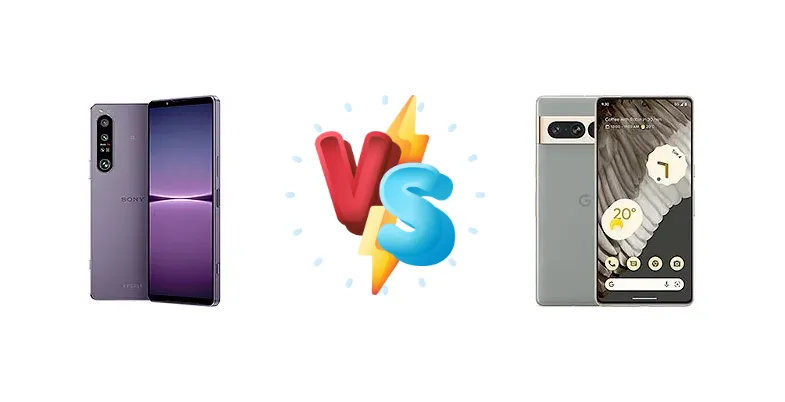
Sony Xperia 1 IV vs Google Pixel 7 Pro: The Ultimate Showdown
| Phones Images | |||||
|---|---|---|---|---|---|
|
🏆 Quick Verdict
The Pixel 7 Pro offers a more polished and user-friendly experience with its superior software and brighter display. However, the Xperia 1 IV caters to content creators with its exceptional camera versatility and unique 4K 120Hz display. Ultimately, the best choice depends on your priorities.
| PHONES | ||
|---|---|---|
| Phone Names | Sony Xperia 1 IV | Google Pixel 7 Pro |
| Network | ||
|---|---|---|
| 2G bands | GSM 850 / 900 / 1800 / 1900 | GSM 850 / 900 / 1800 / 1900 |
| 3G bands | HSDPA 800 / 850 / 900 / 1700(AWS) / 1900 / 2100 | HSDPA 800 / 850 / 900 / 1700(AWS) / 1900 / 2100 |
| 4G bands | 1, 2, 3, 4, 5, 7, 8, 12, 13, 17, 19, 20, 25, 26, 28, 29, 32, 34, 38, 39, 40, 41, 46, 66 - Europe | 1, 2, 3, 4, 5, 7, 8, 12, 13, 14, 17, 18, 19, 20, 25, 26, 28, 29, 30, 38, 39, 40, 41, 42, 46, 48, 66, 71 - GE2AE |
| 5G bands | 1, 3, 5, 7, 8, 20, 28, 38, 40, 41, 77, 78 SA/NSA/Sub6 - Europe | 1, 2, 3, 5, 7, 8, 12, 14, 20, 25, 28, 30, 38, 40, 41, 48, 66, 71, 77, 78, 257, 258, 260, 261 SA/NSA/Sub6/mmWave - GE2AE |
| Speed | HSPA, LTE, 5G | HSPA, LTE, 5G |
| Technology | GSM / HSPA / LTE / 5G | GSM / CDMA / HSPA / EVDO / LTE / 5G |
| 1, 3, 5, 7, 8, 28, 38, 40, 41, 77, 78, 79 SA/NSA/Sub6 - Asia | 1, 2, 3, 5, 7, 8, 12, 14, 20, 25, 28, 30, 38, 40, 41, 48, 66, 71, 75, 76, 77, 78 SA/NSA/Sub6 - GP4BC | |
| Launch | ||
|---|---|---|
| Announced | 2022, May 11 | 2022, October 06 |
| Status | Available. Released 2022, June 11 | Available. Released 2022, October 13 |
| Body | ||
|---|---|---|
| Build | Glass front (Gorilla Glass Victus), glass back (Gorilla Glass Victus), aluminum frame | Glass front (Gorilla Glass Victus), glass back (Gorilla Glass Victus), aluminum frame |
| Dimensions | 165 x 71 x 8.2 mm (6.50 x 2.80 x 0.32 in) | 162.9 x 76.6 x 8.9 mm (6.41 x 3.02 x 0.35 in) |
| SIM | · Nano-SIM + eSIM· Nano-SIM + Nano-SIM | Nano-SIM + eSIM |
| Weight | 185 g (6.53 oz) | 212 g (7.48 oz) |
| IP65/IP68 dust/water resistant (up to 1.5m for 30 min) | IP68 dust/water resistant (up to 1.5m for 30 min) | |
| Display | ||
|---|---|---|
| Protection | Corning Gorilla Glass Victus | Corning Gorilla Glass Victus |
| Resolution | 1644 x 3840 pixels, 21:9 ratio (~643 ppi density) | 1440 x 3120 pixels, 19.5:9 ratio (~512 ppi density) |
| Size | 6.5 inches, 98.6 cm2 (~84.2% screen-to-body ratio) | 6.7 inches, 110.6 cm2 (~88.7% screen-to-body ratio) |
| Type | OLED, 1B colors, 120Hz, HDR BT.2020 | LTPO AMOLED, 120Hz, HDR10+, 1000 nits (HBM), 1500 nits (peak) |
| Runs at 1096 x 2560 pixels except for select use cases | Always-on display | |
| Platform | ||
|---|---|---|
| CPU | Octa-core (1x3.00 GHz Cortex-X2 & 3x2.50 GHz Cortex-A710 & 4x1.80 GHz Cortex-A510) | Octa-core (2x2.85 GHz Cortex-X1 & 2x2.35 GHz Cortex-A78 & 4x1.80 GHz Cortex-A55) |
| Chipset | Qualcomm SM8450 Snapdragon 8 Gen 1 (4 nm) | Google Tensor G2 (5 nm) |
| GPU | Adreno 730 | Mali-G710 MP7 |
| OS | Android 12, upgradable to Android 13 | Android 13, upgradable to Android 15, up to 5 major Android upgrades |
| Memory | ||
|---|---|---|
| Card slot | microSDXC (uses shared SIM slot) | No |
| Internal | 256GB 12GB RAM, 512GB 12GB RAM, 512GB 16GB RAM | 128GB 8GB RAM, 256GB 8GB RAM, 128GB 12GB RAM, 256GB 12GB RAM, 512GB 12GB RAM |
| UFS 3.X | UFS 3.1 | |
| Main Camera | ||
|---|---|---|
| Features | Zeiss optics, Zeiss T* lens coating, color spectrum sensor, LED flash, panorama, HDR, eye tracking | Laser AF, Dual-LED flash, Pixel Shift, Auto-HDR, panorama |
| Single | 12 MP, f/2.0, 24mm (wide), 1/2.9", 1.25µm | 10.8 MP, f/2.2, 21mm (ultrawide), 1/3.1", 1.22µm |
| Triple | 12 MP, f/1.7, 24mm (wide), 1/1.7", 1.8µm, dual pixel PDAF, OIS 12 MP, f/2.3, 85mm (telephoto), f/2.8, 125mm (telephoto), 1/3.5", dual pixel PDAF, 3.5x-5.2x continuous optical zoom, OIS 12 MP, f/2.2, 124˚, 16mm (ultrawide), 1/2.5", dual pixel PDAF 0.3 MP, TOF 3D, (depth) | 50 MP, f/1.9, 25mm (wide), 1/1.31", 1.2µm, dual pixel PDAF, OIS 48 MP, f/3.5, 120mm (periscope telephoto), 1/2.55", 0.7µm, dual pixel PDAF, OIS, 5x optical zoom 12 MP, f/2.2, 126˚ (ultrawide), 1/2.9", 1.25µm, AF |
| Video | 4K@24/25/30/60/120fps HDR, 1080p@30/60/120fps; 5-axis gyro-EIS, OIS | 4K@30/60fps, 1080p@30/60/120/240fps; gyro-EIS, OIS, 10-bit HDR |
| Selfie camera | ||
|---|---|---|
| Features | HDR | HDR, panorama |
| Single | 12 MP, f/2.0, 24mm (wide), 1/2.9", 1.25µm | 10.8 MP, f/2.2, 21mm (ultrawide), 1/3.1", 1.22µm |
| Video | 4K@30fps, 1080p@30/60fps, 5-axis gyro-EIS | 4K@30/60fps, 1080p@30/60fps |
| Sound | ||
|---|---|---|
| 3.5mm jack | Yes | No |
| 35mm jack | Yes | No |
| Loudspeaker | Yes, with stereo speakers | Yes, with stereo speakers |
| 24-bit/192kHz audio Dynamic vibration system | - | |
| Comms | ||
|---|---|---|
| Bluetooth | 5.2, A2DP, LE Audio, aptX HD, aptX Adaptive | 5.2, A2DP, LE, aptX HD |
| NFC | Yes | Yes |
| Positioning | GPS, GLONASS, BDS, GALILEO, QZSS | GPS (L1+L5), GLONASS (G1), BDS (B1I+B1c+B2a), GALILEO (E1+E5a), QZSS (L1+L5) |
| Radio | No | No |
| USB | USB Type-C 3.2, OTG, video output | USB Type-C 3.2 |
| WLAN | Wi-Fi 802.11 a/b/g/n/ac/6e, dual-band or tri-band (region dependent), Wi-Fi Direct, DLNA | Wi-Fi 802.11 a/b/g/n/ac/6e, tri-band, Wi-Fi Direct |
| Features | ||
|---|---|---|
| Sensors | Fingerprint (side-mounted), accelerometer, gyro, proximity, barometer, compass | Fingerprint (under display, optical), accelerometer, gyro, proximity, compass, barometer |
| Native Sony Alpha camera support | Ultra Wideband (UWB) support | |
| Battery | ||
|---|---|---|
| Charging | 30W wired, PD3.0, PPS, 50% in 30 min Wireless Reverse wireless | 23W wired, PD3.0, 50% in 30 min 23W wireless Reverse wireless |
| Type | Li-Po 5000 mAh | Li-Ion 5000 mAh |
| Misc | ||
|---|---|---|
| Colors | Black, Violet, White | Obsidian, Snow, Hazel |
| Models | XQCT62-B, XQCT54, XQCT54C0V.YD, XQCT54C0B.YD, XQCT54C0W.YD, XQCT54C0V.EEAC, XQCT54C0B.EEAC, XQ-CT72, XQ-CT54, XQ-CT62, SO-51C | GP4BC, GE2AE, GFE4J |
| Price | $ 1,120.00 / € 489.00 | € 248.84 / $ 204.00 / £ 259.99 / ₹ 36,999 |
| Tests | ||
|---|---|---|
| Battery life | Endurance rating 100h | Endurance rating 83h |
| Camera | Photo / Video | Photo / Video |
| Display | Contrast ratio: Infinite (nominal) | Contrast ratio: Infinite (nominal) |
| Loudspeaker | -27.6 LUFS (Good) | -24.8 LUFS (Very good) |
| Performance | AnTuTu: 838832 (v9) GeekBench: 3403 (v5.1) GFXBench: 74fps (ES 3.1 onscreen) | AnTuTu: 796369 (v9) GeekBench: 3187 (v5.1) GFXBench: 34fps (ES 3.1 onscreen) |
Sony Xperia 1 IV
- Exceptional 4K 120Hz display
- Versatile camera system with variable zoom
- Dedicated shutter button
- Creator-focused features
- Excellent battery life (rated)
- Snapdragon 8 Gen 1 can throttle under load
- Lower peak brightness compared to Pixel 7 Pro
- Software experience less polished than Pixel
- Slower wireless charging
Google Pixel 7 Pro
- Brighter and more vibrant display
- Excellent computational photography
- Seamless Android experience
- Google’s AI features (Magic Eraser, etc.)
- Faster wireless charging
- Tensor G2 not as powerful as Snapdragon 8 Gen 1
- Less manual camera control
- Battery life slightly lower (rated)
- Charging speed slower than Xperia 1 IV
Display Comparison
The Xperia 1 IV boasts a 6.5-inch 4K OLED display with a 120Hz refresh rate and a peak brightness of 602 nits. While the resolution is impressive, the Pixel 7 Pro’s 6.7-inch OLED display shines with a significantly higher peak brightness of 1090 nits, making it much easier to see outdoors. Both offer excellent contrast and color accuracy, but the Pixel 7 Pro’s brightness gives it a clear edge.
Camera Comparison
Both phones have exceptional camera systems. The Xperia 1 IV offers a versatile triple-lens setup with a 12MP main, 12MP ultrawide, and 12MP telephoto lens, plus a variable optical zoom. The Pixel 7 Pro features a 50MP main, 12MP ultrawide, and 48MP telephoto lens with a 5x optical zoom. The Pixel 7 Pro excels in computational photography, producing consistently excellent images in various conditions. The Xperia 1 IV provides more manual control and a dedicated shutter button, appealing to serious photographers.
Performance
The Xperia 1 IV utilizes the Snapdragon 8 Gen 1, a powerful chipset, but known for thermal throttling. The Pixel 7 Pro’s Google Tensor G2, while not as rawly powerful, is optimized for Google’s AI and machine learning tasks, resulting in smooth performance for everyday tasks and enhanced features like Magic Eraser. The Tensor G2 also tends to run cooler. While the Xperia 1 IV has a slight edge in benchmark scores, the Pixel 7 Pro’s optimized performance is more noticeable in real-world usage.
Battery Life
The Xperia 1 IV has a reported endurance rating of 100 hours, which is impressive. The Pixel 7 Pro’s endurance rating is 83 hours. However, real-world usage often differs. Both phones support fast charging, but the Xperia 1 IV’s 30W wired charging is slightly faster than the Pixel 7 Pro’s 23W wired charging. Wireless charging is available on both, but the Pixel 7 Pro offers faster wireless charging speeds.
Buying Guide
The Sony Xperia 1 IV is ideal for photographers and videographers who value manual controls, a dedicated shutter button, and a creator-centric feature set. The Google Pixel 7 Pro is perfect for users who want a seamless Android experience, exceptional computational photography, and a phone that's easy to use.