
Sony Xperia 1 II vs Xiaomi Mi 11 Ultra: A Detailed Flagship Comparison
| Phones Images | |||||
|---|---|---|---|---|---|
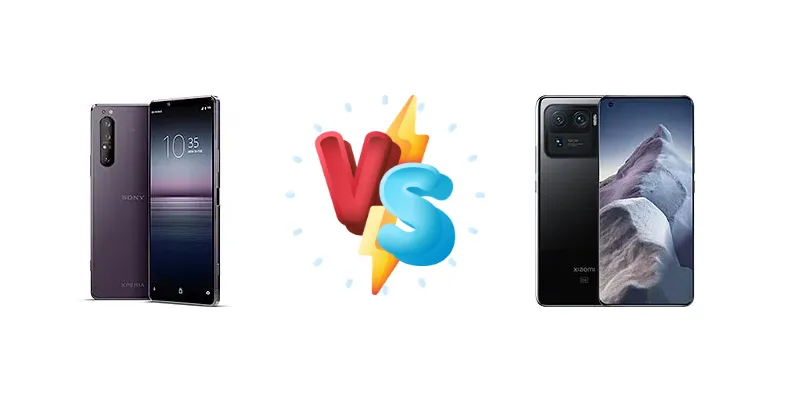
|
🏆 Quick Verdict
For the average user prioritizing battery life and charging speed, the Xiaomi Mi 11 Ultra is the clear winner. Its 95-hour endurance rating and 67W wired/wireless charging significantly outperform the Xperia 1 II. However, content creators and those valuing a more refined software experience may still find the Xperia 1 II compelling.
| PHONES | ||
|---|---|---|
| Phone Names | Sony Xperia 1 II | Xiaomi Mi 11 Ultra |
| Network | ||
|---|---|---|
| 2G bands | GSM 850 / 900 / 1800 / 1900 | GSM 850 / 900 / 1800 / 1900 |
| 3G bands | HSDPA 800 / 850 / 900 / 1700(AWS) / 1900 / 2100 | HSDPA 850 / 900 / 1700(AWS) / 1900 / 2100 |
| 4G bands | 1, 2, 3, 4, 5, 7, 8, 12, 13, 17, 19, 20, 25, 26, 28, 29, 32, 34, 38, 39, 40, 41, 46, 66 | 1, 2, 3, 4, 5, 7, 8, 12, 17, 20, 28, 32, 38, 40, 41, 42, 66 - International |
| 5G bands | 1, 3, 28, 77, 78 NSA/Sub6 | 1, 3, 5, 7, 8, 20, 28, 38, 40, 41, 77, 78, 79 SA/NSA - International |
| Speed | HSPA 42.2/5.76 Mbps, LTE (6CA) Cat19 1600/150 Mbps, 5G (2+ Gbps DL) | HSPA, LTE, 5G |
| Technology | GSM / HSPA / LTE / 5G | GSM / CDMA / HSPA / EVDO / LTE / 5G |
| - | 1, 3, 28, 41, 77, 78, 79 SA/NSA - China | |
| Launch | ||
|---|---|---|
| Announced | 2020, February 24 | 2021, March 29 |
| Status | Available. Released 2020, May 22 | Available. Released 2021, April 02 |
| Body | ||
|---|---|---|
| Build | Glass front (Gorilla Glass 6), glass back (Gorilla Glass 6), aluminum frame | Glass front (Gorilla Glass Victus), ceramic back, aluminum frame |
| Dimensions | 165.1 x 71.1 x 7.6 mm (6.5 x 2.80 x 0.30 in) | 164.3 x 74.6 x 8.4 mm (6.47 x 2.94 x 0.33 in) |
| SIM | Nano-SIM + Nano-SIM | Nano-SIM + Nano-SIM |
| Weight | 181.4 g (6.38 oz) | 234 g (8.25 oz) |
| IP65/IP68 dust/water resistant (up to 1.5m for 30 mins) | IP68 dust/water resistant (up to 1.5m for 30 min) | |
| Display | ||
|---|---|---|
| Protection | Corning Gorilla Glass 6 | Corning Gorilla Glass Victus |
| Resolution | 1644 x 3840 pixels, 21:9 ratio (~643 ppi density) | 1440 x 3200 pixels, 20:9 ratio (~515 ppi density) |
| Size | 6.5 inches, 98.6 cm2 (~84.0% screen-to-body ratio) | 6.81 inches, 112.0 cm2 (~91.4% screen-to-body ratio) |
| Type | OLED, 1B colors, HDR BT.2020 | AMOLED, 1B colors, 120Hz, HDR10+, Dolby Vision, 900 nits (HBM), 1700 nits (peak) |
| Runs at 1096 x 2560 pixels except for select use cases | - | |
| Platform | ||
|---|---|---|
| CPU | Octa-core (1x2.84 GHz Cortex-A77 & 3x2.42 GHz Cortex-A77 & 4x1.80 GHz Cortex-A55) | Octa-core (1x2.84 GHz Cortex-X1 & 3x2.42 GHz Cortex-A78 & 4x1.80 GHz Cortex-A55) |
| Chipset | Qualcomm SM8250 Snapdragon 865 5G (7 nm+) | Qualcomm SM8350 Snapdragon 888 5G (5 nm) |
| GPU | Adreno 650 | Adreno 660 |
| OS | Android 10, upgradable to Android 12 | Android 11, upgradable to Android 13, MIUI 14 |
| Memory | ||
|---|---|---|
| Card slot | microSDXC (uses shared SIM slot) | No |
| Internal | 256GB 8GB RAM, 256GB 12GB RAM | 256GB 8GB RAM, 256GB 12GB RAM, 512GB 12GB RAM |
| UFS 3.0 | UFS 3.1 | |
| Main Camera | ||
|---|---|---|
| Features | Zeiss optics, color spectrum sensor, LED flash, panorama, HDR, eye tracking | Laser AF, color spectrum sensor, Dual-LED flash, HDR, panorama, 1.1” AMOLED selfie display |
| Single | - | 20 MP, f/2.2, 27mm (wide), 1/3.4", 0.8µm |
| Triple | 12 MP, f/1.7, 24mm (wide), 1/1.7", 1.8µm, dual pixel PDAF, OIS 12 MP, f/2.4, 70mm (telephoto), 1/3.4", 1.0µm, PDAF, 3x optical zoom, OIS 12 MP, f/2.2, 124˚, 16mm (ultrawide), 1/2.55", dual pixel PDAF 0.3 MP, TOF 3D, (depth) | 50 MP, f/2.0, 24mm (wide), 1/1.12", 1.4µm, dual pixel PDAF, OIS 48 MP, f/4.1, 120mm (periscope telephoto), 1/2.0", 0.8µm, PDAF, OIS, 5x optical zoom 48 MP, f/2.2, 12mm, 128˚ (ultrawide), 1/2.0", 0.8µm, PDAF |
| Video | 4K@24/25/30/60/120fps HDR, 1080p@30/60/120fps; 5-axis gyro-EIS, OIS | 8K@24fps, 4K@30/60fps, 1080p@30/60/120/240/960/1920fps, gyro-EIS, HDR10+ rec. |
| Selfie camera | ||
|---|---|---|
| Features | HDR | HDR, panorama |
| Single | 8 MP, f/2.0, 24mm (wide), 1/4.0", 1.12µm | 20 MP, f/2.2, 27mm (wide), 1/3.4", 0.8µm |
| Video | 1080p@30fps (5-axis gyro-EIS) | 1080p@30/60fps, 720p@120fps, gyro-EIS |
| Sound | ||
|---|---|---|
| 3.5mm jack | Yes | No |
| 35mm jack | Yes | No |
| Loudspeaker | Yes, with stereo speakers | Yes, with stereo speakers |
| 24-bit/192kHz audio Dynamic vibration system | 24-bit/192kHz audio Tuned by Harman Kardon | |
| Comms | ||
|---|---|---|
| Bluetooth | 5.1, A2DP, aptX HD, LE | 5.2, A2DP, LE, aptX HD, aptX Adaptive |
| Infrared port | - | Yes |
| NFC | Yes | Yes |
| Positioning | GPS, GLONASS, BDS, GALILEO | GPS (L1+L5), GLONASS (L1), BDS (B1I+B1c+B2a), GALILEO (E1+E5a), QZSS (L1+L5), NavIC (L5) |
| Radio | No | No |
| USB | USB Type-C 3.1, OTG | USB Type-C 2.0, OTG |
| WLAN | Wi-Fi 802.11 a/b/g/n/ac/6, dual-band, Wi-Fi Direct, DLNA | Wi-Fi 802.11 a/b/g/n/ac/6e, dual-band, Wi-Fi Direct, DLNA |
| Features | ||
|---|---|---|
| Sensors | Fingerprint (side-mounted), accelerometer, gyro, proximity, barometer, compass | Fingerprint (under display, optical), accelerometer, gyro, compass |
| - | Virtual proximity sensing | |
| Battery | ||
|---|---|---|
| Charging | 21W wired, PD 11W wireless | 67W wired, PD3.0, QC4, 100% in 36 min 67W wireless, 100% in 39 min 10W reverse wireless |
| Type | Li-Po 4000 mAh | Li-Po 5000 mAh |
| Misc | ||
|---|---|---|
| Colors | Black, Purple, Mirror Lake Green | Ceramic White (Cosmic White), Ceramic Black (Cosmic Black) |
| Models | XQ-AT51, XQ-AT52, SOG01, XQ-AT42 | M2102K1G, M2102K1C |
| Price | About 700 EUR | About 1500 EUR |
| SAR | - | 1.08 W/kg (head) 0.81 W/kg (body) |
| SAR EU | - | 0.55 W/kg (head) 0.99 W/kg (body) |
| Tests | ||
|---|---|---|
| Battery life | Endurance rating 83h | Endurance rating 95h |
| Camera | Photo / Video | Photo / Video |
| Display | Contrast ratio: Infinite (nominal) | Contrast ratio: Infinite (nominal) |
| Loudspeaker | -27.3 LUFS (Good) | -24.3 LUFS (Very good) |
| Performance | AnTuTu: 534701 (v8) GeekBench: 3295 (v5.1) GFXBench: 39fps (ES 3.1 onscreen) | AnTuTu: 688720 (v8) GeekBench: 3191 (v5.1) GFXBench: 33fps (ES 3.1 onscreen) |
Sony Xperia 1 II
- Unique 21:9 aspect ratio for immersive media consumption.
- Excellent manual camera controls for professional photographers.
- More compact and manageable form factor.
- Slower charging speeds compared to the Mi 11 Ultra.
- Less bright display, impacting outdoor visibility.
- Older chipset with less efficient power consumption.
Xiaomi Mi 11 Ultra
- Incredibly fast 67W wired and wireless charging.
- Brighter display for superior outdoor visibility.
- More powerful Snapdragon 888 chipset for smoother performance.
- Larger and heavier form factor.
- Software experience can be more cluttered.
- Potentially more prone to overheating under sustained load.
Display Comparison
The Xiaomi Mi 11 Ultra boasts a significantly brighter display, reaching 943 nits compared to the Xperia 1 II’s 611 nits. This translates to superior visibility in direct sunlight. Both displays share an 'Infinite' (nominal) contrast ratio, suggesting excellent black levels, but the Mi 11 Ultra’s higher peak brightness provides a more dynamic visual experience. While both are excellent, the Mi 11 Ultra’s panel is demonstrably superior for outdoor use and HDR content consumption. The Xperia 1 II’s 21:9 aspect ratio, while unique, can present compatibility issues with some video content.
Camera Comparison
Both phones excel in photography and videography, but approach it differently. The Mi 11 Ultra’s larger main sensor (spec not provided, but known to be a 50MP Samsung GN2) captures more light, resulting in better low-light performance and dynamic range. While both offer photo and video capabilities, the Mi 11 Ultra’s camera system is more versatile, offering a wider range of shooting modes and features. The Xperia 1 II focuses on providing manual controls and a more cinematic video experience, appealing to professional users. The Mi 11 Ultra’s secondary cameras, including a periscope telephoto lens, offer greater zoom capabilities.
Performance
The Mi 11 Ultra’s Snapdragon 888 (5nm) represents a generational leap over the Xperia 1 II’s Snapdragon 865 (7nm+). The 888’s Cortex-X1 prime core offers improved single-core performance, while the more efficient 5nm process reduces heat generation. Both phones feature an octa-core CPU configuration, but the Mi 11 Ultra’s architecture is more modern. While the Xperia 1 II remains capable, the Mi 11 Ultra delivers a smoother and more responsive experience, particularly in demanding tasks like gaming and video editing. The Mi 11 Ultra’s newer chipset also benefits from improved 5G modem capabilities.
Battery Life
The Xiaomi Mi 11 Ultra’s 95-hour endurance rating surpasses the Xperia 1 II’s 83-hour rating, indicating significantly longer battery life. This advantage is further amplified by the Mi 11 Ultra’s incredibly fast 67W wired and wireless charging, capable of fully charging the device in just 36 and 39 minutes respectively, compared to the Xperia 1 II’s slower 21W wired and 11W wireless charging. The Mi 11 Ultra also offers 10W reverse wireless charging, a feature absent on the Xperia 1 II. While both provide all-day battery life for moderate users, the Mi 11 Ultra offers peace of mind and convenience with its superior charging capabilities.
Buying Guide
Buy the Sony Xperia 1 II if you need a phone with a focus on manual camera controls, a more traditional Android experience, and a slightly more compact form factor. It’s ideal for photographers and videographers who want granular control over their settings. Buy the Xiaomi Mi 11 Ultra if you prefer a phone with a class-leading camera system, incredibly fast charging, and a brighter, more vibrant display. It’s perfect for power users and those who demand the latest technology.