
Sony Xperia 1 II vs OnePlus 9 Pro: A Detailed Flagship Comparison
| Phones Images | |||||
|---|---|---|---|---|---|
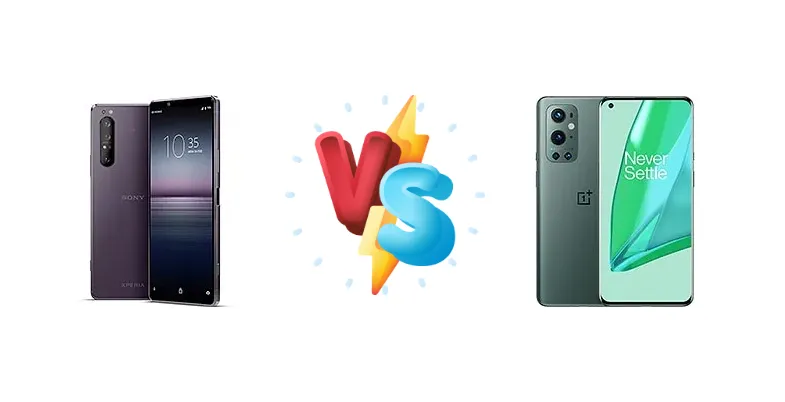
|
🏆 Quick Verdict
For most users, the OnePlus 9 Pro emerges as the better choice. Its newer Snapdragon 888 chipset, significantly faster charging (65W vs 21W), and brighter display offer a more modern and convenient experience. However, the Xperia 1 II still holds appeal for videographers and those valuing a unique, elongated display.
| PHONES | ||
|---|---|---|
| Phone Names | Sony Xperia 1 II | OnePlus 9 Pro |
| Network | ||
|---|---|---|
| 2G bands | GSM 850 / 900 / 1800 / 1900 | GSM 850 / 900 / 1800 / 1900 |
| 3G bands | HSDPA 800 / 850 / 900 / 1700(AWS) / 1900 / 2100 | HSDPA 800 / 850 / 900 / 1700(AWS) / 1800 / 1900 / 2100 |
| 4G bands | 1, 2, 3, 4, 5, 7, 8, 12, 13, 17, 19, 20, 25, 26, 28, 29, 32, 34, 38, 39, 40, 41, 46, 66 | 1, 2, 3, 4, 5, 7, 8, 12, 13, 17, 18, 19, 20, 25, 26, 28, 32, 38, 39, 40, 41, 66 - EU |
| 5G bands | 1, 3, 28, 77, 78 NSA/Sub6 | 1, 3, 5, 7, 8, 20, 28, 38, 40, 41, 66, 78 SA/NSA - EU |
| Speed | HSPA 42.2/5.76 Mbps, LTE (6CA) Cat19 1600/150 Mbps, 5G (2+ Gbps DL) | HSPA 42.2/5.76 Mbps, LTE Cat20 2000/200 Mbps, 5G |
| Technology | GSM / HSPA / LTE / 5G | GSM / CDMA / HSPA / LTE / 5G |
| - | 1, 3, 28, 41, 78, 79 SA/NSA - CN | |
| Launch | ||
|---|---|---|
| Announced | 2020, February 24 | 2021, March 23 |
| Status | Available. Released 2020, May 22 | Available. Released 2021, March 30 |
| Body | ||
|---|---|---|
| Build | Glass front (Gorilla Glass 6), glass back (Gorilla Glass 6), aluminum frame | Glass front (Gorilla Glass 5), glass back (Gorilla Glass 5), aluminum frame |
| Dimensions | 165.1 x 71.1 x 7.6 mm (6.5 x 2.80 x 0.30 in) | 163.2 x 73.6 x 8.7 mm (6.43 x 2.90 x 0.34 in) |
| SIM | Nano-SIM + Nano-SIM | · Nano-SIM· Nano-SIM + Nano-SIM |
| Weight | 181.4 g (6.38 oz) | 197 g (6.95 oz) |
| IP65/IP68 dust/water resistant (up to 1.5m for 30 mins) | IP68 dust/water resistant (up to 1.5m for 30 min) | |
| Display | ||
|---|---|---|
| Protection | Corning Gorilla Glass 6 | Corning Gorilla Glass 5 |
| Resolution | 1644 x 3840 pixels, 21:9 ratio (~643 ppi density) | 1440 x 3216 pixels, 20:9 ratio (~525 ppi density) |
| Size | 6.5 inches, 98.6 cm2 (~84.0% screen-to-body ratio) | 6.7 inches, 108.4 cm2 (~90.3% screen-to-body ratio) |
| Type | OLED, 1B colors, HDR BT.2020 | LTPO Fluid2 AMOLED, 1B colors, 120Hz, HDR10+, 1300 nits (peak) |
| Runs at 1096 x 2560 pixels except for select use cases | Always-on display | |
| Platform | ||
|---|---|---|
| CPU | Octa-core (1x2.84 GHz Cortex-A77 & 3x2.42 GHz Cortex-A77 & 4x1.80 GHz Cortex-A55) | Octa-core (1x2.84 GHz Cortex-X1 & 3x2.42 GHz Cortex-A78 & 4x1.80 GHz Cortex-A55 |
| Chipset | Qualcomm SM8250 Snapdragon 865 5G (7 nm+) | Qualcomm SM8350 Snapdragon 888 5G (5 nm) |
| GPU | Adreno 650 | Adreno 660 |
| OS | Android 10, upgradable to Android 12 | Android 11, upgradable to Android 14, OxygenOS 14 |
| Memory | ||
|---|---|---|
| Card slot | microSDXC (uses shared SIM slot) | No |
| Internal | 256GB 8GB RAM, 256GB 12GB RAM | 128GB 8GB RAM, 256GB 8GB RAM, 256GB 12GB RAM |
| UFS 3.0 | UFS 3.1 | |
| Main Camera | ||
|---|---|---|
| Features | Zeiss optics, color spectrum sensor, LED flash, panorama, HDR, eye tracking | Laser AF, color spectrum sensor, Hasselblad Color Calibration, dual-LED flash, HDR, panorama |
| Quad | - | 48 MP, f/1.8, 23mm (wide), 1/1.43", 1.12µm, multi-directional PDAF, OIS 8 MP, f/2.4, 77mm (telephoto), 1.0µm, PDAF, OIS, 3.3x optical zoom 50 MP, f/2.2, 14mm (ultrawide), 1/1.56", 1.0µm, AF 2 MP, f/2.4, (monochrome) |
| Single | - | 16 MP, f/2.4, (wide), 1/3.06", 1.0µm |
| Triple | 12 MP, f/1.7, 24mm (wide), 1/1.7", 1.8µm, dual pixel PDAF, OIS 12 MP, f/2.4, 70mm (telephoto), 1/3.4", 1.0µm, PDAF, 3x optical zoom, OIS 12 MP, f/2.2, 124˚, 16mm (ultrawide), 1/2.55", dual pixel PDAF 0.3 MP, TOF 3D, (depth) | - |
| Video | 4K@24/25/30/60/120fps HDR, 1080p@30/60/120fps; 5-axis gyro-EIS, OIS | 8K@30fps, 4K@30/60/120fps, 1080p@30/60/240fps, Auto HDR, gyro-EIS |
| Selfie camera | ||
|---|---|---|
| Features | HDR | HDR |
| Single | 8 MP, f/2.0, 24mm (wide), 1/4.0", 1.12µm | 16 MP, f/2.4, (wide), 1/3.06", 1.0µm |
| Video | 1080p@30fps (5-axis gyro-EIS) | 1080p@30fps, gyro-EIS |
| Sound | ||
|---|---|---|
| 3.5mm jack | Yes | No |
| 35mm jack | Yes | No |
| Loudspeaker | Yes, with stereo speakers | Yes, with stereo speakers |
| 24-bit/192kHz audio Dynamic vibration system | 24-bit/192kHz audio | |
| Comms | ||
|---|---|---|
| Bluetooth | 5.1, A2DP, aptX HD, LE | 5.2, A2DP, LE, aptX HD |
| NFC | Yes | Yes |
| Positioning | GPS, GLONASS, BDS, GALILEO | GPS (L1+L5), GLONASS (G1), BDS (B1), GALILEO (E1+E5a) |
| Radio | No | No |
| USB | USB Type-C 3.1, OTG | USB Type-C 3.1, OTG |
| WLAN | Wi-Fi 802.11 a/b/g/n/ac/6, dual-band, Wi-Fi Direct, DLNA | Wi-Fi 802.11 a/b/g/n/ac/6, dual-band, Wi-Fi Direct, DLNA |
| Features | ||
|---|---|---|
| Sensors | Fingerprint (side-mounted), accelerometer, gyro, proximity, barometer, compass | Fingerprint (under display, optical), accelerometer, gyro, proximity, compass |
| Battery | ||
|---|---|---|
| Charging | 21W wired, PD 11W wireless | 65W wired, PD, 100% in 29 min 50W wireless, 100% in 43 min 5W reverse wireless |
| Type | Li-Po 4000 mAh | Li-Po 4500 mAh |
| Misc | ||
|---|---|---|
| Colors | Black, Purple, Mirror Lake Green | Morning Mist, Forest Green, Stellar Black |
| Models | XQ-AT51, XQ-AT52, SOG01, XQ-AT42 | LE2121, LE2125, LE2123, LE2120, LE2127 |
| Price | About 700 EUR | € 246.17 / $ 264.95 / £ 287.00 |
| Tests | ||
|---|---|---|
| Battery life | Endurance rating 83h | Endurance rating 86h |
| Camera | Photo / Video | Photo / Video |
| Display | Contrast ratio: Infinite (nominal) | - |
| Loudspeaker | -27.3 LUFS (Good) | -24.1 LUFS (Very good) |
| Performance | AnTuTu: 534701 (v8) GeekBench: 3295 (v5.1) GFXBench: 39fps (ES 3.1 onscreen) | - |
Sony Xperia 1 II
- Unique 21:9 aspect ratio display
- Strong video recording capabilities
- Understated and professional design
- Slower Snapdragon 865 chipset
- Significantly slower charging speeds
- Lower display brightness
OnePlus 9 Pro
- Faster Snapdragon 888 chipset
- Significantly faster wired and wireless charging
- Brighter and more color-accurate display
- More conventional design
- Potential for software bloat (OnePlus history)
- May not appeal to users seeking a unique aspect ratio
Display Comparison
The OnePlus 9 Pro boasts a significantly brighter display, reaching 859 nits compared to the Xperia 1 II’s 611 nits. This translates to superior visibility under direct sunlight. While both feature OLED technology, the OnePlus 9 Pro’s higher peak brightness and likely wider color gamut (though not specified) provide a more vibrant and engaging viewing experience. The Xperia 1 II’s 21:9 aspect ratio, while unique, can present compatibility issues with some apps and content, whereas the OnePlus 9 Pro’s more conventional ratio offers broader support. Contrast ratios are nominally infinite on both, typical of OLED panels.
Camera Comparison
Both phones offer versatile camera systems, but differ in their approach. While detailed sensor specs are missing, the OnePlus 9 Pro’s collaboration with Hasselblad suggests a focus on color science and image processing. The Snapdragon 888’s improved ISP (Image Signal Processor) also contributes to better image quality. The Xperia 1 II, known for its video capabilities, likely excels in that area, offering manual controls and professional features. However, the OnePlus 9 Pro’s faster processor and potentially larger main sensor (based on market positioning) likely provide superior low-light performance and faster image processing. The absence of detailed sensor information prevents a definitive camera winner.
Performance
The OnePlus 9 Pro’s Snapdragon 888 (5nm) represents a generational leap over the Xperia 1 II’s Snapdragon 865 (7nm+). The 5nm process node delivers improved power efficiency and thermal performance, allowing the 888 to sustain higher clock speeds for longer periods. The CPU architecture also differs; the OnePlus 9 Pro utilizes a Cortex-X1 prime core, offering a performance advantage over the Xperia 1 II’s Cortex-A77 prime core. While both phones feature 8GB or 12GB of RAM, the OnePlus 9 Pro benefits from faster LPDDR5 RAM, further enhancing responsiveness. This translates to snappier app loading times and smoother multitasking on the OnePlus 9 Pro.
Battery Life
Both phones achieve similar endurance ratings (86h for OnePlus 9 Pro vs 83h for Xperia 1 II), despite the Xperia 1 II potentially having a larger battery capacity (not specified). This suggests the OnePlus 9 Pro’s more efficient Snapdragon 888 chipset offsets any capacity difference. However, the charging speeds are drastically different. The OnePlus 9 Pro’s 65W wired charging can fully charge the device in just 29 minutes, while the Xperia 1 II’s 21W charging takes considerably longer. The OnePlus 9 Pro also offers 50W wireless charging and 5W reverse wireless charging, features absent on the Xperia 1 II. This makes the OnePlus 9 Pro significantly more convenient for users who frequently need to top up their battery.
Buying Guide
Buy the Sony Xperia 1 II if you are a content creator prioritizing video recording capabilities, appreciate a 21:9 aspect ratio display for multitasking, and value a more understated design. Buy the OnePlus 9 Pro if you prioritize fast charging, a brighter and more color-accurate display, and the latest processor for demanding tasks and gaming. The OnePlus 9 Pro is the better all-rounder for the average user.