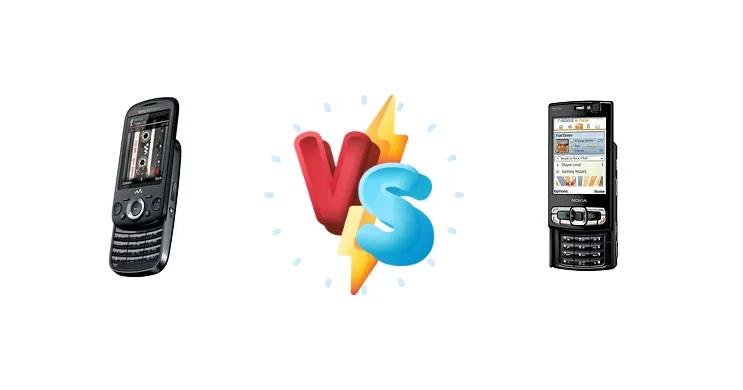
The mid-2000s were a golden age for mobile innovation. The Sony Ericsson Zylo and Nokia N95 8GB represented different approaches to the burgeoning smartphone market. Let's revisit these iconic devices and see how they stack up today.
🏆 Quick Verdict
The Nokia N95 8GB ultimately wins due to its superior processing power, more versatile features (like GPS), and generally more robust multimedia capabilities. While the Zylo boasts a sleek design, the N95 offers a more complete smartphone experience for its time.
| Network |
|---|
| 2G bands | GSM 850 / 900 / 1800 / 1900 | GSM 850 / 900 / 1800 / 1900 |
| 3G bands | HSDPA 900 / 2100 | HSDPA 2100 |
| Speed | HSPA 7.2/2 Mbps | HSPA |
| Technology | GSM / HSPA | GSM / HSPA |
| | HSDPA 2100 | HSDPA 850 / 1900 - American version |
| Launch |
|---|
| Announced | 2010, April. Released 2010, July | 2007, August. Released 2007, October |
| Status | Discontinued | Discontinued |
| Body |
|---|
| Dimensions | 103 x 52 x 16 mm (4.06 x 2.05 x 0.63 in) | 99 x 53 x 21 mm, 96 cc (3.90 x 2.09 x 0.83 in) |
| SIM | Mini-SIM | Mini-SIM |
| Weight | 115 g (4.06 oz) | 128 g (4.52 oz) |
| | - | Dual slide design |
| Display |
|---|
| Protection | Scratch-resistant glass | - |
| Resolution | 240 x 320 pixels, 4:3 ratio (~154 ppi density) | 240 x 320 pixels, 4:3 ratio (~143 ppi density) |
| Size | 2.6 inches, 20.9 cm2 (~39.1% screen-to-body ratio) | 2.8 inches, 24.3 cm2 (~46.3% screen-to-body ratio) |
| Type | TFT, 256K colors | TFT, 16M colors |
| Platform |
|---|
| CPU | - | 332 MHz Dual ARM 11 |
| GPU | - | 3D Graphics HW Accelerator |
| OS | - | Symbian OS 9.2, S60 rel. 3.1 |
| Memory |
|---|
| Call records | Yes | - |
| Card slot | microSDHC (dedicated slot) | No |
| Internal | 260MB | 8GB 128MB RAM |
| Phonebook | 2000 entries, Photocall | - |
| Main Camera |
|---|
| Features | - | Carl Zeiss optics, LED flash |
| Single | 3.15 MP | 5 MP, AF |
| Video | 480p@24fps | 480p@30fps |
| Selfie camera |
|---|
| Single | - | QVGA videocall camera |
| | No | - |
| Sound |
|---|
| 3.5mm jack | No | Yes |
| 35mm jack | No | Yes |
| Alert types | - | Vibration; Downloadable polyphonic, monophonic, MP3 ringtones |
| Loudspeaker | Yes | Yes, with stereo speakers |
| Comms |
|---|
| Bluetooth | 2.1, A2DP | 2.0, A2DP |
| Infrared port | - | Yes |
| Positioning | No | GPS, A-GPS; Nokia Maps |
| Radio | Stereo FM radio, RDS | Stereo FM radio |
| USB | USB 2.0 | miniUSB 2.0 |
| WLAN | No | Wi-Fi 802.11 b/g, UPnP technology |
| Features |
|---|
| Browser | WAP 2.0/xHTML, HTML (NetFront), RSS reader | WAP 2.0/xHTML, HTML |
| Games | Yes, incl. motion-based + downloadable | - |
| Java | Yes, MIDP 2.0 | - |
| Messaging | SMS(threaded view), MMS, Email, Push Email, IM | - |
| Sensors | Accelerometer | Accelerometer |
| | Walkman 4.0 player
FLAC/MP3/eAAC+/WAV player
SensMe, Track ID
MP4/H.264 player
Photo editor
YouTube, Facebook, Twitter applications
Organizer
Predictive text input | WMV/RV/MP4/3GP player
MP3/WMA/WAV/RA/AAC/M4A player
TV-out
Organizer
Document viewer (Word, Excel, PowerPoint, PDF)
Predictive text input
Push to talk
Voice dial/memo |
| Battery |
|---|
| Stand-by | Up to 340 h (2G) / Up to 400 h (3G) | Up to 280 h |
| Talk time | Up to 4 h (2G) / Up to 3 h 30 min (3G) | Up to 6 h |
| Type | Removable Li-Ion battery | Removable Li-Ion 1200 mAh battery (BL-6F) |
| Misc |
|---|
| Colors | Jazz Black, Chacha Silver, Swing Pink, Energetic Black, Meteorite White, Nebula Red | Black |
| Price | About 80 EUR | About 230 EUR |
| SAR | - | 0.05 W/kg (head) 0.76 W/kg (body) |
| SAR EU | 0.88 W/kg (head) | 0.79 W/kg (head) |
| Tests |
|---|
| Audio quality |
Noise -85.5dB / Crosstalk -84.8dB |
Noise -77.1dB / Crosstalk -68.5dB |
| Camera |
Photo | - |
| Loudspeaker |
Voice 65dB / Noise 66dB / Ring 78dB
|
Voice 75dB / Noise 66dB / Ring 70dB |
Sony Ericsson Zylo
- Sleek and minimalist design
- Simple and easy-to-use interface
- Compact size
- Limited processing power
- Basic camera
- Lack of advanced features
- Scarce specifications available
Nokia N95 8GB
- Powerful processor for its time
- Versatile multimedia capabilities
- GPS functionality
- Dual-screen display
- Better camera
- Bulky design
- Complex operating system (S60)
- Battery life could be better
- Dated technology
Display Comparison
The Zylo featured a 2.2-inch QVGA display, while the N95 had a dual-screen setup: a 2.8-inch main screen and a smaller secondary screen. The N95's dual-screen offered more information at a glance, but both displays were limited by the technology of the era. The N95's larger screen gives it a slight edge.
Camera Comparison
Both phones offered cameras, but the N95's camera was generally considered superior, offering better image quality and more features. The Zylo's camera was primarily for basic snapshots. The N95's camera was a key selling point.
Performance
The N95's 332 MHz Dual ARM 11 processor provided significantly better performance than the Zylo's likely single-core processor (specs are scarce). The N95 handled multitasking and demanding applications far more smoothly. This is a major differentiator.
Battery Life
Battery life was a concern for both devices, typical of the time. The N95, with its more power-hungry features, likely had slightly shorter battery life under heavy use compared to the Zylo's simpler operation.
Buying Guide
The Sony Ericsson Zylo is for those who appreciate minimalist design and a simple user experience. The Nokia N95 8GB is for enthusiasts seeking a feature-rich, albeit slightly dated, smartphone with multimedia prowess and a more complex operating system.
Frequently Asked Questions
❓ Which phone was released first?
The Sony Ericsson Zylo was released in 2007, while the Nokia N95 8GB was released in 2007 as well, but slightly later in the year.
❓ Are spare parts readily available for these phones?
Finding spare parts for both phones can be challenging due to their age. Online marketplaces and specialized retro phone repair services are your best bet.