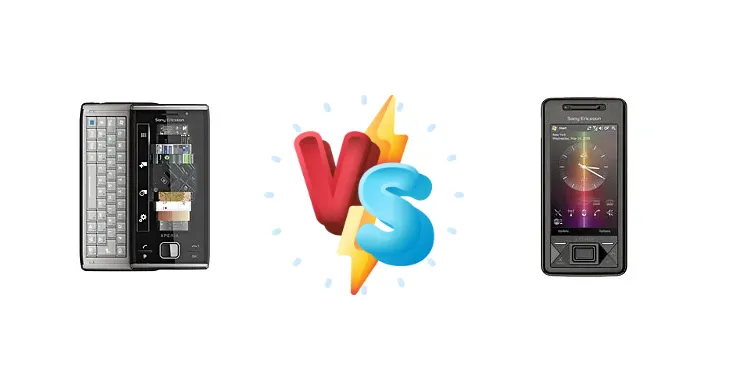
The Sony Ericsson Xperia X2 and X1 represent a fascinating period in smartphone evolution. Both devices offered a glimpse into the future of mobile technology, but with distinct approaches. Let's dive into a detailed comparison to see which one holds up best today.
🏆 Quick Verdict
The Xperia X2 edges out the X1 thanks to its slightly improved chipset and potential for better multimedia capabilities. While both are relics of the past, the X2 offers a marginally more refined experience, though both are severely limited by today's standards.
| Network |
|---|
| 2G bands | GSM 850 / 900 / 1800 / 1900 | GSM 850 / 900 / 1800 / 1900 |
| 3G bands | HSDPA 900 / 1900 / 2100 | HSDPA 900 / 1900 / 2100 |
| Speed | HSPA 7.2/2 Mbps | HSPA 7.2/2 Mbps |
| Technology | GSM / HSPA | GSM / HSPA |
| | HSDPA 850 / 1900 / 2100 - XPERIA X2a | HSDPA 850 / 1900 / 2100 - XPERIA X1a |
| Launch |
|---|
| Announced | 2009, September. Released 2010, January | 2008, February. Released 2008, October |
| Status | Discontinued | Discontinued |
| Body |
|---|
| Dimensions | 110 x 54 x 16 mm (4.33 x 2.13 x 0.63 in) | 110.5 x 52.6 x 17 mm (4.35 x 2.07 x 0.67 in) |
| Keyboard | QWERTY | QWERTY |
| SIM | Mini-SIM | Mini-SIM |
| Weight | 155 g (5.47 oz) | 145 g (5.11 oz) |
| | Optical trackpad | Optical trackpad |
| Display |
|---|
| Resolution | 480 x 800 pixels, 5:3 ratio (~292 ppi density) | 480 x 800 pixels, 5:3 ratio (~311 ppi density) |
| Size | 3.2 inches, 29.1 cm2 (~49.1% screen-to-body ratio) | 3.0 inches, 25.6 cm2 (~44.1% screen-to-body ratio) |
| Type | TFT resistive touchscreen, 65K colors | TFT resistive touchscreen, 65K colors |
| | XPERIA panels UI | - |
| Platform |
|---|
| CPU | 528 MHz ARM 11 | 528 MHz ARM 11 |
| Chipset | Qualcomm MSM7200A | Qualcomm MSM7200 |
| GPU | Adreno 130 | - |
| OS | Microsoft Windows Mobile 6.5/6.5.2 Professional | Microsoft Windows Mobile 6.1 Professional |
| Memory |
|---|
| Card slot | microSDHC (dedicated slot) | microSD (dedicated slot) |
| Internal | 110MB 256MB RAM 512MB ROM | 256MB RAM, 512MB ROM |
| Main Camera |
|---|
| Features | LED flash | LED flash |
| Single | 8 MP, AF | 3.15 MP, AF |
| Video | w480p@30fps | 480p@30fps |
| Selfie camera |
|---|
| Single | - | Videocall camera |
| | Videocall, via SW update | - |
| Sound |
|---|
| 3.5mm jack | Yes | Yes |
| 35mm jack | Yes | Yes |
| Alert types | - | Vibration; Downloadable polyphonic, MP3 ringtones, composer |
| Loudspeaker | Yes, with stereo speakers | Yes |
| Comms |
|---|
| Bluetooth | 2.1, A2DP | 2.0, A2DP |
| Positioning | GPS, A-GPS | GPS, A-GPS |
| Radio | Stereo FM (via software update) | Stereo FM radio, RDS |
| USB | microUSB 2.0 | miniUSB 2.0 |
| WLAN | Wi-Fi 802.11b/g, DLNA | Wi-Fi 802.11b/g |
| Features |
|---|
| Browser | WAP 2.0/HTML (IE), RSS feeds | WAP 2.0/HTML (IE), RSS feeds |
| Sensors | Accelerometer | - |
| | MP3/WAV/eAAC+/WMA player
MP4/Xvid/WMV9/H.264 player
TV Out
YouTube application
Pocket Office
Photo editor
Organizer
Voice memo/dial
Predictive text input | MP3/AAC/MP4 player
Pocket Office
Photo editor
Organizer
Predictive text input
Voice memo/dial |
| Battery |
|---|
| Music play | Up to 20 h | - |
| Stand-by | Up to 500 h (2G) / Up to 640 h (3G) | Up to 833 h (2G) / Up to 640 h (3G) |
| Talk time | Up to 10 h (2G) / Up to 6 h (3G) | Up to 10 h (2G) / Up to 6 h (3G) |
| Type | Removable Li-Po 1500 mAh battery (BST-41) | Removable Li-Po 1500 mAh battery (BST-41) |
| Misc |
|---|
| Colors | Elegant Black, Modern Silver | Solid Black, Steel Silver |
| Price | About 140 EUR | About 220 EUR |
| SAR EU | 0.90 W/kg (head) | 0.57 W/kg (head) |
| Tests |
|---|
| Audio quality |
Noise -81.3dB / Crosstalk -93.1dB |
Noise -93.2dB / Crosstalk -96.3dB |
| Camera |
Photo | - |
| Loudspeaker |
Voice 66dB / Noise 69dB / Ring 65dB |
Voice 75dB / Noise 66dB / Ring 82dB |
Sony Ericsson Xperia X2
- Slightly better chipset (MSM7200A)
- Limited app support
- Outdated hardware
- Poor camera quality
Sony Ericsson Xperia X1
- Unique slider design
- Early smartphone experience
- Limited app support
- Outdated hardware
- Poor camera quality
Display Comparison
Both the Xperia X2 and X1 featured a 3.2-inch touchscreen display, likely with a resolution around 320x480 pixels. Display technology was limited at the time, so expect muted colors and relatively low brightness. There's no clear winner here; both offer a similar, dated viewing experience.
Camera Comparison
Both devices were primarily marketed as 'photo' phones, suggesting a focus on image capture. However, camera specifications were basic, likely around 3.2MP. Image quality would be poor by today's standards, with limited dynamic range and noise. The X2's chipset *might* offer slightly better image processing, but the difference would be minimal.
Performance
While both phones share a 528 MHz ARM 11 CPU, the X2 boasts the Qualcomm MSM7200A chipset, a slight upgrade over the X1's MSM7200. This translates to marginally better performance and potentially smoother multitasking, though both will feel sluggish by modern standards. Expect slow app loading and limited multitasking capabilities.
Battery Life
Battery capacity was around 1000mAh for both devices. Expect a day's usage at best with light use, and significantly less with more demanding tasks. Battery life was a common complaint for smartphones of this era, and neither phone excels in this area.
Buying Guide
The Xperia X2 is for collectors and enthusiasts interested in experiencing early smartphone design and functionality. The Xperia X1 might appeal to those specifically seeking its unique slider form factor and slightly different software experience, but overall, the X2 is the stronger choice.
Frequently Asked Questions
❓ Are apps available for these phones?
App availability is extremely limited. These phones ran older versions of Symbian, and app support has long since ended. You'll be restricted to pre-installed apps and potentially some very old, unsupported third-party software.
❓ Can I use these phones as modern smartphones?
No. These phones are relics of the past and are not suitable for modern smartphone usage. They lack essential features like 3G/4G connectivity, modern app compatibility, and adequate processing power.