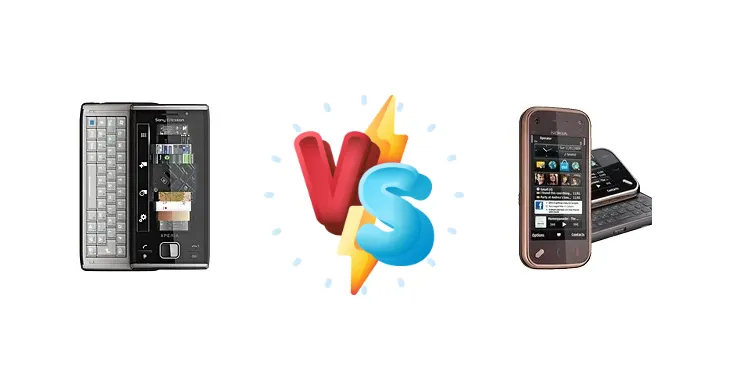
The mid-to-late 2000s were a golden age for smartphones, with innovative devices pushing the boundaries of mobile technology. Today, we're revisiting two iconic contenders: the Sony Ericsson Xperia X2 and the Nokia N97 mini. Let's see how these retro powerhouses stack up against each other.
🏆 Quick Verdict
The Xperia X2 edges out the N97 mini thanks to its slightly faster processor and generally more responsive UI. While both offer a taste of classic smartphone functionality, the X2 provides a marginally smoother experience, making it the preferred choice for those seeking a nostalgic mobile experience.
| Network |
|---|
| 2G bands | GSM 850 / 900 / 1800 / 1900 | GSM 850 / 900 / 1800 / 1900 |
| 3G bands | HSDPA 900 / 1900 / 2100 | HSDPA 900 / 1900 / 2100 |
| Speed | HSPA 7.2/2 Mbps | HSPA 3.6/0.384 Mbps |
| Technology | GSM / HSPA | GSM / HSPA |
| | HSDPA 850 / 1900 / 2100 - XPERIA X2a | HSDPA 850 / 1900 / 2100 - American version |
| Launch |
|---|
| Announced | 2009, September. Released 2010, January | 2009, September. Released 2009, November |
| Status | Discontinued | Discontinued |
| Body |
|---|
| Dimensions | 110 x 54 x 16 mm (4.33 x 2.13 x 0.63 in) | 113 x 52.5 x 14.2 mm, 75 cc (4.45 x 2.07 x 0.56 in) |
| Keyboard | QWERTY | QWERTY |
| SIM | Mini-SIM | Mini-SIM |
| Weight | 155 g (5.47 oz) | 138 g (4.87 oz) |
| | Optical trackpad | - |
| Display |
|---|
| Resolution | 480 x 800 pixels, 5:3 ratio (~292 ppi density) | 360 x 640 pixels, 16:9 ratio (~229 ppi density) |
| Size | 3.2 inches, 29.1 cm2 (~49.1% screen-to-body ratio) | 3.2 inches, 28.2 cm2 (~47.6% screen-to-body ratio) |
| Type | TFT resistive touchscreen, 65K colors | TFT resistive touchscreen, 16M colors |
| | XPERIA panels UI | Handwriting recognition |
| Platform |
|---|
| CPU | 528 MHz ARM 11 | 434 MHz ARM 11 |
| Chipset | Qualcomm MSM7200A | - |
| GPU | Adreno 130 | - |
| OS | Microsoft Windows Mobile 6.5/6.5.2 Professional | Symbian 9.4, Series 60 rel. 5 |
| Memory |
|---|
| Card slot | microSDHC (dedicated slot) | microSDHC (dedicated slot) |
| Internal | 110MB 256MB RAM 512MB ROM | 8GB 128MB RAM |
| Main Camera |
|---|
| Features | LED flash | Carl Zeiss optics, Dual-LED flash, video light |
| Single | 8 MP, AF | 5 MP, AF |
| Video | w480p@30fps | 480p@30fps |
| Selfie camera |
|---|
| Video | - | VGA@15fps |
| | Videocall, via SW update | - |
| Sound |
|---|
| 3.5mm jack | Yes | Yes |
| 35mm jack | Yes | Yes |
| Loudspeaker | Yes, with stereo speakers | Yes, with stereo speakers |
| Comms |
|---|
| Bluetooth | 2.1, A2DP | 2.0, A2DP |
| Positioning | GPS, A-GPS | GPS, A-GPS; Nokia Maps |
| Radio | Stereo FM (via software update) | Stereo FM radio, RDS |
| USB | microUSB 2.0 | microUSB 2.0 |
| WLAN | Wi-Fi 802.11b/g, DLNA | Wi-Fi 802.11 b/g, UPnP technology |
| Features |
|---|
| Browser | WAP 2.0/HTML (IE), RSS feeds | WAP 2.0/xHTML, HTML, Adobe Flash Lite |
| Sensors | Accelerometer | Accelerometer, proximity, compass |
| | MP3/WAV/eAAC+/WMA player
MP4/Xvid/WMV9/H.264 player
TV Out
YouTube application
Pocket Office
Photo editor
Organizer
Voice memo/dial
Predictive text input | MP3/WMA/WAV/eAAC+ player
WMV/RealVideo/MP4 player
TV-out
Voice command/dial
Document viewer (Word, Excel, PowerPoint, PDF)
Video and photo editor
Predictive text input |
| Battery |
|---|
| Music play | Up to 20 h | Up to 32 h |
| Stand-by | Up to 500 h (2G) / Up to 640 h (3G) | Up to 320 h (2G) / 310 h (3G) |
| Talk time | Up to 10 h (2G) / Up to 6 h (3G) | Up to 7 h 10 min (2G) / Up to 6 h (3G) |
| Type | Removable Li-Po 1500 mAh battery (BST-41) | Removable Li-Ion 1200 mAh battery (BL-4D) |
| Misc |
|---|
| Colors | Elegant Black, Modern Silver | Gold, Cherry Black, Garnet, White |
| Price | About 140 EUR | About 120 EUR |
| SAR | - | 0.90 W/kg (head) 1.25 W/kg (body) |
| SAR EU | 0.90 W/kg (head) | 0.67 W/kg (head) |
| Tests |
|---|
| Audio quality |
Noise -81.3dB / Crosstalk -93.1dB |
Noise -90.5dB / Crosstalk -91.0dB |
| Camera |
Photo |
Photo |
| Loudspeaker |
Voice 66dB / Noise 69dB / Ring 65dB |
Voice 68dB / Noise 66dB / Ring 83dB |
Sony Ericsson Xperia X2
- Slightly faster processor
- More responsive UI
- Stylish design
- Good build quality
- Limited app ecosystem
- Low-resolution display
- Basic camera
- Battery life could be better
Nokia N97 mini
- Classic Nokia design
- Symbian OS familiarity
- Decent battery life
- Compact size
- Slower processor
- Less responsive UI
- Limited app ecosystem
- Low-resolution display
Display Comparison
Both phones feature relatively small displays by today's standards. The Xperia X2 has a 3.2-inch touchscreen, while the N97 mini boasts a 3.2-inch display as well. Screen resolution was a limitation of the era, with both offering fairly low pixel densities. Viewing angles and color reproduction are not comparable to modern smartphones.
Camera Comparison
Both devices feature 'photo' cameras, indicating basic camera functionality. Image quality is expected to be low by today's standards, with limited resolution and poor low-light performance. Neither phone is a serious contender for photography.
Performance
The Xperia X2 holds a slight advantage here. It's powered by a 528 MHz ARM 11 processor, compared to the N97 mini's 434 MHz ARM 11. While both run Symbian OS, the X2's extra processing power translates to slightly snappier performance and quicker app loading times. However, don't expect modern smartphone speeds.
Battery Life
The Nokia N97 mini generally had a slightly better battery life due to its slightly larger battery capacity (1200 mAh vs. the X2's 1000 mAh). However, battery life was heavily dependent on usage patterns, and both phones would require daily charging with moderate use.
Buying Guide
The Sony Ericsson Xperia X2 is ideal for collectors and enthusiasts seeking a slightly more powerful and responsive retro smartphone. The Nokia N97 mini is a good option for those who appreciate Nokia's classic design and Symbian OS, and are less concerned with peak performance.
Frequently Asked Questions
❓ Are these phones still usable in 2024?
Yes, but with limitations. Network compatibility can be an issue as 3G networks are being phased out. App availability is extremely limited. They are primarily suitable for collectors or those seeking a nostalgic experience.
❓ Which operating system do these phones use?
Both phones run Symbian OS, a mobile operating system popular in the late 2000s. It's significantly different from modern Android or iOS.