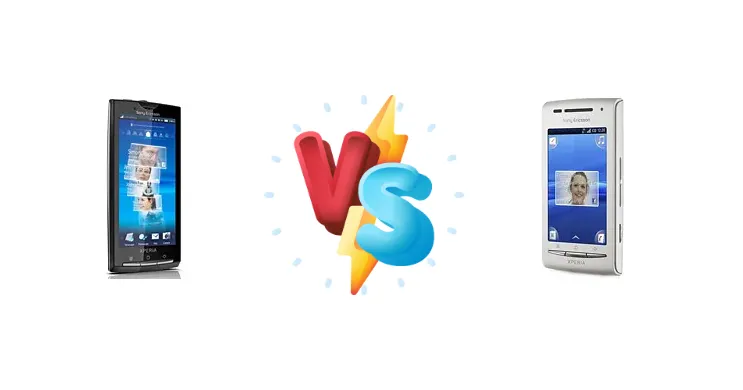
The Sony Ericsson Xperia X10 and X8 were flagship devices in their time, representing Sony Ericsson's push into the Android market. Both offered unique features, but catered to slightly different users. This comparison dives deep into their specs, performance, and overall value to help you understand which phone reigned supreme.
🏆 Quick Verdict
The Xperia X10 clearly edges out the X8 thanks to its faster processor, smoother performance, and video recording capabilities. While the X8 offered a more compact design, the X10's superior hardware and Android experience make it the better choice for most users, even considering their age.
| Network |
|---|
| 2G bands | GSM 850 / 900 / 1800 / 1900 | GSM 850 / 900 / 1800 / 1900 |
| 3G bands | HSDPA 900 / 1700 / 2100 | HSDPA 900 / 2100 |
| EDGE | - | Class 10 |
| GPRS | - | Class 10 |
| Speed | HSPA 7.2/2 Mbps | HSPA 7.2/2 Mbps |
| Technology | GSM / HSPA | GSM / HSPA |
| | HSDPA 850 / 1900 / 2100 / 800 - X10a for Americas | HSDPA 850 / 1900 / 2100 |
| Launch |
|---|
| Announced | 2009, November. Released 2010, March | 2010, June. Released 2010, September |
| Status | Discontinued | Discontinued |
| Body |
|---|
| Dimensions | 119 x 63 x 13 mm (4.69 x 2.48 x 0.51 in) | 99 x 54 x 15 mm (3.90 x 2.13 x 0.59 in) |
| SIM | Mini-SIM | Mini-SIM |
| Weight | 135 g (4.76 oz) | 104 g (3.67 oz) |
| Display |
|---|
| Protection | Scratch-resistant glass | Scratch-resistant glass |
| Resolution | 480 x 854 pixels, 16:9 ratio (~245 ppi density) | 320 x 480 pixels, 3:2 ratio (~192 ppi density) |
| Size | 4.0 inches, 44.1 cm2 (~58.8% screen-to-body ratio) | 3.0 inches, 26.8 cm2 (~50.1% screen-to-body ratio) |
| Type | TFT, 65K colors | TFT |
| | Timescape/Mediascape UI | Timescape UI |
| Platform |
|---|
| CPU | 1.0 GHz Scorpion | 600 MHz ARM 11 |
| Chipset | Qualcomm QSD8250 Snapdragon S1 | Qualcomm MSM7227 Snapdragon S1 |
| GPU | Adreno 200 | Adreno 200 |
| OS | Android 1.6 (Donut), upgradable to 2.3 (Gingerbread) | Android 1.6 (Donut), upgradable to 2.1 (Eclair) |
| Memory |
|---|
| Call records | - | 20 dialed, 20 received, 20 missed calls |
| Card slot | microSDHC (dedicated slot), 8 GB included | microSDHC (dedicated slot), 2 GB included |
| Internal | 1GB 384MB RAM | 128MB 168MB RAM |
| Phonebook | - | 1000 entries , Photocall |
| Main Camera |
|---|
| Features | LED flash | - |
| Single | 8 MP, AF | 3.15 MP |
| Video | w480p@30fps, 720p@30fps (via SW update) | 480p@30fps |
| Sound |
|---|
| 3.5mm jack | Yes | Yes |
| 35mm jack | Yes | Yes |
| Loudspeaker | Yes | Yes |
| Comms |
|---|
| Bluetooth | 2.1, A2DP | 2.1, A2DP |
| Positioning | GPS, A-GPS | GPS, A-GPS |
| Radio | No | Stereo FM radio, RDS |
| USB | microUSB 2.0 | microUSB 2.0 |
| WLAN | Wi-Fi 802.11 b/g, DLNA, hotspot | Wi-Fi 802.11 b/g |
| Features |
|---|
| Browser | HTML, Adobe Flash | HTML |
| Games | - | Yes |
| Java | - | Yes, MIDP 2.1 |
| Messaging | - | SMS, MMS, Email |
| Sensors | Accelerometer, proximity, compass | Accelerometer, proximity, compass |
| | - | ANT+ |
| Battery |
|---|
| Music play | - | Up to 23 h 40 min |
| Stand-by | Up to 415 h (2G) / Up to 425 h (3G) | Up to 446 h (2G) / Up to 476 h (3G) |
| Talk time | Up to 10 h (2G) / Up to 8 h (3G) | Up to 4 h 45 min (2G) / Up to 5 h 40 min (3G) |
| Type | Removable Li-Po 1500 mAh battery (BST-41) | Removable Li-Po 1200 mAh battery |
| Misc |
|---|
| Colors | Sensous Black, Luster White | White, Dark Blue/ White, Aqua Blue/ White, Pink/ White, Silver/ White |
| Price | About 120 EUR | About 100 EUR |
| SAR | 0.87 W/kg (head) 0.81 W/kg (body) | 0.76 W/kg (head) 0.68 W/kg (body) |
| SAR EU | 1.25 W/kg (head) | 0.84 W/kg (head) |
| Tests |
|---|
| Audio quality |
Noise -85.4dB / Crosstalk -83.6dB |
Noise -75.6dB / Crosstalk -70.7dB |
| Camera |
Photo / Video |
Photo |
| Loudspeaker |
Voice 66dB / Noise 66dB / Ring 68dB
|
Voice 66dB / Noise 66dB / Ring 69dB
|
Sony Ericsson Xperia X10
- Faster Processor
- HD Video Recording
- Larger Display
- More Responsive UI
- Larger Size
- Older Software (Android 2.3)
Sony Ericsson Xperia X8
- More Compact Design
- Potentially Easier to Handle
- Slower Processor
- No HD Video Recording
- Smaller Display
- Less Responsive UI
Display Comparison
The Xperia X10 boasts a 4.0-inch TFT LCD screen with a resolution of 480x854 pixels. The X8 features a slightly smaller 3.0-inch TFT LCD screen with a resolution of 320x480 pixels. The X10's larger size and higher resolution provide a noticeably sharper and more immersive viewing experience.
Camera Comparison
The X10 features an 8.1MP camera capable of recording 720p HD video, a significant advantage over the X8's 8MP camera which only supports standard definition video. While both cameras produce acceptable photos in good lighting, the X10's video recording is a major differentiator.
Performance
Here's where the X10 shines. It's powered by a 1.0 GHz Scorpion processor, significantly faster than the X8's 600 MHz ARM 11. This translates to snappier app loading, smoother multitasking, and a generally more responsive user interface on the X10. The X8 can feel sluggish by today's standards.
Battery Life
The Xperia X10 has a 1500 mAh battery, while the X8 has a 1200 mAh battery. While real-world battery life varied based on usage, the X10 generally offered slightly better endurance due to its more efficient processor and software optimization.
Buying Guide
The Xperia X10 is ideal for users who prioritize performance and a more modern Android experience. The Xperia X8 might appeal to those seeking a smaller, more pocketable device, but be prepared for a slower experience. Given their age, neither is recommended for primary use in 2024.
Frequently Asked Questions
❓ What Android version did these phones ship with?
The Xperia X10 initially shipped with Android 2.1, later upgradable to 2.3. The Xperia X8 shipped with Android 2.1.
❓ Are these phones still worth using today?
Given their age and lack of software updates, neither phone is recommended for regular use. They are primarily of historical interest or for niche projects.