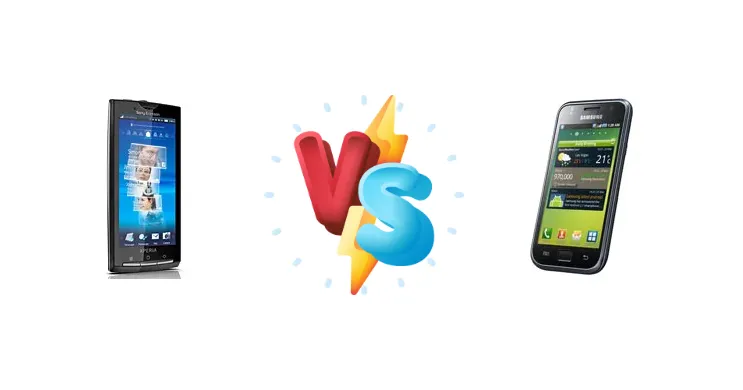
The Sony Ericsson Xperia X10 and Samsung Galaxy S were titans of the early Android landscape, representing distinct approaches to the burgeoning mobile OS. Both devices were highly anticipated, but which one ultimately delivered a better experience? Let's dive into a detailed comparison to settle the score.
🏆 Quick Verdict
The Samsung Galaxy S emerges as the clear winner. While the Xperia X10 had a unique design, the Galaxy S boasted a superior display, faster processor, and a more polished Android experience, setting a new standard for smartphones.
| Network |
|---|
| 2G bands | GSM 850 / 900 / 1800 / 1900 | GSM 850 / 900 / 1800 / 1900 |
| 3G bands | HSDPA 900 / 1700 / 2100 | HSDPA 900 / 1900 / 2100 |
| Speed | HSPA 7.2/2 Mbps | HSPA 7.2/5.76 Mbps |
| Technology | GSM / HSPA | GSM / HSPA |
| | HSDPA 850 / 1900 / 2100 / 800 - X10a for Americas | - |
| Launch |
|---|
| Announced | 2009, November. Released 2010, March | 2010, March. Released 2010, June |
| Status | Discontinued | Discontinued |
| Body |
|---|
| Dimensions | 119 x 63 x 13 mm (4.69 x 2.48 x 0.51 in) | 122.4 x 64.2 x 9.9 mm (4.82 x 2.53 x 0.39 in) |
| SIM | Mini-SIM | Mini-SIM |
| Weight | 135 g (4.76 oz) | 119 g (4.20 oz) |
| Display |
|---|
| Protection | Scratch-resistant glass | Corning Gorilla Glass |
| Resolution | 480 x 854 pixels, 16:9 ratio (~245 ppi density) | 480 x 800 pixels, 5:3 ratio (~233 ppi density) |
| Size | 4.0 inches, 44.1 cm2 (~58.8% screen-to-body ratio) | 4.0 inches, 45.5 cm2 (~58.0% screen-to-body ratio) |
| Type | TFT, 65K colors | Super AMOLED |
| | Timescape/Mediascape UI | - |
| Platform |
|---|
| CPU | 1.0 GHz Scorpion | 1.0 GHz Cortex-A8 |
| Chipset | Qualcomm QSD8250 Snapdragon S1 | Hummingbird |
| GPU | Adreno 200 | PowerVR SGX540 |
| OS | Android 1.6 (Donut), upgradable to 2.3 (Gingerbread) | Android 2.1 (Eclair), upgradable to 2.3 (Gingerbread), TouchWiz UI 3 |
| Memory |
|---|
| Card slot | microSDHC (dedicated slot), 8 GB included | microSDHC (dedicated slot) |
| Internal | 1GB 384MB RAM | 8GB 512MB RAM, 16GB 512MB RAM |
| Main Camera |
|---|
| Features | LED flash | - |
| Single | 8 MP, AF | 5 MP, AF |
| Video | w480p@30fps, 720p@30fps (via SW update) | 720p@30fps |
| Selfie camera |
|---|
| Single | - | VGA |
| | No | - |
| Sound |
|---|
| 3.5mm jack | Yes | Yes |
| 35mm jack | Yes | Yes |
| Loudspeaker | Yes | Yes |
| Comms |
|---|
| Bluetooth | 2.1, A2DP | 3.0, A2DP, aptX |
| Positioning | GPS, A-GPS | GPS, A-GPS |
| Radio | No | FM radio, RDS |
| USB | microUSB 2.0 | microUSB 2.0 |
| WLAN | Wi-Fi 802.11 b/g, DLNA, hotspot | Wi-Fi 802.11 b/g/n, DLNA, hotspot (Android 2.2) |
| Features |
|---|
| Browser | HTML, Adobe Flash | WAP 2.0/xHTML, HTML, Adobe Flash |
| Sensors | Accelerometer, proximity, compass | Accelerometer, proximity, compass |
| | - | ISDB-Tb Digital TV tuner (only available for Brazilian market) |
| Battery |
|---|
| Stand-by | Up to 415 h (2G) / Up to 425 h (3G) | Up to 750 h (2G) / Up to 576 h (3G) |
| Talk time | Up to 10 h (2G) / Up to 8 h (3G) | Up to 13 h 30 min (2G) / Up to 6 h 30 min (3G) |
| Type | Removable Li-Po 1500 mAh battery (BST-41) | Removable Li-Ion 1500 mAh battery |
| Misc |
|---|
| Colors | Sensous Black, Luster White | Black, White |
| Models | - | GT-I9000 |
| Price | About 120 EUR | About 120 EUR |
| SAR | 0.87 W/kg (head) 0.81 W/kg (body) | - |
| SAR EU | 1.25 W/kg (head) | 0.27 W/kg (head) 0.51 W/kg (body) |
| Tests |
|---|
| Audio quality |
Noise -85.4dB / Crosstalk -83.6dB |
Noise -90.7dB / Crosstalk -90.6dB |
| Camera |
Photo / Video |
Photo / Video |
| Display | - |
Contrast ratio: Infinite (nominal) / 3.155:1 (sunlight) |
| Loudspeaker |
Voice 66dB / Noise 66dB / Ring 68dB
|
Voice 66dB / Noise 65dB / Ring 66dB
|
Sony Ericsson Xperia X10
- Unique design
- Good build quality
- Timescape UI (initially)
- Decent multimedia playback
- Slow software updates
- Laggy performance
- Subpar camera software
- LCD display quality
Samsung I9000 Galaxy S
- Superior display (Super AMOLED)
- Faster processor
- Smoother Android experience
- Better camera quality
- More responsive UI
- Plastic build (compared to some contemporaries)
- Early Android software quirks
- Battery life could be better with heavy use
Display Comparison
The Samsung Galaxy S takes a commanding lead in the display department. While both had similar resolutions, the Galaxy S's Super AMOLED display offered significantly better contrast, vibrant colors, and wider viewing angles compared to the X10's LCD screen. The 'Infinite' contrast ratio (nominal) and 3.155:1 (sunlight) figures highlight its superior performance.
Camera Comparison
Both phones featured cameras capable of taking photos and videos, but the Galaxy S generally produced better image quality, particularly in low-light conditions. The X10's camera software was often criticized for its slow processing times. While both were limited by the technology of the time, the Galaxy S held a slight edge.
Performance
The Galaxy S's Hummingbird chipset with a 1.0 GHz Cortex-A8 CPU proved noticeably faster than the Xperia X10's Qualcomm QSD8250 Snapdragon S1 with a 1.0 GHz Scorpion CPU. This translated to smoother multitasking, quicker app loading times, and a generally more responsive user experience on the Galaxy S.
Battery Life
Battery life was a mixed bag for both devices. The Galaxy S, with its slightly larger battery capacity, often provided marginally better endurance. However, usage patterns significantly impacted battery performance on both phones.
Buying Guide
Who should buy the Sony Ericsson Xperia X10? Nostalgic Android enthusiasts or those appreciating Sony's design aesthetic. Who should buy the Samsung Galaxy S? Anyone seeking a more powerful and feature-rich Android experience, even by today's standards (considering its age).
Frequently Asked Questions
❓ What was the Timescape UI on the Xperia X10?
Timescape was Sony Ericsson's attempt at a unique UI layer on top of Android, focusing on social networking integration. However, it was often criticized for being slow and confusing.
❓ Why was the Galaxy S considered so revolutionary?
The Galaxy S was revolutionary for its time due to its Super AMOLED display, powerful processor, and relatively clean Android experience. It helped establish Samsung as a major player in the smartphone market.