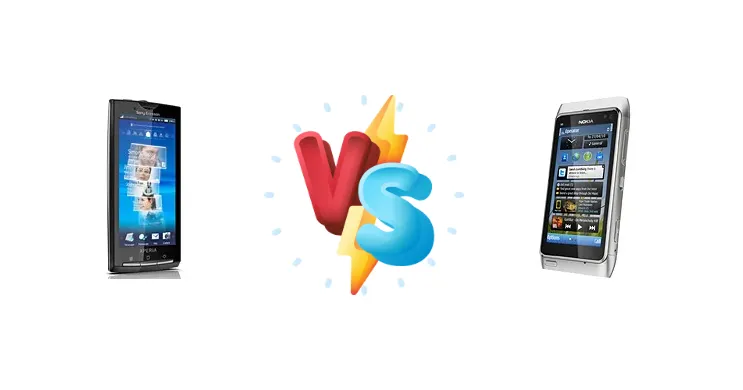
The late 2000s and early 2010s were a golden age for mobile innovation. The Sony Ericsson Xperia X10, an early Android contender, faced off against the Nokia N8, a flagship Symbian device renowned for its camera. Let's revisit these iconic phones and see how they stack up today.
🏆 Quick Verdict
The Nokia N8 edges out the Xperia X10 thanks to its superior camera, exceptional sunlight readability on its display, and overall build quality. While the X10 offered a taste of Android, the N8’s hardware and imaging capabilities were ultimately more impressive.
| Network |
|---|
| 2G bands | GSM 850 / 900 / 1800 / 1900 | GSM 850 / 900 / 1800 / 1900 |
| 3G bands | HSDPA 900 / 1700 / 2100 | HSDPA 850 / 900 / 1700 / 1900 / 2100 |
| Speed | HSPA 7.2/2 Mbps | HSPA 10.2/2 Mbps |
| Technology | GSM / HSPA | GSM / HSPA |
| | HSDPA 850 / 1900 / 2100 / 800 - X10a for Americas | - |
| Launch |
|---|
| Announced | 2009, November. Released 2010, March | 2010, April. Released 2010, October |
| Status | Discontinued | Discontinued |
| Body |
|---|
| Dimensions | 119 x 63 x 13 mm (4.69 x 2.48 x 0.51 in) | 113.5 x 59.1 x 12.9 mm, 86 cc (4.47 x 2.33 x 0.51 in) |
| SIM | Mini-SIM | Mini-SIM |
| Weight | 135 g (4.76 oz) | 135 g (4.76 oz) |
| Display |
|---|
| Protection | Scratch-resistant glass | Corning Gorilla Glass |
| Resolution | 480 x 854 pixels, 16:9 ratio (~245 ppi density) | 360 x 640 pixels, 16:9 ratio (~210 ppi density) |
| Size | 4.0 inches, 44.1 cm2 (~58.8% screen-to-body ratio) | 3.5 inches, 33.8 cm2 (~50.3% screen-to-body ratio) |
| Type | TFT, 65K colors | AMOLED |
| | Timescape/Mediascape UI | - |
| Platform |
|---|
| CPU | 1.0 GHz Scorpion | 680 MHz ARM 11 |
| Chipset | Qualcomm QSD8250 Snapdragon S1 | - |
| GPU | Adreno 200 | Broadcom BCM2727 |
| OS | Android 1.6 (Donut), upgradable to 2.3 (Gingerbread) | Symbian^3, upgradable to Nokia Belle Refresh |
| Memory |
|---|
| Card slot | microSDHC (dedicated slot), 8 GB included | microSDHC (dedicated slot) |
| Internal | 1GB 384MB RAM | 16GB 256MB RAM |
| Main Camera |
|---|
| Features | LED flash | Carl Zeiss optics, Xenon flash, ND filter |
| Single | 8 MP, AF | 12 MP, 1/1.83", AF |
| Video | w480p@30fps, 720p@30fps (via SW update) | 720p@25fps, 720p@30fps (via SW update) |
| Selfie camera |
|---|
| Single | - | VGA videocall camera |
| | No | - |
| Sound |
|---|
| 3.5mm jack | Yes | Yes |
| 35mm jack | Yes | Yes |
| Loudspeaker | Yes | Yes |
| Comms |
|---|
| Bluetooth | 2.1, A2DP | 3.0, A2DP |
| Positioning | GPS, A-GPS | GPS, A-GPS; Ovi Maps 3.0 |
| Radio | No | Stereo FM radio, RDS; FM transmitter |
| USB | microUSB 2.0 | microUSB 2.0, OTG |
| WLAN | Wi-Fi 802.11 b/g, DLNA, hotspot | Wi-Fi 802.11 b/g/n, UPnP technology |
| Features |
|---|
| Browser | HTML, Adobe Flash | WAP 2.0/xHTML, HTML, Adobe Flash Lite |
| Sensors | Accelerometer, proximity, compass | Accelerometer, proximity, compass |
| | - | TV-out (720p video) via HDMI with Dolby Digital Plus sound
Anodized aluminum casing |
| Battery |
|---|
| Music play | - | Up to 50 h |
| Stand-by | Up to 415 h (2G) / Up to 425 h (3G) | Up to 390 h (2G) / Up to 400 h (3G) |
| Talk time | Up to 10 h (2G) / Up to 8 h (3G) | Up to 12 h (2G) / Up to 5 h 50 min (3G) |
| Type | Removable Li-Po 1500 mAh battery (BST-41) | Non-removable Li-Ion 1200 mAh battery (BL-4D) |
| Misc |
|---|
| Colors | Sensous Black, Luster White | Dark Grey, Silver White, Green, Blue, Orange, Pink, Bronze |
| Price | About 120 EUR | About 140 EUR |
| SAR | 0.87 W/kg (head) 0.81 W/kg (body) | 1.09 W/kg (head) 0.85 W/kg (body) |
| SAR EU | 1.25 W/kg (head) | 1.02 W/kg (head) |
| Tests |
|---|
| Audio quality |
Noise -85.4dB / Crosstalk -83.6dB |
Noise -89.9dB / Crosstalk -90.9dB |
| Camera |
Photo / Video |
Photo / Video |
| Display | - |
Contrast ratio: 2.144:1 (sunlight) |
| Loudspeaker |
Voice 66dB / Noise 66dB / Ring 68dB
|
Voice 75dB / Noise 66dB / Ring 82dB |
Sony Ericsson Xperia X10
- Early Android experience
- Faster processor (Snapdragon)
- Slightly more modern UI (for the time)
- Weaker camera
- Poor sunlight display visibility
- Limited software updates
- Plastic build quality
Nokia N8
- Exceptional camera with Zeiss optics
- Excellent sunlight display readability
- Robust build quality
- Longer battery life
- Dedicated camera features
- Slower processor
- Symbian OS (outdated)
- Less intuitive UI compared to Android
- Can feel sluggish by today's standards
Display Comparison
The Nokia N8 boasts a significantly better display experience, particularly in sunlight. Its 2.144:1 contrast ratio is exceptional for the time, offering vibrant colors and deep blacks. The Xperia X10's display, while decent, struggles in direct sunlight. The N8's resolution was also slightly higher, contributing to a sharper image.
Camera Comparison
This is where the Nokia N8 truly shines. Its 12MP sensor with Carl Zeiss optics was groundbreaking for its time, delivering exceptional image quality, detail, and dynamic range. The X10's camera, while capable, couldn't match the N8's photographic prowess. The N8 also offered features like Xenon flash and advanced shooting modes.
Performance
The Xperia X10's 1.0 GHz Scorpion processor, paired with the Qualcomm Snapdragon chipset, offered a noticeable performance advantage over the Nokia N8's 680 MHz ARM 11 CPU. The X10 felt snappier in everyday tasks and app navigation, though both phones show their age by modern standards. The Snapdragon chipset provided better graphics capabilities.
Battery Life
The Nokia N8 generally had better battery life due to its more efficient Symbian OS and larger battery capacity (1200 mAh vs X10's 1500 mAh). While both phones would require daily charging with moderate use, the N8 provided a slightly longer runtime.
Buying Guide
The Sony Ericsson Xperia X10 is for those interested in experiencing an early Android device and appreciate its slightly more modern software feel (though limited by age). The Nokia N8 is ideal for photography enthusiasts who value a dedicated camera experience and robust hardware, even with a Symbian OS.
Frequently Asked Questions
❓ Which phone has the better operating system?
The Xperia X10 runs Android, which was more forward-looking at the time. However, both phones are outdated now. The N8's Symbian OS is significantly less supported.
❓ Is it worth buying either of these phones today?
Primarily for nostalgia or as a collector's item. Neither phone is suitable for modern smartphone usage due to their age and lack of software support.