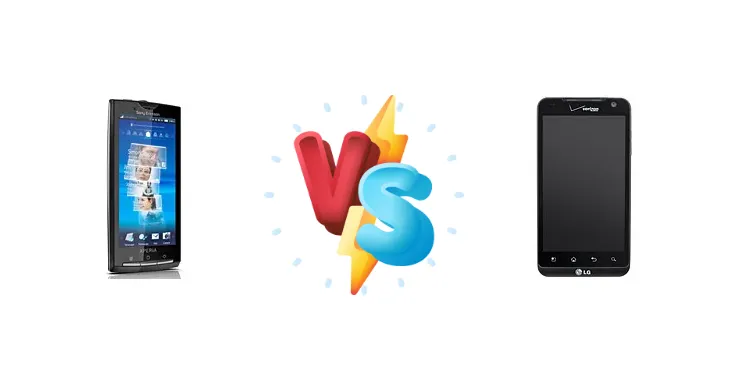
The Xperia X10 and LG Revolution represent a fascinating era in smartphone history – the dawn of Android. Both devices were ambitious attempts to deliver a compelling Android experience, but they had distinct strengths and weaknesses. Let's revisit these pioneers and see how they stack up today.
🏆 Quick Verdict
The LG Revolution edges out the Xperia X10 due to its slightly more refined software experience and marginally better overall performance. While both are relics of the past, the Revolution's Snapdragon S2 offered a small but noticeable advantage. However, both are severely outdated.
| Network |
|---|
| 2G bands | GSM 850 / 900 / 1800 / 1900 | CDMA 800 / 1900 |
| 3G bands | HSDPA 900 / 1700 / 2100 | CDMA2000 1xEV-DO |
| 4G bands | - | 13 |
| Speed | HSPA 7.2/2 Mbps | LTE, EV-DO Rev.A 3.1 Mbps |
| Technology | GSM / HSPA | CDMA / EVDO / LTE |
| | HSDPA 850 / 1900 / 2100 / 800 - X10a for Americas | - |
| Launch |
|---|
| Announced | 2009, November. Released 2010, March | 2011, January. Released 2011, May |
| Status | Discontinued | Discontinued |
| Body |
|---|
| Dimensions | 119 x 63 x 13 mm (4.69 x 2.48 x 0.51 in) | 128 x 67 x 13.2 mm (5.04 x 2.64 x 0.52 in) |
| SIM | Mini-SIM | Mini-SIM |
| Weight | 135 g (4.76 oz) | 172 g (6.07 oz) |
| Display |
|---|
| Protection | Scratch-resistant glass | - |
| Resolution | 480 x 854 pixels, 16:9 ratio (~245 ppi density) | 480 x 800 pixels, 5:3 ratio (~217 ppi density) |
| Size | 4.0 inches, 44.1 cm2 (~58.8% screen-to-body ratio) | 4.3 inches, 52.6 cm2 (~61.4% screen-to-body ratio) |
| Type | TFT, 65K colors | TFT |
| | Timescape/Mediascape UI | - |
| Platform |
|---|
| CPU | 1.0 GHz Scorpion | 1.0 GHz Scorpion |
| Chipset | Qualcomm QSD8250 Snapdragon S1 | Qualcomm MSM8655 Snapdragon S2 |
| GPU | Adreno 200 | Adreno 205 |
| OS | Android 1.6 (Donut), upgradable to 2.3 (Gingerbread) | Android 2.2 (Froyo), upgradable to 2.3 (Gingerbread) |
| Memory |
|---|
| Card slot | microSDHC (dedicated slot), 8 GB included | microSDHC (dedicated slot), 16 GB included |
| Internal | 1GB 384MB RAM | 16GB |
| Main Camera |
|---|
| Features | LED flash | LED flash |
| Single | 8 MP, AF | 5 MP, AF |
| Video | w480p@30fps, 720p@30fps (via SW update) | 720p |
| Selfie camera |
|---|
| Single | - | 1.3 MP |
| | No | - |
| Sound |
|---|
| 3.5mm jack | Yes | Yes |
| 35mm jack | Yes | Yes |
| Loudspeaker | Yes | Yes |
| Comms |
|---|
| Bluetooth | 2.1, A2DP | 3.0, A2DP, EDR |
| Positioning | GPS, A-GPS | GPS, A-GPS |
| Radio | No | No |
| USB | microUSB 2.0 | microUSB 2.0 |
| WLAN | Wi-Fi 802.11 b/g, DLNA, hotspot | Wi-Fi 802.11 b/g/n, DLNA, hotspot |
| Features |
|---|
| Browser | HTML, Adobe Flash | HTML, Adobe Flash |
| Sensors | Accelerometer, proximity, compass | Accelerometer, proximity, compass |
| | - | HDMI port
MP4/H.264/DivX player
MP3/WAV/WMA/eAAC+ player
Document viewer
Photo editor
Organizer
Voice memo/dial/commands
Predictive text input (Swype) |
| Battery |
|---|
| Stand-by | Up to 415 h (2G) / Up to 425 h (3G) | Up to 335 h |
| Talk time | Up to 10 h (2G) / Up to 8 h (3G) | Up to 7 h 20 min |
| Type | Removable Li-Po 1500 mAh battery (BST-41) | Removable Li-Ion 1500 mAh battery |
| Misc |
|---|
| Colors | Sensous Black, Luster White | Black |
| Price | About 120 EUR | About 80 EUR |
| SAR | 0.87 W/kg (head) 0.81 W/kg (body) | 0.66 W/kg (head) 0.79 W/kg (body) |
| SAR EU | 1.25 W/kg (head) | - |
| Tests |
|---|
| Audio quality |
Noise -85.4dB / Crosstalk -83.6dB | - |
| Camera |
Photo / Video | - |
| Loudspeaker |
Voice 66dB / Noise 66dB / Ring 68dB
| - |
Sony Ericsson Xperia X10
- Larger screen (slightly)
- Distinctive Sony design
- Outdated software
- Slower performance
- Limited camera quality
- Poor battery life
LG Revolution
- Slightly better performance (Snapdragon S2)
- IPS display (better viewing angles)
- More refined software (at launch)
- Outdated software
- Limited camera quality
- Poor battery life
- Smaller screen
Display Comparison
The Xperia X10 featured a 4.0-inch Reality Display with a resolution of 480x854 pixels. The LG Revolution boasted a 3.8-inch IPS display with a resolution of 480x800 pixels. While both were decent for their time, the LG's IPS technology offered slightly better viewing angles and color reproduction. The X10's screen felt a bit larger, but the difference was minimal.
Camera Comparison
The Xperia X10 had an 8.1MP rear camera with LED flash. The LG Revolution also featured an 8MP rear camera. Image quality was generally comparable, with both struggling in low-light conditions. Video recording capabilities were limited to 480p on both devices. Neither camera was particularly impressive by today's standards.
Performance
Both phones were powered by a 1.0 GHz Scorpion CPU and Qualcomm Snapdragon chipsets. However, the LG Revolution utilized the Snapdragon S2 (MSM8655), a slightly more advanced chipset than the Xperia X10's Snapdragon S1 (QSD8250). This resulted in marginally faster app loading times and smoother multitasking on the Revolution. Both suffered from the limitations of early Android optimization.
Battery Life
The Xperia X10 had a 1500mAh battery, while the LG Revolution had a 1450mAh battery. Battery life was adequate for light usage on both devices, but heavy users would need to charge them frequently. Expect significantly shorter battery life than modern smartphones.
Buying Guide
Neither phone is recommended for purchase in 2024. They are historical artifacts. The Xperia X10 might appeal to collectors of early Android devices, while the LG Revolution could interest those curious about LG's early Android efforts. Consider modern smartphones for practical use.
Frequently Asked Questions
❓ Are these phones still usable today?
Technically yes, but they are severely outdated. Expect slow performance, limited app compatibility, and poor battery life. They are not recommended for daily use.
❓ What Android version did these phones ship with?
The Xperia X10 launched with Android 1.6 (Donut) and was later updated to Android 2.3 (Gingerbread). The LG Revolution launched with Android 2.2 (Froyo).