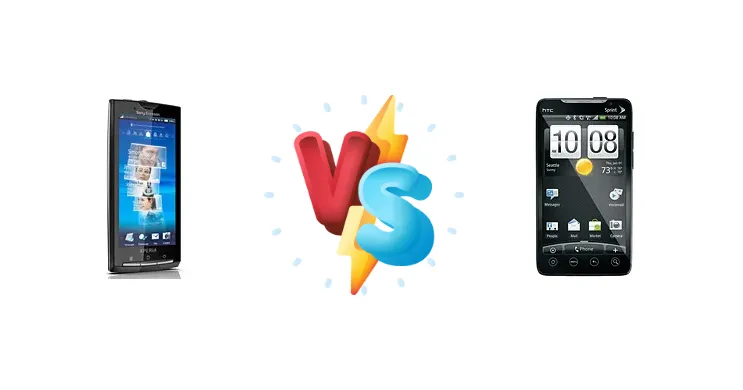
The Sony Ericsson Xperia X10 and HTC Evo 4G represent a pivotal moment in smartphone history – the rise of Android. Both devices were highly anticipated, boasting innovative features for their time. But which one ultimately delivered a better experience? Let's dive into a detailed comparison to settle the score.
🏆 Quick Verdict
The HTC Evo 4G edges out the Xperia X10 thanks to its superior 4G connectivity (a major selling point at the time), slightly better chipset, and generally smoother software experience. While the X10 had a unique design, the Evo 4G offered a more compelling overall package.
| Network |
|---|
| 2G bands | GSM 850 / 900 / 1800 / 1900 | CDMA 800 / 1900 |
| 3G bands | HSDPA 900 / 1700 / 2100 | CDMA2000 1xEV-DO |
| Speed | HSPA 7.2/2 Mbps | EV-DO Rev.A 3.1 Mbps |
| Technology | GSM / HSPA | CDMA / EVDO |
| | HSDPA 850 / 1900 / 2100 / 800 - X10a for Americas | - |
| Launch |
|---|
| Announced | 2009, November. Released 2010, March | 2010, March. Released 2010, June |
| Status | Discontinued | Discontinued |
| Body |
|---|
| Dimensions | 119 x 63 x 13 mm (4.69 x 2.48 x 0.51 in) | 122 x 66 x 13 mm (4.80 x 2.60 x 0.51 in) |
| SIM | Mini-SIM | Mini-SIM |
| Weight | 135 g (4.76 oz) | 170 g (6.00 oz) |
| Display |
|---|
| Protection | Scratch-resistant glass | Corning Gorilla Glass |
| Resolution | 480 x 854 pixels, 16:9 ratio (~245 ppi density) | 480 x 800 pixels, 5:3 ratio (~217 ppi density) |
| Size | 4.0 inches, 44.1 cm2 (~58.8% screen-to-body ratio) | 4.3 inches, 52.6 cm2 (~65.4% screen-to-body ratio) |
| Type | TFT, 65K colors | TFT, 65K colors |
| | Timescape/Mediascape UI | - |
| Platform |
|---|
| CPU | 1.0 GHz Scorpion | 1.0 GHz Scorpion |
| Chipset | Qualcomm QSD8250 Snapdragon S1 | Qualcomm QSD8650 Snapdragon S1 |
| GPU | Adreno 200 | Adreno 200 |
| OS | Android 1.6 (Donut), upgradable to 2.3 (Gingerbread) | Android 2.1 (Eclair), upgradable to 2.3 (Gingerbread), Sense UI |
| Memory |
|---|
| Card slot | microSDHC (dedicated slot), 8 GB included | microSDHC (dedicated slot), 8 GB included |
| Internal | 1GB 384MB RAM | 1GB 512MB RAM |
| Main Camera |
|---|
| Features | LED flash | Dual-LED flash |
| Single | 8 MP, AF | 8 MP, AF |
| Video | w480p@30fps, 720p@30fps (via SW update) | 720p |
| Selfie camera |
|---|
| Single | - | 1.3 MP |
| | No | - |
| Sound |
|---|
| 3.5mm jack | Yes | Yes |
| 35mm jack | Yes | Yes |
| Loudspeaker | Yes | Yes |
| Comms |
|---|
| Bluetooth | 2.1, A2DP | 2.1, A2DP |
| Positioning | GPS, A-GPS | GPS, A-GPS |
| Radio | No | Stereo FM radio, RDS |
| USB | microUSB 2.0 | microUSB 2.0 |
| WLAN | Wi-Fi 802.11 b/g, DLNA, hotspot | Wi-Fi 802.11 b/g, WiMAX 802.16 e (Wi-Fi router) |
| Features |
|---|
| Browser | HTML, Adobe Flash | HTML, Adobe Flash |
| Sensors | Accelerometer, proximity, compass | Accelerometer, proximity, compass |
| | - | HDMI port
Dedicated search key
MP3/AAC+/WAV/WMA9 player
MP4/H.264/WMV9 player
Voice memo
Predictive text input |
| Battery |
|---|
| Stand-by | Up to 415 h (2G) / Up to 425 h (3G) | Up to 146 h |
| Talk time | Up to 10 h (2G) / Up to 8 h (3G) | Up to 5 h 12 min |
| Type | Removable Li-Po 1500 mAh battery (BST-41) | Removable Li-Ion 1500 mAh battery |
| Misc |
|---|
| Colors | Sensous Black, Luster White | Black, White |
| Price | About 120 EUR | About 90 EUR |
| SAR | 0.87 W/kg (head) 0.81 W/kg (body) | 1.03 W/kg (head) 0.96 W/kg (body) |
| SAR EU | 1.25 W/kg (head) | - |
| Tests |
|---|
| Audio quality |
Noise -85.4dB / Crosstalk -83.6dB | - |
| Camera |
Photo / Video | - |
| Loudspeaker |
Voice 66dB / Noise 66dB / Ring 68dB
| - |
Sony Ericsson Xperia X10
- Unique Sony Ericsson design
- Vibrant OLED display
- Decent camera for its time
- Slower performance compared to Evo 4G
- Software updates were slow and limited
- Less responsive user interface
HTC Evo 4G
- Faster performance due to chipset
- 4G connectivity (significant at the time)
- Larger screen
- Smoother Android experience
- LCD display not as vibrant as OLED
- Bulky design
- Battery life could be better with 4G usage
Display Comparison
The Xperia X10 featured a 4-inch OLED display, known for its vibrant colors, while the Evo 4G had a larger 3.2-inch LCD screen. While the X10's OLED offered better contrast, the Evo 4G's larger size provided a slightly more immersive experience for media consumption. Resolution was similar, around 480x854 pixels on both.
Camera Comparison
The Xperia X10 boasted an 8.1MP camera with LED flash, while the Evo 4G had a slightly lower 8MP camera. Image quality was comparable, with both producing decent photos in good lighting conditions but struggling in low light. Video recording capabilities were similar, offering 720p resolution.
Performance
Both phones utilized a 1.0 GHz Scorpion processor, but the Evo 4G's Qualcomm QSD8650 Snapdragon chipset offered a slight performance advantage over the X10's QSD8250 Snapdragon. This translated to marginally faster app loading times and smoother multitasking on the Evo 4G. However, both struggled with demanding modern apps.
Battery Life
The Xperia X10 had a 1500mAh battery, while the Evo 4G featured a 1500mAh battery as well. Battery life was generally adequate for moderate usage on both devices, but heavy usage, especially with 4G on the Evo 4G, would drain the battery quickly.
Buying Guide
The Sony Ericsson Xperia X10 might appeal to collectors or those nostalgic for Sony Ericsson's design aesthetic. The HTC Evo 4G is more suitable for users who prioritize speed and a more polished Android experience, though both are obsolete for modern use.
Frequently Asked Questions
❓ Which phone was released first?
The Sony Ericsson Xperia X10 was released first, in early 2010, followed by the HTC Evo 4G later that year.
❓ Are these phones still usable today?
While technically usable, both phones are severely outdated. They lack modern features, security updates, and compatibility with current apps. They are primarily of historical interest.