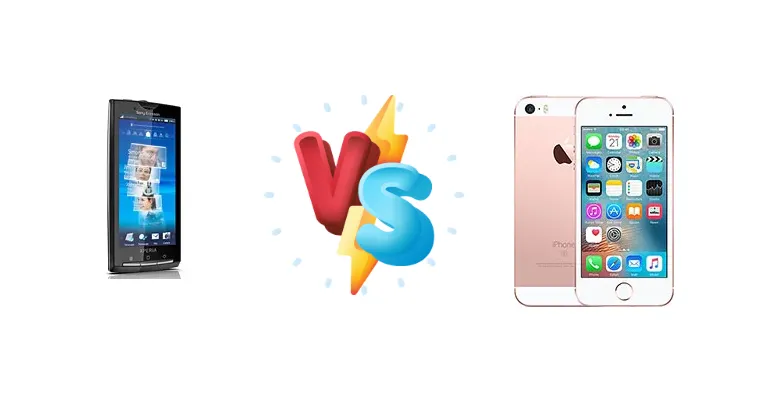
The Sony Ericsson Xperia X10 represented a bold step for Android in 2010, while the iPhone SE (2016) offered a powerful, compact iOS experience. This comparison dives into how these two devices stack up today, considering their original strengths and current limitations.
🏆 Quick Verdict
The iPhone SE decisively wins this comparison. While the Xperia X10 holds nostalgic appeal, the iPhone SE's superior performance, camera, and battery life make it the more practical and capable device, even by today's standards. The SE's iOS ecosystem is also a significant advantage.
| Network |
|---|
| 2G bands | GSM 850 / 900 / 1800 / 1900 | GSM 850 / 900 / 1800 / 1900 - A1662, A1723 |
| 3G bands | HSDPA 900 / 1700 / 2100 | HSDPA 800 / 850 / 900 / 1700(AWS) / 1900 / 2100 - A1662, A1723 |
| 4G bands | - | 1, 2, 3, 4, 5, 8, 12, 13, 17, 18, 19, 20, 25, 26, 29 - A1662 |
| Speed | HSPA 7.2/2 Mbps | HSPA, LTE Cat4 150/50 Mbps |
| Technology | GSM / HSPA | GSM / CDMA / HSPA / EVDO / LTE |
| | HSDPA 850 / 1900 / 2100 / 800 - X10a for Americas | 1, 2, 3, 4, 5, 7, 8, 12, 17, 18, 19, 20, 25, 26, 28, 38, 39, 40, 41 - A1723 |
| Launch |
|---|
| Announced | 2009, November. Released 2010, March | 2016, March 21. Released 2016, March 31 |
| Status | Discontinued | Discontinued |
| Body |
|---|
| Build | - | Glass front (Corning-made glass), aluminum back, aluminum frame |
| Dimensions | 119 x 63 x 13 mm (4.69 x 2.48 x 0.51 in) | 123.8 x 58.6 x 7.6 mm (4.87 x 2.31 x 0.30 in) |
| SIM | Mini-SIM | Nano-SIM |
| Weight | 135 g (4.76 oz) | 113 g (3.99 oz) |
| | - | Apple Pay (Visa, MasterCard, AMEX certified) |
| Display |
|---|
| Protection | Scratch-resistant glass | - |
| Resolution | 480 x 854 pixels, 16:9 ratio (~245 ppi density) | 640 x 1136 pixels, 16:9 ratio (~326 ppi density) |
| Size | 4.0 inches, 44.1 cm2 (~58.8% screen-to-body ratio) | 4.0 inches, 44.1 cm2 (~60.8% screen-to-body ratio) |
| Type | TFT, 65K colors | IPS LCD |
| | Timescape/Mediascape UI | - |
| Platform |
|---|
| CPU | 1.0 GHz Scorpion | Dual-core 1.84 GHz Twister |
| Chipset | Qualcomm QSD8250 Snapdragon S1 | Apple A9 (14 nm) |
| GPU | Adreno 200 | PowerVR GT7600 (six-core graphics) |
| OS | Android 1.6 (Donut), upgradable to 2.3 (Gingerbread) | iOS 9.3.2, upgradable to iOS 15.8.5 |
| Memory |
|---|
| Card slot | microSDHC (dedicated slot), 8 GB included | No |
| Internal | 1GB 384MB RAM | 16GB 2GB RAM, 32GB 2GB RAM, 64GB 2GB RAM, 128GB 2GB RAM |
| | - | NVMe |
| Main Camera |
|---|
| Features | LED flash | Dual-LED dual-tone flash, HDR |
| Single | 8 MP, AF | 12 MP, f/2.2, 29mm (standard), 1/3.0", 1.22µm, PDAF |
| Video | w480p@30fps, 720p@30fps (via SW update) | 4K@30fps, 1080p@30/60fps, 1080p@120fps, 720p@240fps |
| Selfie camera |
|---|
| Features | - | Face detection, HDR, panorama |
| Single | - | 1.2 MP, f/2.4, 31mm (standard) |
| Video | - | 720p@30fps |
| | No | - |
| Sound |
|---|
| 3.5mm jack | Yes | Yes |
| 35mm jack | Yes | Yes |
| Loudspeaker | Yes | Yes |
| | - | 16-bit/44.1kHz audio
|
| Comms |
|---|
| Bluetooth | 2.1, A2DP | 4.2, A2DP, LE |
| NFC | - | Yes (Apple Pay only) |
| Positioning | GPS, A-GPS | GPS, GLONASS |
| Radio | No | No |
| USB | microUSB 2.0 | Lightning, USB 2.0 |
| WLAN | Wi-Fi 802.11 b/g, DLNA, hotspot | Wi-Fi 802.11 a/b/g/n/ac, hotspot |
| Features |
|---|
| Browser | HTML, Adobe Flash | - |
| Sensors | Accelerometer, proximity, compass | Fingerprint (front-mounted), accelerometer, gyro, proximity, compass |
| Battery |
|---|
| Stand-by | Up to 415 h (2G) / Up to 425 h (3G) | Up to 240 h (3G) |
| Talk time | Up to 10 h (2G) / Up to 8 h (3G) | Up to 14 h (3G) |
| Type | Removable Li-Po 1500 mAh battery (BST-41) | Li-Po 1624 mAh, non-removable (6.21 Wh) |
| Misc |
|---|
| Colors | Sensous Black, Luster White | Space Gray, Silver, Gold, Rose Gold |
| Models | - | A1662, A1723, A1724, iPhone8,4 |
| Price | About 120 EUR | About 140 EUR |
| SAR | 0.87 W/kg (head) 0.81 W/kg (body) | 1.17 W/kg (head) 1.19 W/kg (body) |
| SAR EU | 1.25 W/kg (head) | 0.72 W/kg (head) 0.97 W/kg (body) |
| Tests |
|---|
| Audio quality |
Noise -85.4dB / Crosstalk -83.6dB |
Noise -93.0dB / Crosstalk -72.9dB |
| Battery life | - |
Endurance rating 73h
|
| Camera |
Photo / Video |
Photo / Video |
| Display | - |
Contrast ratio: 804:1 (nominal), 3.681 (sunlight) |
| Loudspeaker |
Voice 66dB / Noise 66dB / Ring 68dB
|
Voice 66dB / Noise 65dB / Ring 69dB
|
| Performance | - |
Basemark OS II 2.0: 2163 |
Sony Ericsson Xperia X10
- Nostalgic Android experience
- Unique design for its time
- Expandable storage (MicroSD)
- Outdated performance
- Poor camera quality
- Short battery life
- Limited app support
Apple iPhone SE
- Powerful performance (A9 chip)
- Excellent camera
- Long battery life
- Access to iOS ecosystem
- Compact size
- Small screen by modern standards
- Limited storage options (depending on model)
- Older iOS version (depending on model)
Display Comparison
The iPhone SE's 4.0-inch Retina display offered significantly better clarity and color accuracy than the Xperia X10's 4.0-inch Reality Display. While both had similar resolutions, Apple's display technology was noticeably superior. The iPhone SE also had better outdoor visibility.
Camera Comparison
The iPhone SE's camera, while not top-tier by today's standards, was considerably better than the Xperia X10's. The iPhone SE captured more detail, had better dynamic range, and produced more accurate colors. The X10's camera struggled in low light.
Performance
The iPhone SE's Apple A9 chip and dual-core 1.84 GHz Twister CPU utterly outpaced the Xperia X10's Qualcomm QSD8250 Snapdragon S1 and 1.0 GHz Scorpion CPU. Apps launched faster, multitasking was smoother, and the iPhone SE handled demanding tasks with ease. The X10's performance feels sluggish by modern standards.
Battery Life
The iPhone SE boasted a significantly better battery life, with an endurance rating of 73 hours. The Xperia X10's battery life was considerably shorter, requiring more frequent charging.
Buying Guide
Who should buy the Sony Ericsson Xperia X10? Primarily collectors or those seeking a nostalgic Android experience. Who should buy the Apple iPhone SE? Users wanting a compact, powerful phone with excellent performance, a great camera, and access to the iOS ecosystem, especially those on a budget.
Frequently Asked Questions
❓ Is the Xperia X10 still usable in 2024?
While technically possible, the Xperia X10's outdated hardware and software make it a frustrating experience. App compatibility is limited, and performance is slow.
❓ Why was the iPhone SE so popular?
The iPhone SE offered flagship-level performance in a compact and affordable package, appealing to users who didn't want a large phone or a high price tag.
❓ Can I find apps for the Xperia X10?
Finding compatible apps for the Xperia X10 is increasingly difficult. Many modern apps are not optimized for its older Android version.