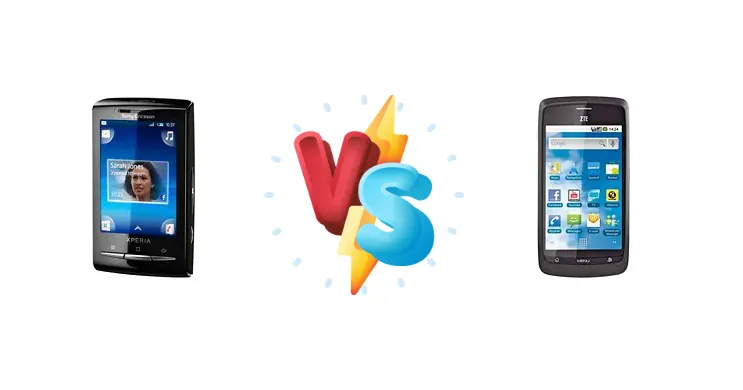
Remember the days of smaller screens and simpler smartphones? The Sony Ericsson Xperia X10 mini and ZTE Blade represent that era. Both were budget-friendly options, but which one held up better? Let's dive into a detailed comparison to see which phone reigns supreme in this nostalgic battle.
🏆 Quick Verdict
The ZTE Blade edges out the Xperia X10 mini due to slightly better overall build quality and potentially more readily available software updates during its lifespan. Both offer a similar experience, but the Blade's subtle advantages make it the marginally better choice for those seeking a retro smartphone.
| Network |
|---|
| 2G bands | GSM 850 / 900 / 1800 / 1900 | GSM 900 / 1800 / 1900 |
| 3G bands | HSDPA 900 / 2100 - E10i | HSDPA 900 / 2100 |
| Speed | HSPA 7.2/2 Mbps | HSPA 7.2/5.76 Mbps |
| Technology | GSM / HSPA | GSM / HSPA |
| | HSDPA 850 / 1900 / 2100 - E10a | - |
| Launch |
|---|
| Announced | 2010, February. Released 2010, May | 2010, October. Released 2010, November |
| Status | Discontinued | Discontinued |
| Body |
|---|
| Dimensions | 83 x 50 x 16 mm (3.27 x 1.97 x 0.63 in) | 116 x 56.5 x 11.8 mm (4.57 x 2.22 x 0.46 in) |
| SIM | Mini-SIM | Mini-SIM |
| Weight | 88 g (3.10 oz) | 110 g (3.88 oz) |
| Display |
|---|
| Protection | Scratch-resistant glass | - |
| Resolution | 240 x 320 pixels, 4:3 ratio (~157 ppi density) | 480 x 800 pixels, 5:3 ratio (~267 ppi density) |
| Size | 2.55 inches, 20.1 cm2 (~48.5% screen-to-body ratio) | 3.5 inches, 34.9 cm2 (~53.2% screen-to-body ratio) |
| Type | TFT (65K effective) | AMOLED or LCD, 256K colors |
| | Timescape UI | - |
| Platform |
|---|
| CPU | 600 MHz ARM 11 | 600 MHz ARM 11 |
| Chipset | Qualcomm MSM7227 Snapdragon S1 | Qualcomm MSM7227 Snapdragon S1 |
| GPU | Adreno 200 | Adreno 200 |
| OS | Android 1.6 (Donut), upgradable to 2.1 (Eclair) | Android 2.1 (Eclair), upgradable to 2.2 (Froyo) |
| Memory |
|---|
| Card slot | microSDHC (dedicated slot), 2 GB included | microSDHC (dedicated slot), 2 GB included |
| Internal | 128MB | 512MB RAM, 512MB |
| Main Camera |
|---|
| Features | LED flash | - |
| Single | 5 MP, AF | 3.15 MP, AF |
| Video | 480p@30fps | Yes |
| Sound |
|---|
| 3.5mm jack | Yes | Yes |
| 35mm jack | Yes | Yes |
| Loudspeaker | Yes | Yes |
| Comms |
|---|
| Bluetooth | 2.0, A2DP, EDR | 2.1, A2DP, EDR |
| Positioning | GPS, A-GPS | GPS, A-GPS |
| Radio | Stereo FM radio, RDS | Stereo FM radio, RDS |
| USB | microUSB 2.0 | microUSB 2.0 |
| WLAN | Wi-Fi 802.11 b/g, hotspot (v2.2 or higher) | Wi-Fi 802.11 b/g, hotspot (Android 2.2) |
| Features |
|---|
| Browser | HTML | WAP 2.0/xHTML, HTML |
| Sensors | Accelerometer, proximity, compass | Accelerometer, proximity, compass |
| | ANT+
MP4/H.264/WMV player
MP3/eAAC+/WMA/WAV player
TrackID music recognition
Document viewer
Voice memo
Predictive text input | MP4/H.264 player
MP3/WAV/eAAC+ player
Organizer
Voice memo
Predictive text input |
| Battery |
|---|
| Stand-by | Up to 285 h (2G) / Up to 360 h (3G) | Up to 192 h |
| Talk time | Up to 4 h (2G) / Up to 3 h 30 min (3G) | Up to 4 h |
| Type | Non-removable Li-Po 950 mAh battery | Removable Li-Ion 1250 mAh battery |
| Misc |
|---|
| Colors | Gold, Pearl White, Black, Pink, Lime, Red, Silver | Black |
| Price | About 70 EUR | About 170 EUR |
| SAR EU | 1.17 W/kg (head) | - |
| Tests |
|---|
| Audio quality |
Noise -86.5dB / Crosstalk -83.8dB | - |
| Camera |
Photo | - |
| Loudspeaker |
Voice 65dB / Noise 66dB / Ring 67dB | - |
Sony Ericsson Xperia X10 mini
- Compact size
- Classic Sony Ericsson design
- Potentially slightly better display color
- Limited battery life
- Lower RAM
- Outdated software
- Poor camera quality
ZTE Blade
- Slightly better battery life
- Potentially more robust build
- Slightly better RAM management
- Basic design
- Outdated software
- Poor camera quality
- Small screen
Display Comparison
Both phones featured relatively small displays for their time – the Xperia X10 mini had a 2.9-inch screen, and the ZTE Blade a 3.0-inch screen. Resolution was low by modern standards, but acceptable for the era. The Xperia X10 mini's screen might have had slightly better color reproduction due to Sony's historical expertise in displays, but the difference would be minimal.
Camera Comparison
The Xperia X10 mini had a 3.15MP camera, while the ZTE Blade featured a 3.2MP camera. Both were primarily for basic photo capture. Image quality was generally poor by modern standards, with limited dynamic range and noticeable noise. The Xperia X10 mini's camera software might have offered slightly more features, but the hardware differences were minimal.
Performance
Both devices share the same Qualcomm MSM7227 Snapdragon S1 chipset and a 600 MHz ARM 11 CPU. Performance will be very similar – expect sluggishness by today's standards. Basic tasks like calling, texting, and light web browsing are manageable, but demanding apps or multitasking will be a struggle. The Blade might have slightly better RAM management, potentially leading to marginally smoother performance.
Battery Life
The Xperia X10 mini typically had a 800mAh battery, while the ZTE Blade had a 1100mAh battery. This gives the ZTE Blade a clear advantage in terms of battery life. Expect significantly longer usage times on the Blade, especially considering the similar processing power.
Buying Guide
The Sony Ericsson Xperia X10 mini is for dedicated collectors of vintage Sony Ericsson devices or those seeking a very compact phone for basic tasks. The ZTE Blade is for those wanting a slightly more robust and potentially longer-supported retro smartphone experience, still prioritizing affordability.
Frequently Asked Questions
❓ Are these phones still usable in 2024?
Yes, but with significant limitations. Network compatibility and app support are major concerns. They are best suited for very basic tasks or as collector's items.
❓ Can I find software updates for either of these phones?
Officially, no. Both phones are long past their end-of-life. Custom ROMs might be available for advanced users, but are not guaranteed.