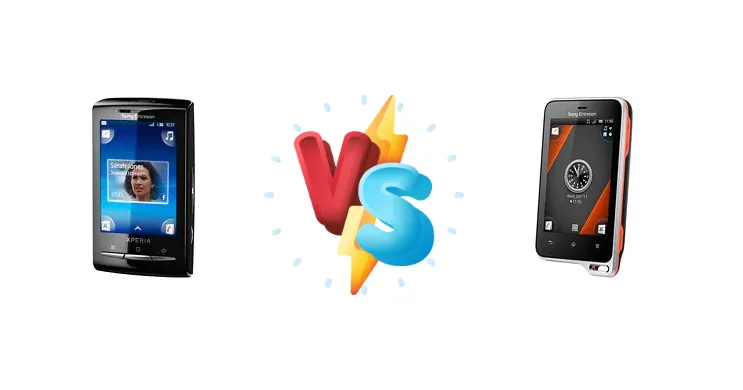
Remember the era of ultra-compact smartphones? The Sony Ericsson Xperia X10 mini and Xperia active represent that time. Both were designed for users prioritizing portability, but which one held up better? Let's dive into a detailed comparison to see which phone reigns supreme.
🏆 Quick Verdict
The Xperia active emerges as the clear winner. Its faster processor, improved camera capabilities (including video recording), and slightly better battery life provide a more modern and usable experience, despite both phones being quite dated now. The X10 mini was a solid choice for its time, but the active offers more.
| Network |
|---|
| 2G bands | GSM 850 / 900 / 1800 / 1900 | GSM 850 / 900 / 1800 / 1900 |
| 3G bands | HSDPA 900 / 2100 - E10i | HSDPA 900 / 2100 |
| EDGE | - | No |
| GPRS | - | Yes |
| Speed | HSPA 7.2/2 Mbps | HSPA 7.2/5.76 Mbps |
| Technology | GSM / HSPA | GSM / HSPA |
| | HSDPA 850 / 1900 / 2100 - E10a | HSDPA 1900 / 2100 / 800 |
| Launch |
|---|
| Announced | 2010, February. Released 2010, May | 2011, June. Released 2011, October |
| Status | Discontinued | Discontinued |
| Body |
|---|
| Dimensions | 83 x 50 x 16 mm (3.27 x 1.97 x 0.63 in) | 92 x 55 x 16.5 mm (3.62 x 2.17 x 0.65 in) |
| SIM | Mini-SIM | Mini-SIM |
| Weight | 88 g (3.10 oz) | 110.8 g (3.88 oz) |
| | - | IP67 dust/water resistant (up to 1m for 30 min)
Flashlight |
| Display |
|---|
| Protection | Scratch-resistant glass | Scratch-resistant glass |
| Resolution | 240 x 320 pixels, 4:3 ratio (~157 ppi density) | 320 x 480 pixels, 3:2 ratio (~192 ppi density) |
| Size | 2.55 inches, 20.1 cm2 (~48.5% screen-to-body ratio) | 3.0 inches, 26.8 cm2 (~53.0% screen-to-body ratio) |
| Type | TFT (65K effective) | LED-backlit LCD, |
| | Timescape UI | Touch sensitive controls |
| Platform |
|---|
| CPU | 600 MHz ARM 11 | 1.0 GHz Scorpion |
| Chipset | Qualcomm MSM7227 Snapdragon S1 | Qualcomm MSM8255 Snapdragon S2 |
| GPU | Adreno 200 | Adreno 205 |
| OS | Android 1.6 (Donut), upgradable to 2.1 (Eclair) | Android 2.3 (Gingerbread), upgradable to 4.0 (Ice Cream Sandwich) |
| Memory |
|---|
| Call records | - | Yes |
| Card slot | microSDHC (dedicated slot), 2 GB included | microSDHC (dedicated slot), 2 GB included |
| Internal | 128MB | 1GB (320MB user available), 512MB RAM |
| Phonebook | - | Yes, up to 500 entries |
| Main Camera |
|---|
| Features | LED flash | LED flash |
| Single | 5 MP, AF | 5 MP, AF |
| Video | 480p@30fps | 720p |
| Sound |
|---|
| 3.5mm jack | Yes | Yes |
| 35mm jack | Yes | Yes |
| Alert types | - | Vibration; Polyphonic, MP3, WAV ringtones |
| Loudspeaker | Yes | Yes |
| Comms |
|---|
| Bluetooth | 2.0, A2DP, EDR | 2.1, A2DP, EDR |
| Positioning | GPS, A-GPS | GPS, A-GPS |
| Radio | Stereo FM radio, RDS | Stereo FM radio, RDS |
| USB | microUSB 2.0 | microUSB 2.0 |
| WLAN | Wi-Fi 802.11 b/g, hotspot (v2.2 or higher) | Wi-Fi 802.11 b/g/n, DLNA, hotspot |
| Features |
|---|
| Browser | HTML | HTML, Adobe Flash |
| Games | - | Yes |
| Java | - | No |
| Messaging | - | SMS |
| Sensors | Accelerometer, proximity, compass | Accelerometer, proximity, compass |
| | ANT+
MP4/H.264/WMV player
MP3/eAAC+/WMA/WAV player
TrackID music recognition
Document viewer
Voice memo
Predictive text input | ANT+
MP4/H.264 player
MP3/eAAC+/WAV player
TrackID music recognition
Document viewer
Voice memo
Predictive text input |
| Battery |
|---|
| Music play | - | Up to 25 h |
| Stand-by | Up to 285 h (2G) / Up to 360 h (3G) | Up to 351 h (2G) / Up to 335 h (3G) |
| Talk time | Up to 4 h (2G) / Up to 3 h 30 min (3G) | Up to 4 h 53 min (2G) / Up to 5 h 31 min (3G) |
| Type | Non-removable Li-Po 950 mAh battery | Removable Li-Ion 1200 mAh battery |
| Misc |
|---|
| Colors | Gold, Pearl White, Black, Pink, Lime, Red, Silver | Orange/Black, White/Black |
| Price | About 70 EUR | About 170 EUR |
| SAR | - | 1.12 W/kg (head) 1.07 W/kg (body) |
| SAR EU | 1.17 W/kg (head) | - |
| Tests |
|---|
| Audio quality |
Noise -86.5dB / Crosstalk -83.8dB |
Noise -89.5dB / Crosstalk -91.4dB |
| Camera |
Photo |
Photo / Video |
| Loudspeaker |
Voice 65dB / Noise 66dB / Ring 67dB |
Voice 70dB / Noise 64dB / Ring 68dB
|
Sony Ericsson Xperia X10 mini
- Extremely compact
- Lightweight
- Classic Sony Ericsson design
- Slow performance
- Limited functionality (no video recording)
- Low-resolution display
- Outdated software
Sony Ericsson Xperia active
- Faster processor
- Video recording capability
- Slightly larger display
- More responsive
- Still quite dated
- Low-resolution display
- Resistive touchscreen
- Limited app support
Display Comparison
The Xperia active boasts a slightly larger 3.5-inch display compared to the X10 mini's 2.9-inch screen. While both are relatively low resolution by today's standards, the active's larger size offers a marginally better viewing experience. Both used resistive touchscreens, which are less responsive than modern capacitive displays.
Camera Comparison
The Xperia active's camera is a clear winner, offering both photo and video recording capabilities. The X10 mini was limited to still photos only. While the image quality on both is basic, the ability to record video on the active adds significant value. Both cameras likely had around 3.2MP resolution.
Performance
The Xperia active's 1.0 GHz Scorpion processor significantly outperforms the X10 mini's 600 MHz ARM 11. This translates to snappier app loading, smoother multitasking (though limited), and a generally more responsive user interface on the active. The Snapdragon S2 chipset in the active is also more advanced than the S1 in the X10 mini.
Battery Life
The Xperia active generally offered slightly better battery life than the X10 mini, likely due to its more efficient processor and optimized software. While both had relatively small batteries (around 1200mAh), the active managed to squeeze a bit more usage time.
Buying Guide
The Xperia X10 mini might appeal to collectors or those seeking a truly tiny, nostalgic device. However, for anyone looking for a functional smartphone, even a basic one, the Xperia active is the better choice. Neither is recommended for modern use due to age and software limitations.
Frequently Asked Questions
❓ Are these phones still usable in 2024?
While technically usable, both phones are extremely outdated. Software support is non-existent, and app compatibility is severely limited. They are best suited for collectors or as novelty items.
❓ What operating system did these phones use?
Both phones ran Sony Ericsson's proprietary Android-based operating system, which was heavily customized and is now obsolete.