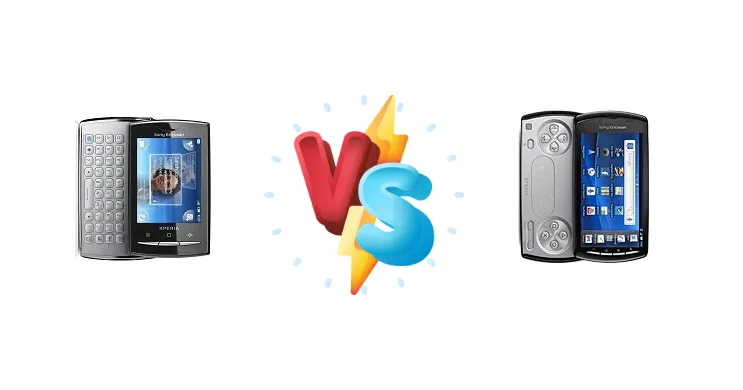
The Sony Ericsson Xperia X10 mini pro and Xperia PLAY represent a fascinating period in smartphone history, showcasing early attempts at compact design and gaming integration. Both devices hold a nostalgic appeal, but which one holds up better today? Let's dive into a detailed comparison to determine the ultimate winner.
🏆 Quick Verdict
The Xperia PLAY takes the crown thanks to its significantly faster processor, dedicated gaming controls, and slightly better overall performance. While the X10 mini pro boasts a more compact form factor, the PLAY's gaming capabilities and improved speed make it the more compelling choice for most users.
| Network |
|---|
| 2G bands | GSM 850 / 900 / 1800 / 1900 | GSM 850 / 900 / 1800 / 1900 |
| 3G bands | HSDPA 900 / 2100 | HSDPA 900 / 2100 |
| 4G bands | - | 2, 4, 5, 7, 12, 38, 66, 71 |
| Speed | HSPA 7.2/2 Mbps | HSPA 7.2/5.76 Mbps |
| Technology | GSM / HSPA | GSM / HSPA |
| | HSDPA 850 / 1900 / 2100 | HSDPA 850 / 1900 / 2100 / 800 |
| Launch |
|---|
| Announced | 2010, February. Released 2010, June | 2011, February. Released 2011, March |
| Status | Discontinued | Discontinued |
| Body |
|---|
| Dimensions | 90 x 52 x 17 mm (3.54 x 2.05 x 0.67 in) | 119 x 62 x 16 mm (4.69 x 2.44 x 0.63 in) |
| Keyboard | QWERTY | - |
| SIM | Mini-SIM | Mini-SIM |
| Weight | 120 g (4.23 oz) | 175 g (6.17 oz) |
| Display |
|---|
| Protection | Scratch-resistant glass | - |
| Resolution | 240 x 320 pixels, 4:3 ratio (~157 ppi density) | 480 x 854 pixels, 16:9 ratio (~245 ppi density) |
| Size | 2.55 inches, 20.1 cm2 (~43.0% screen-to-body ratio) | 4.0 inches, 44.1 cm2 (~59.8% screen-to-body ratio) |
| Type | TFT (65K effective) | LED-backlit LCD, |
| | Timescape UI | Touch-sensitive gaming controls
PSP like gaming buttons
Timescape UI |
| Platform |
|---|
| CPU | 600 MHz ARM 11 | 1.0 GHz Scorpion |
| Chipset | Qualcomm MSM7227 Snapdragon S1 | Qualcomm MSM8255 Snapdragon S2 |
| GPU | Adreno 200 | Adreno 205 |
| OS | Android 1.6 (Donut), upgradable to 2.1 (Eclair) | Android 2.3.4 (Gingerbread) |
| Memory |
|---|
| Card slot | microSDHC (dedicated slot), 2 GB included | microSDHC (dedicated slot), 8 GB included |
| Internal | 128MB | 400MB 512MB RAM |
| Main Camera |
|---|
| Features | LED flash | LED flash |
| Single | 5 MP, AF | 5 MP, AF |
| Video | 480p@30fps | 720p |
| Selfie camera |
|---|
| Features | - | LED flash |
| Single | - | VGA |
| | No | - |
| Sound |
|---|
| 3.5mm jack | Yes | Yes |
| 35mm jack | Yes | Yes |
| Loudspeaker | Yes | Yes, with stereo speakers |
| Comms |
|---|
| Bluetooth | 2.1, A2DP | 2.1, A2DP, EDR |
| NFC | - | No |
| Positioning | GPS, A-GPS | GPS, A-GPS, GLONASS |
| Radio | Stereo FM radio, RDS | No |
| USB | microUSB 2.0 | microUSB 2.0, OTG |
| WLAN | Wi-Fi 802.11 b/g, hotspot (v2.2 or higher) | Wi-Fi 802.11 b/g/n, DLNA, hotspot |
| Features |
|---|
| Browser | HTML | WAP 2.0/xHTML, HTML5, Adobe Flash |
| Sensors | Accelerometer, proximity, compass | Accelerometer, proximity, compass |
| | ANT+
MP4/H.264/WMV player
MP3/eAAC+/WMA/WAV player
TrackID music recognition
Document viewer
Voice memo
Predictive text input | Dedicated game store
MP4/H.264/WMV player
MP3/eAAC+/WMA/WAV player
Organizer
Document viewer/editor
Voice memo/dial/commands
Predictive text input (Swype) |
| Battery |
|---|
| Charging | - | 10W wired |
| Music play | - | Up to 31 h |
| Stand-by | Up to 285 h (2G) / Up to 360 h (3G) | Up to 425 h (2G) / Up to 413 h (3G) |
| Talk time | Up to 4 h (2G) / Up to 3 h 30 min (3G) | Up to 8 h 25 min (2G) / Up to 6 h 25 min (3G) |
| Type | Removable Li-Po 930 mAh battery | Removable Li-Ion 1500 mAh battery |
| Misc |
|---|
| Colors | Black, Red, Pink | Black, White, Stealth Blue (for Play 4G), Orange |
| Price | About 70 EUR | About 140 EUR |
| SAR EU | 1.61 W/kg (head) | 0.36 W/kg (head) |
| Tests |
|---|
| Audio quality |
Noise -86.8dB / Crosstalk -83.6dB |
Noise -89.6dB / Crosstalk -91.0dB |
| Camera |
Photo |
Photo |
| Loudspeaker |
Voice 66dB / Noise 66dB / Ring 75dB
|
Voice 66dB / Noise 62dB / Ring 79dB
|
Sony Ericsson Xperia X10 mini pro
- Extremely compact and pocketable
- Classic Sony Ericsson design
- Lightweight
- Slow performance
- Low-resolution display
- Basic camera
- Limited app support
Sony Ericsson Xperia PLAY
- Faster processor and better performance
- Dedicated gaming controls
- Larger display
- Improved gaming experience
- Larger size compared to X10 mini pro
- Battery life still limited
- Camera quality is basic
- App compatibility issues
Display Comparison
The X10 mini pro features a 2.55-inch QVGA display, while the Xperia PLAY has a 4.0-inch FWVGA display. The PLAY's larger screen offers a significantly better viewing experience, especially for gaming and media consumption. Resolution and color accuracy are both limited by the age of the devices, but the PLAY's size advantage is undeniable.
Camera Comparison
Both devices feature a 'Photo' camera, implying basic camera functionality. Given the era, expect low resolution and limited features. Image quality is generally poor on both, but the PLAY's slightly better processing might yield marginally better results in ideal lighting conditions. Don't expect high-quality photos from either.
Performance
Here's where the Xperia PLAY truly shines. Its 1.0 GHz Scorpion CPU is a substantial upgrade over the X10 mini pro's 600 MHz ARM 11. The Snapdragon S2 chipset in the PLAY provides noticeably smoother performance, especially when running apps or playing games. The X10 mini pro can feel sluggish by modern standards.
Battery Life
The X10 mini pro likely has a smaller battery due to its compact size, potentially offering shorter battery life. The Xperia PLAY, with its 10W wired charging and larger battery (estimated around 1500mAh), should provide longer usage between charges, although both will struggle to compete with modern battery life.
Buying Guide
The Xperia X10 mini pro is ideal for those prioritizing extreme portability and a classic, minimalist design. It's a good choice for basic communication and light usage. The Xperia PLAY is for retro gaming enthusiasts and users who appreciate a more powerful processor and dedicated gaming controls, even with the compromises of an older device.
Frequently Asked Questions
❓ Are these phones still usable in 2024?
Yes, but with significant limitations. App compatibility is a major issue, and performance will be slow compared to modern smartphones. They are best suited for nostalgia or very basic tasks.
❓ Can I install Android on either of these devices?
Custom ROMs exist for both devices, but the process is complex and requires technical expertise. Success is not guaranteed, and you may encounter bugs or instability.