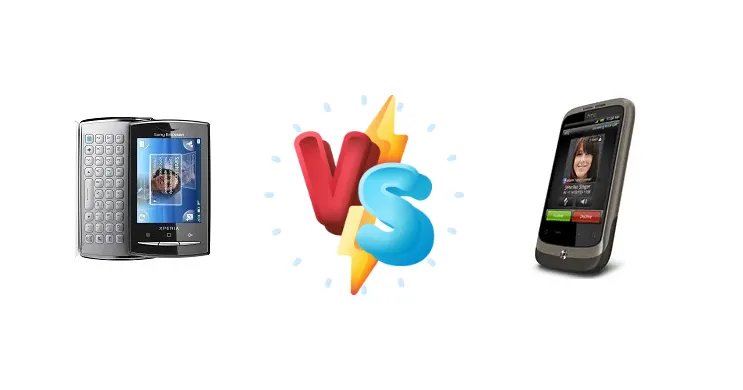
The Sony Ericsson Xperia X10 mini pro and HTC Wildfire were popular budget Android phones vying for attention in a crowded market. Both offered a taste of Android on a smaller scale, but which one delivered the better experience? Let's dive into a detailed comparison to help you decide which was the better choice back then.
🏆 Quick Verdict
The Xperia X10 mini pro edges out the Wildfire thanks to its slightly faster processor and more robust chipset. While both are dated, the X10 mini pro's Snapdragon S1 offered a marginal performance advantage, making it the slightly better option for the time.
| Network |
|---|
| 2G bands | GSM 850 / 900 / 1800 / 1900 | GSM 850 / 900 / 1800 / 1900 |
| 3G bands | HSDPA 900 / 2100 | HSDPA 900 / 2100 |
| Speed | HSPA 7.2/2 Mbps | HSPA 7.2/0.384 Mbps |
| Technology | GSM / HSPA | GSM / HSPA |
| | HSDPA 850 / 1900 / 2100 | - |
| Launch |
|---|
| Announced | 2010, February. Released 2010, June | 2010, May. Released 2010, May |
| Status | Discontinued | Discontinued |
| Body |
|---|
| Dimensions | 90 x 52 x 17 mm (3.54 x 2.05 x 0.67 in) | 106.8 x 60.4 x 12 mm (4.20 x 2.38 x 0.47 in) |
| Keyboard | QWERTY | - |
| SIM | Mini-SIM | Mini-SIM |
| Weight | 120 g (4.23 oz) | 118 g (4.16 oz) |
| | - | Optical trackpad |
| Display |
|---|
| Protection | Scratch-resistant glass | Corning Gorilla Glass |
| Resolution | 240 x 320 pixels, 4:3 ratio (~157 ppi density) | 240 x 320 pixels, 4:3 ratio (~125 ppi density) |
| Size | 2.55 inches, 20.1 cm2 (~43.0% screen-to-body ratio) | 3.2 inches, 31.7 cm2 (~49.2% screen-to-body ratio) |
| Type | TFT (65K effective) | TFT |
| | Timescape UI | - |
| Platform |
|---|
| CPU | 600 MHz ARM 11 | 528 MHz ARM 11 |
| Chipset | Qualcomm MSM7227 Snapdragon S1 | Qualcomm MSM7225 Snapdragon S1 |
| GPU | Adreno 200 | No |
| OS | Android 1.6 (Donut), upgradable to 2.1 (Eclair) | Android 2.1 (Eclair), upgradable to 2.2 (Froyo), Sense UI |
| Memory |
|---|
| Card slot | microSDHC (dedicated slot), 2 GB included | microSDHC (dedicated slot) |
| Internal | 128MB | 384MB RAM; 512MB |
| Main Camera |
|---|
| Features | LED flash | LED flash |
| Single | 5 MP, AF | 5 MP, AF |
| Video | 480p@30fps | Yes |
| Sound |
|---|
| 3.5mm jack | Yes | Yes |
| 35mm jack | Yes | Yes |
| Loudspeaker | Yes | Yes |
| Comms |
|---|
| Bluetooth | 2.1, A2DP | 2.1, A2DP |
| Positioning | GPS, A-GPS | GPS, A-GPS |
| Radio | Stereo FM radio, RDS | Stereo FM radio, RDS |
| USB | microUSB 2.0 | microUSB 2.0 |
| WLAN | Wi-Fi 802.11 b/g, hotspot (v2.2 or higher) | Wi-Fi 802.11 b/g, hotspot (Android 2.2) |
| Features |
|---|
| Browser | HTML | HTML |
| Sensors | Accelerometer, proximity, compass | Accelerometer, proximity, compass |
| | ANT+
MP4/H.264/WMV player
MP3/eAAC+/WMA/WAV player
TrackID music recognition
Document viewer
Voice memo
Predictive text input | MP3/AAC+/WAV/WMA9 player
MP4/H.264/WMV9 player
Voice memo
Predictive text input |
| Battery |
|---|
| Stand-by | Up to 285 h (2G) / Up to 360 h (3G) | Up to 480 h (2G) / Up to 690 h (3G) |
| Talk time | Up to 4 h (2G) / Up to 3 h 30 min (3G) | Up to 7 h 20 min (2G) / Up to 8 h 10 min (3G) |
| Type | Removable Li-Po 930 mAh battery | Removable Li-Ion 1300 mAh battery |
| Misc |
|---|
| Colors | Black, Red, Pink | Black, Brown, White, Red, Silver |
| Price | About 70 EUR | About 90 EUR |
| SAR | - | 1.15 W/kg (head) 1.13 W/kg (body) |
| SAR EU | 1.61 W/kg (head) | - |
| Tests |
|---|
| Audio quality |
Noise -86.8dB / Crosstalk -83.6dB |
Noise -84.8dB / Crosstalk -84.8dB |
| Camera |
Photo | - |
| Loudspeaker |
Voice 66dB / Noise 66dB / Ring 75dB
|
Voice 74dB / Noise 66dB / Ring 75dB |
Sony Ericsson Xperia X10 mini pro
- Slightly faster processor
- More robust chipset (Snapdragon S1)
- Better battery life
- Compact form factor
- Low-resolution display
- Basic camera
- Limited storage
HTC Wildfire
- Slightly larger screen
- Affordable price point
- Compact design
- Slower processor
- Less robust chipset
- Shorter battery life
- Low-resolution display
Display Comparison
Both phones featured relatively small displays – the X10 mini pro with a 2.9-inch screen and the Wildfire with a 3.2-inch screen. Resolution was similar, around QVGA, resulting in a pixelated appearance by today's standards. Neither display was particularly bright or vibrant, typical for budget phones of that era. The Wildfire's slightly larger screen offered a marginally better viewing experience, but the difference was minimal.
Camera Comparison
Both phones featured basic cameras, primarily intended for quick snapshots. The Xperia X10 mini pro had a 3.15MP camera, while the Wildfire had a 3.2MP camera. Image quality was generally poor, with limited detail and noticeable noise, especially in low-light conditions. Neither phone offered advanced camera features.
Performance
The Xperia X10 mini pro boasted a 600 MHz ARM 11 processor paired with a Qualcomm MSM7227 Snapdragon S1 chipset, while the Wildfire had a 528 MHz ARM 11 processor and a Qualcomm MSM7225 Snapdragon S1 chipset. The X10 mini pro's slightly faster processor and more advanced chipset generally resulted in smoother multitasking and app loading times. However, both phones struggled with demanding apps and games.
Battery Life
Battery life was a crucial factor for these devices. The Xperia X10 mini pro typically offered around 8 hours of talk time and 400 hours of standby time, while the HTC Wildfire offered around 6 hours of talk time and 300 hours of standby time. The X10 mini pro generally provided slightly better battery performance.
Buying Guide
The Sony Ericsson Xperia X10 mini pro was ideal for users prioritizing a compact form factor and a slightly more responsive experience. The HTC Wildfire appealed to those seeking a very affordable entry point into the Android ecosystem, prioritizing affordability over raw power.
Frequently Asked Questions
❓ Which phone was released first?
The HTC Wildfire was released slightly earlier than the Sony Ericsson Xperia X10 mini pro.
❓ Are these phones still usable today?
While technically usable, both phones are extremely outdated and will struggle with modern apps and operating systems. They are not recommended for everyday use.