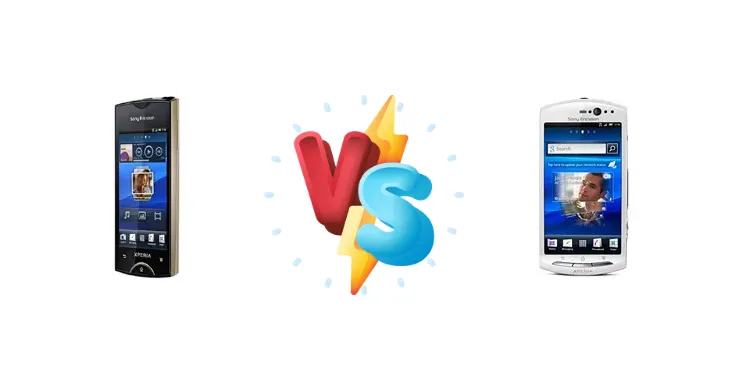
Reliving the golden age of Sony Ericsson, the Xperia Ray and Neo V offer a glimpse into a simpler era of smartphones. Both devices packed decent features for their time, but which one holds up better today? This comparison dives deep into their specs and performance to help you decide.
🏆 Quick Verdict
The Xperia Neo V edges out the Ray thanks to its significantly better display contrast and impressive battery life. While both share the same chipset and CPU, the Neo V's overall package provides a more enjoyable user experience, especially considering its longevity.
| Network |
|---|
| 2G bands | GSM 850 / 900 / 1800 / 1900 | GSM 850 / 900 / 1800 / 1900 |
| 3G bands | HSDPA 900 / 2100 - ST18i | HSDPA 900 / 2100 - MT11i |
| 4G bands | 1, 2, 3, 4, 5, 6, 7, 8, 9, 18, 19, 20, 26, 34, 38, 39, 40, 41 - International | - |
| 5G bands | 1, 3, 38, 41, 77, 78, 79 SA/NSA - International | - |
| EDGE | - | No |
| GPRS | - | Class 10 |
| Speed | HSPA 7.2/5.76 Mbps | HSPA 7.2/5.76 Mbps |
| Technology | GSM / HSPA | GSM / HSPA |
| | HSDPA 850 / 1900 / 2100 - ST18a | HSDPA 850 / 1900 / 2100 - MT11a |
| Launch |
|---|
| Announced | 2011, June. Released 2011, August | 2011, August. Released 2011, October |
| Status | Discontinued | Discontinued |
| Body |
|---|
| Dimensions | 111 x 53 x 9.4 mm (4.37 x 2.09 x 0.37 in) | 116 x 57 x 13 mm (4.57 x 2.24 x 0.51 in) |
| Keyboard | - | QWERTY |
| SIM | Mini-SIM | Mini-SIM |
| Weight | 100 g (3.53 oz) | 126 g (4.44 oz) |
| Display |
|---|
| Protection | Scratch-resistant glass | Scratch-resistant glass |
| Resolution | 480 x 854 pixels, 16:9 ratio (~297 ppi density) | 480 x 854 pixels, 16:9 ratio (~265 ppi density) |
| Size | 3.3 inches, 30.0 cm2 (~51.0% screen-to-body ratio) | 3.7 inches, 37.7 cm2 (~57.1% screen-to-body ratio) |
| Type | LED-backlit LCD, | LED-backlit LCD, |
| | Touch sensitive controls | - |
| Platform |
|---|
| CPU | 1.0 GHz Scorpion | 1.0 GHz Scorpion |
| Chipset | Qualcomm MSM8255 Snapdragon S2 | Qualcomm MSM8255 Snapdragon S2 |
| GPU | Adreno 205 | Adreno 205 |
| OS | Android 2.3 (Gingerbread), upgradable to 4.0.4 (Ice Cream Sandwich) | Android 2.3.4 (Gingerbread), upgradable to 4.0 (Ice Cream Sandwich) |
| Memory |
|---|
| Call records | - | Yes |
| Card slot | microSDHC (dedicated slot), 4 GB included | microSDHC (dedicated slot), 2 GB included |
| Internal | 1GB (300MB user available), 512MB RAM | 1GB (320MB user available), 512MB RAM |
| Phonebook | - | Yes, Photocall |
| Main Camera |
|---|
| Features | LED flash | LED flash, panorama |
| Quad | 40 MP, f/1.8, 27mm (wide), 1/1.7", PDAF
8 MP, f/3.4, 125mm (Periscope telephoto), PDAF, OIS, 5x optical zoom
8 MP, f/2.4, 17mm (ultrawide)
2 MP, (depth) | - |
| Single | 8 MP, AF | 5 MP, AF |
| Video | 720p | 720p@30fps |
| Selfie camera |
|---|
| Features | HDR | - |
| Single | VGA | VGA |
| Sound |
|---|
| 3.5mm jack | Yes | Yes |
| 35mm jack | Yes | Yes |
| Loudspeaker | Yes | Yes |
| Comms |
|---|
| Bluetooth | 2.1, A2DP, EDR | 2.1, A2DP, EDR |
| NFC | Yes | - |
| Positioning | GPS, A-GPS | GPS, A-GPS |
| Radio | Stereo FM radio, RDS | Stereo FM radio, RDS |
| USB | microUSB 2.0 | microUSB 2.0, OTG |
| WLAN | Wi-Fi 802.11 b/g/n, DLNA, hotspot | Wi-Fi 802.11 b/g/n, DLNA, hotspot |
| Features |
|---|
| Browser | HTML, Adobe Flash | No |
| Games | - | Yes |
| Java | - | No |
| Messaging | - | SMS, MMS |
| Sensors | Accelerometer, proximity, compass | Accelerometer, proximity, compass |
| | ANT+
MP4/H.264 player
MP3/WAV player
TrackID music recognition
SensMe
Document viewer
Voice memo
Predictive text input | ANT+
HDMI port
MP4/H.264/WMV player
MP3/WMA/WAV/eAAC+ player
TrackID music recognition
Organizer
Document viewer
Voice memo/dial/commands
Predictive text input (T9 Trace) |
| Battery |
|---|
| Charging | 40W wired
5W reverse wired | - |
| Music play | Up to 36 h | Up to 31 h |
| Stand-by | Up to 430 h (2G) / Up to 440 h (3G) | Up to 430 h (2G) / Up to 400 h (3G) |
| Talk time | Up to 6 h 50 min (2G) / Up to 7 h (3G) | Up to 6 h 55 min (2G) / Up to 7 h (3G) |
| Type | Removable Li-Ion 1500 mAh battery | Removable Li-Po 1500 mAh battery |
| Misc |
|---|
| Colors | Black, Gold, White, Pink | White, Blue Gradient, Silver |
| Models | BMH-AN10, BMH-AN20 | - |
| Price | About 170 EUR | About 150 EUR |
| SAR EU | 0.96 W/kg (head) | 1.10 W/kg (head) |
| Tests |
|---|
| Audio quality |
Noise -89.4dB / Crosstalk -91.3dB |
Noise -89.6dB / Crosstalk -80.9dB |
| Battery life | - |
Endurance rating 42h
|
| Camera |
Photo / Video |
Photo / Video |
| Display |
Contrast ratio: 1.955:1 (sunlight) |
Contrast ratio: 1578:1 (nominal) |
| Loudspeaker |
Voice 64dB / Noise 61dB / Ring 66dB
|
Voice 68dB / Noise 65dB / Ring 71dB
|
Sony Ericsson Xperia ray
- Compact design
- Potentially slightly better sunlight readability (though contrast is poor)
- Poor display contrast
- Below-average battery life
- Limited availability of spare parts
Sony Ericsson Xperia neo V
- Excellent display contrast
- Outstanding battery life
- More readily available spare parts (relatively)
- Slightly larger than the Ray
- Performance limited by older hardware
Display Comparison
The Xperia Neo V boasts a much higher contrast ratio (1578:1 nominal) compared to the Ray's 1.955:1 (sunlight). This translates to richer colors, deeper blacks, and better overall image quality on the Neo V. The Ray's sunlight readability is noted, but the Neo V's superior contrast makes it the clear winner in most viewing conditions. Both phones likely used similar LCD panels, but the Neo V's calibration was likely better.
Camera Comparison
Camera specifications are listed as 'Photo / Video' for both, indicating a similar level of photographic capability. Both likely featured 8MP cameras, but image quality would depend on Sony Ericsson's image processing algorithms. Expect decent daytime shots, but struggles in low light. The Neo V might have slightly better image processing due to later firmware updates.
Performance
Both phones are powered by the Qualcomm MSM8255 Snapdragon S2 chipset and a 1.0 GHz Scorpion CPU. Performance will be very similar, adequate for basic tasks and older Android games, but struggling with modern apps. Don't expect blazing speeds from either device.
Battery Life
The Xperia Neo V shines in this category with an endurance rating of 42 hours, significantly outperforming the Ray (no battery rating provided, but generally considered below average for the time). This extended battery life makes the Neo V a more practical choice for daily use.
Buying Guide
The Xperia Ray might appeal to those prioritizing a slightly more compact design. However, the Xperia Neo V is the better choice for most, offering a superior display and longer battery life, making it a more practical retro device.
Frequently Asked Questions
❓ Are these phones still worth buying?
They offer a nostalgic experience and can be fun to tinker with, but don't expect modern smartphone functionality. The Neo V is generally the better choice due to its superior display and battery.
❓ What operating system did these phones run?
Both phones originally shipped with Android 2.3 (Gingerbread), with the Neo V receiving an update to Android 4.0 (Ice Cream Sandwich).