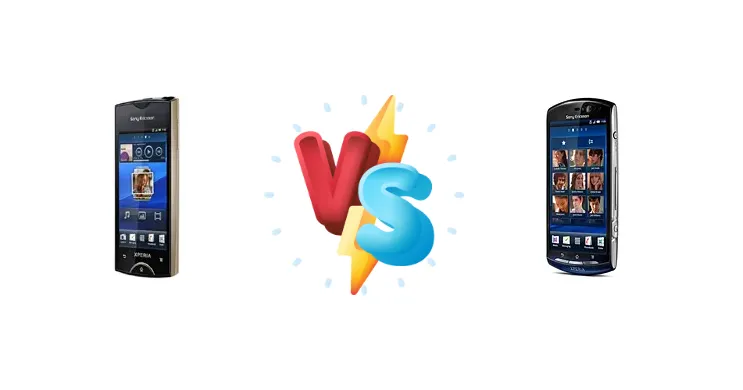
The Sony Ericsson Xperia Ray and Neo were popular Android smartphones from a bygone era. Both offered a taste of Sony's design and technology, but catered to slightly different users. This comparison dives deep into their features to help you understand which phone was the better choice back then, and what their legacies are today.
🏆 Quick Verdict
The Xperia Neo edges out the Ray thanks to its significantly superior display contrast. While both share the same processor, the Neo's screen makes a noticeable difference in viewing experience. Both are dated now, but the Neo offers a slightly more enjoyable experience overall.
| Network |
|---|
| 2G bands | GSM 850 / 900 / 1800 / 1900 | GSM 850 / 900 / 1800 / 1900 |
| 3G bands | HSDPA 900 / 2100 - ST18i | HSDPA 900 / 2100 |
| 4G bands | 1, 2, 3, 4, 5, 6, 7, 8, 9, 18, 19, 20, 26, 34, 38, 39, 40, 41 - International | - |
| 5G bands | 1, 3, 38, 41, 77, 78, 79 SA/NSA - International | - |
| Speed | HSPA 7.2/5.76 Mbps | HSPA 7.2/5.76 Mbps |
| Technology | GSM / HSPA | GSM / HSPA |
| | HSDPA 850 / 1900 / 2100 - ST18a | HSDPA 850 / 1900 / 2100 |
| Launch |
|---|
| Announced | 2011, June. Released 2011, August | 2011, February. Released 2011, March |
| Status | Discontinued | Discontinued |
| Body |
|---|
| Dimensions | 111 x 53 x 9.4 mm (4.37 x 2.09 x 0.37 in) | 116 x 57 x 13 mm (4.57 x 2.24 x 0.51 in) |
| SIM | Mini-SIM | Mini-SIM |
| Weight | 100 g (3.53 oz) | 126 g (4.44 oz) |
| Display |
|---|
| Protection | Scratch-resistant glass | Scratch-resistant glass |
| Resolution | 480 x 854 pixels, 16:9 ratio (~297 ppi density) | 480 x 854 pixels, 16:9 ratio (~265 ppi density) |
| Size | 3.3 inches, 30.0 cm2 (~51.0% screen-to-body ratio) | 3.7 inches, 37.7 cm2 (~57.1% screen-to-body ratio) |
| Type | LED-backlit LCD, | LED-backlit LCD, |
| | Touch sensitive controls | - |
| Platform |
|---|
| CPU | 1.0 GHz Scorpion | 1.0 GHz Scorpion |
| Chipset | Qualcomm MSM8255 Snapdragon S2 | Qualcomm MSM8255 Snapdragon S2 |
| GPU | Adreno 205 | Adreno 205 |
| OS | Android 2.3 (Gingerbread), upgradable to 4.0.4 (Ice Cream Sandwich) | Android 2.3.4 (Gingerbread), upgradable to 4.0 (Ice Cream Sandwich) |
| Memory |
|---|
| Card slot | microSDHC (dedicated slot), 4 GB included | microSDHC (dedicated slot), 8 GB included |
| Internal | 1GB (300MB user available), 512MB RAM | 320MB 512MB RAM |
| Main Camera |
|---|
| Features | LED flash | LED flash |
| Quad | 40 MP, f/1.8, 27mm (wide), 1/1.7", PDAF
8 MP, f/3.4, 125mm (Periscope telephoto), PDAF, OIS, 5x optical zoom
8 MP, f/2.4, 17mm (ultrawide)
2 MP, (depth) | - |
| Single | 8 MP, AF | 8 MP, AF |
| Video | 720p | 720p@30fps |
| Selfie camera |
|---|
| Features | HDR | - |
| Single | VGA | Yes |
| Sound |
|---|
| 3.5mm jack | Yes | Yes |
| 35mm jack | Yes | Yes |
| Loudspeaker | Yes | Yes |
| Comms |
|---|
| Bluetooth | 2.1, A2DP, EDR | 2.1, A2DP |
| NFC | Yes | - |
| Positioning | GPS, A-GPS | GPS, A-GPS |
| Radio | Stereo FM radio, RDS | Stereo FM radio, RDS |
| USB | microUSB 2.0 | microUSB 2.0 |
| WLAN | Wi-Fi 802.11 b/g/n, DLNA, hotspot | Wi-Fi 802.11 b/g/n, DLNA, hotspot |
| Features |
|---|
| Browser | HTML, Adobe Flash | HTML, Adobe Flash |
| Sensors | Accelerometer, proximity, compass | Accelerometer, proximity, compass |
| | ANT+
MP4/H.264 player
MP3/WAV player
TrackID music recognition
SensMe
Document viewer
Voice memo
Predictive text input | ANT+
HDMI port
MP4/H.264/WMV player
MP3/WMA/WAV/eAAC+ player
TrackID music recognition
Organizer
Document viewer
Voice memo/dial/commands
Predictive text input |
| Battery |
|---|
| Charging | 40W wired
5W reverse wired | - |
| Music play | Up to 36 h | Up to 31 h |
| Stand-by | Up to 430 h (2G) / Up to 440 h (3G) | Up to 430 h (2G) / Up to 400 h (3G) |
| Talk time | Up to 6 h 50 min (2G) / Up to 7 h (3G) | Up to 6 h 55 min (2G) / Up to 7 h (3G) |
| Type | Removable Li-Ion 1500 mAh battery | Removable Li-Ion 1500 mAh battery |
| Misc |
|---|
| Colors | Black, Gold, White, Pink | Blue Gradient, Red, Silver |
| Models | BMH-AN10, BMH-AN20 | - |
| Price | About 170 EUR | About 110 EUR |
| SAR EU | 0.96 W/kg (head) | 1.10 W/kg (head) |
| Tests |
|---|
| Audio quality |
Noise -89.4dB / Crosstalk -91.3dB |
Noise -89.8dB / Crosstalk -92.2dB |
| Camera |
Photo / Video |
Photo / Video |
| Display |
Contrast ratio: 1.955:1 (sunlight) |
Contrast ratio: 1670:1 (nominal) |
| Loudspeaker |
Voice 64dB / Noise 61dB / Ring 66dB
|
Voice 65dB / Noise 61dB / Ring 65dB |
Sony Ericsson Xperia ray
- Compact and lightweight design
- Sunlight readable display (to a degree)
- Reverse wired charging
- Poor display contrast
- Dated performance
- Limited RAM
- Camera quality likely average
Sony Ericsson Xperia Neo
- Superior display contrast
- Slightly more modern design
- Comparable performance to Ray
- Likely better image processing
- Dated performance
- Limited RAM
- Camera quality likely average
- Battery life likely limited
Display Comparison
The Xperia Neo boasts a vastly superior display with a contrast ratio of 1670:1 (nominal) compared to the Ray's 1.955:1 (sunlight). This means deeper blacks and more vibrant colors on the Neo, resulting in a much more immersive viewing experience. The Ray's sunlight readability is noted, but the overall picture quality is noticeably inferior. Both phones likely used similar LCD panels, but the Neo's calibration was clearly better.
Camera Comparison
Camera specifications are listed as 'Photo / Video' for both, suggesting similar capabilities. Both likely featured 8MP cameras, but image quality would depend heavily on Sony's image processing algorithms. Expect decent daytime shots, but struggles in low-light conditions. Video recording would likely be limited to 720p.
Performance
Both devices are powered by the same Qualcomm MSM8255 Snapdragon S2 chipset and a 1.0 GHz Scorpion CPU. Performance will be comparable, handling basic tasks and older Android games adequately. Don't expect blazing-fast speeds or smooth multitasking by today's standards. The limited RAM (likely 512MB) on both devices will be a bottleneck.
Battery Life
The Xperia Ray had 40W wired charging and 5W reverse wired charging. The Xperia Neo's battery details are missing, but it likely had a similar capacity and charging speed. Battery life would be a significant factor, but both phones would struggle to last a full day with moderate usage given their age and screen technology.
Buying Guide
Who should buy Sony Ericsson Xperia Ray? Primarily enthusiasts interested in retro Android devices or those seeking a compact form factor. Who should buy Sony Ericsson Xperia Neo? Users prioritizing a better display and a slightly more modern aesthetic, also those interested in retro Android devices.
Frequently Asked Questions
❓ Are these phones still usable today?
While technically usable, these phones are very dated. They will struggle with modern apps and websites. They are best suited for retro Android enthusiasts or as collector's items.
❓ What Android version did these phones ship with?
Both the Xperia Ray and Neo originally shipped with Android 2.3 (Gingerbread), with potential for updates to Android 4.0 (Ice Cream Sandwich).