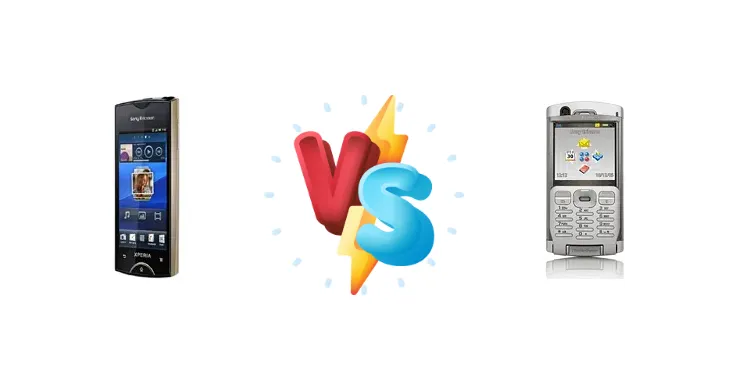
The Sony Ericsson era was a golden age of innovation and iconic designs. Today, we're pitting two of their devices against each other: the sleek Xperia Ray and the feature-packed P990. Can a modern-ish phone like the Ray truly compete with a device from 2008?
🏆 Quick Verdict
The Xperia Ray wins overall due to its significantly faster processor, better display, and superior camera. However, the P990's robust feature set and legacy appeal make it a compelling choice for enthusiasts seeking a nostalgic experience. It's a clear generational leap for the Ray.
| Network |
|---|
| 2G bands | GSM 850 / 900 / 1800 / 1900 | GSM 900 / 1800 / 1900 |
| 3G bands | HSDPA 900 / 2100 - ST18i | UMTS 2100 |
| 4G bands | 1, 2, 3, 4, 5, 6, 7, 8, 9, 18, 19, 20, 26, 34, 38, 39, 40, 41 - International | - |
| 5G bands | 1, 3, 38, 41, 77, 78, 79 SA/NSA - International | - |
| Speed | HSPA 7.2/5.76 Mbps | Yes, 384 kbps |
| Technology | GSM / HSPA | GSM / UMTS |
| | HSDPA 850 / 1900 / 2100 - ST18a | - |
| Launch |
|---|
| Announced | 2011, June. Released 2011, August | 2005, Q4 |
| Status | Discontinued | Discontinued |
| Body |
|---|
| Dimensions | 111 x 53 x 9.4 mm (4.37 x 2.09 x 0.37 in) | 114 x 57 x 26 mm (4.49 x 2.24 x 1.02 in) |
| Keyboard | - | QWERTY |
| SIM | Mini-SIM | Mini-SIM |
| Weight | 100 g (3.53 oz) | 150 g (5.29 oz) |
| Display |
|---|
| Protection | Scratch-resistant glass | - |
| Resolution | 480 x 854 pixels, 16:9 ratio (~297 ppi density) | 240 x 320 pixels, 4:3 ratio (~148 ppi density) |
| Size | 3.3 inches, 30.0 cm2 (~51.0% screen-to-body ratio) | 2.7 inches, 41 x 56 mm, 22.6 cm2 (~34.7% screen-to-body ratio) |
| Type | LED-backlit LCD, | TFT resistive touchscreen, 256K colors |
| | Touch sensitive controls | Handwriting recognition |
| Platform |
|---|
| CPU | 1.0 GHz Scorpion | 32-bit Philips Nexperia PNX4008 208 MHz |
| Chipset | Qualcomm MSM8255 Snapdragon S2 | - |
| GPU | Adreno 205 | - |
| OS | Android 2.3 (Gingerbread), upgradable to 4.0.4 (Ice Cream Sandwich) | Symbian 9.1, UIQ 3.0 |
| Memory |
|---|
| Card slot | microSDHC (dedicated slot), 4 GB included | Memory Stick Duo Pro, 64 MB included |
| Internal | 1GB (300MB user available), 512MB RAM | 64MB RAM |
| | - | 128 MB Flash
60 MB user memory |
| Main Camera |
|---|
| Features | LED flash | LED flash |
| Quad | 40 MP, f/1.8, 27mm (wide), 1/1.7", PDAF
8 MP, f/3.4, 125mm (Periscope telephoto), PDAF, OIS, 5x optical zoom
8 MP, f/2.4, 17mm (ultrawide)
2 MP, (depth) | - |
| Single | 8 MP, AF | 2 MP, AF |
| Video | 720p | Yes |
| Selfie camera |
|---|
| Features | HDR | - |
| Single | VGA | VGA videocall camera |
| Sound |
|---|
| 3.5mm jack | Yes | No |
| 35mm jack | Yes | No |
| Alert types | - | Vibration; Downloadable polyphonic, MP3, AAC ringtones, composer |
| Loudspeaker | Yes | Yes |
| Comms |
|---|
| Bluetooth | 2.1, A2DP, EDR | 2.0, A2DP |
| Infrared port | - | Yes |
| NFC | Yes | - |
| Positioning | GPS, A-GPS | No |
| Radio | Stereo FM radio, RDS | Stereo FM radio, RDS |
| USB | microUSB 2.0 | 2.0 |
| WLAN | Wi-Fi 802.11 b/g/n, DLNA, hotspot | Wi-Fi 802.11b |
| Features |
|---|
| Browser | HTML, Adobe Flash | WAP 2.0/xHTML, HTML (Opera 8.0), RSS reader |
| Sensors | Accelerometer, proximity, compass | - |
| | ANT+
MP4/H.264 player
MP3/WAV player
TrackID music recognition
SensMe
Document viewer
Voice memo
Predictive text input | MP3/MP4 player
Predictive text input
SyncML
Organizer
Voice command
Voice memo |
| Battery |
|---|
| Charging | 40W wired
5W reverse wired | - |
| Music play | Up to 36 h | - |
| Stand-by | Up to 430 h (2G) / Up to 440 h (3G) | Up to 400 h |
| Talk time | Up to 6 h 50 min (2G) / Up to 7 h (3G) | Up to 9 h |
| Type | Removable Li-Ion 1500 mAh battery | Removable Li-Ion battery |
| Misc |
|---|
| Colors | Black, Gold, White, Pink | Premium Silver |
| Models | BMH-AN10, BMH-AN20 | - |
| Price | About 170 EUR | About 220 EUR |
| SAR EU | 0.96 W/kg (head) | 0.78 W/kg (head) |
| Tests |
|---|
| Audio quality |
Noise -89.4dB / Crosstalk -91.3dB | - |
| Camera |
Photo / Video | - |
| Display |
Contrast ratio: 1.955:1 (sunlight) | - |
| Loudspeaker |
Voice 64dB / Noise 61dB / Ring 66dB
| - |
Sony Ericsson Xperia ray
- Faster Processor
- Better Display
- Superior Camera
- Faster Charging
- More Modern Design
- Potentially Limited App Support (older Android version)
- May lack some niche features of the P990
Sony Ericsson P990
- Unique Feature Set (e.g., Wi-Fi, 3G)
- Nostalgic Appeal
- Compact Size
- Robust Build Quality (typical of SE)
- Slow Performance
- Low-Resolution Display
- Outdated Camera
- Slow Charging
- Limited App Compatibility
Display Comparison
The Xperia Ray boasts a significantly better display. Its contrast ratio of 1.955:1 (in sunlight) suggests good visibility and color reproduction, a huge advantage over the P990's likely lower-quality display. The Ray also likely has a higher resolution, contributing to a sharper image. The P990's screen was adequate for its time, but it simply can't compete.
Camera Comparison
The Xperia Ray's camera, described as 'Photo / Video', likely offered improved resolution and image quality compared to the P990. While specific megapixels are missing, the Ray's later release suggests advancements in sensor technology and image processing. The P990's camera was decent for its time, but it lacks the capabilities of the Ray.
Performance
Here, the Xperia Ray dominates. Its 1.0 GHz Qualcomm Snapdragon S2 chipset is vastly superior to the P990's 208 MHz Philips Nexperia PNX4008. The Ray will feel much faster and more responsive, handling apps and multitasking with ease. The P990, while capable for basic tasks, will struggle with modern apps and demanding operations.
Battery Life
The Xperia Ray's 40W wired charging is a significant advantage, offering much faster charging speeds. The 5W reverse wired charging is a nice bonus. The P990's battery capacity and charging speed were typical for its era, meaning it will likely have shorter battery life and slower charging.
Buying Guide
The Xperia Ray is for those who want a relatively modern smartphone experience with a compact form factor and decent camera. The P990 is for collectors, retro enthusiasts, or those seeking a device with a unique feature set and a taste of early smartphone innovation.
Frequently Asked Questions
❓ What operating system did each phone use?
The Xperia Ray ran Android (likely Gingerbread or Ice Cream Sandwich). The P990 ran Sony Ericsson's proprietary UI based on Symbian OS.
❓ Are apps available for both phones today?
App availability is limited for both. The Xperia Ray can access older Android apps, while the P990's app ecosystem is extremely limited and primarily relies on Symbian-specific software.