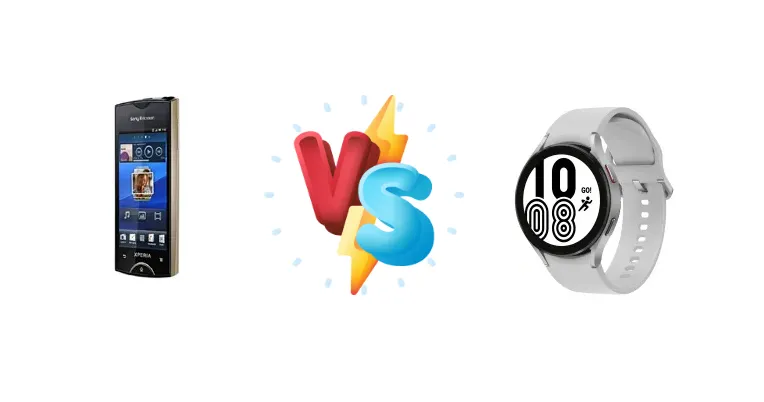
The Sony Ericsson Xperia Ray represents a bygone era of sleek, compact smartphones, while the Samsung Galaxy Watch4 embodies the modern smartwatch revolution. This comparison pits a classic device against a cutting-edge wearable, exploring their strengths and weaknesses to help you decide which is right for you.
🏆 Quick Verdict
The Galaxy Watch4 is the clear winner for modern functionality. Its smartwatch features, fitness tracking, and app ecosystem are unmatched. The Xperia Ray, however, offers a nostalgic smartphone experience with a compact design, appealing to those seeking a simpler, retro feel.
| Network |
|---|
| 2G bands | GSM 850 / 900 / 1800 / 1900 | GSM 850 / 900 / 1800 / 1900 |
| 3G bands | HSDPA 900 / 2100 - ST18i | HSDPA 850 / 900 / 2100 |
| 4G bands | 1, 2, 3, 4, 5, 6, 7, 8, 9, 18, 19, 20, 26, 34, 38, 39, 40, 41 - International | 1, 3, 5, 7, 8, 20 |
| 5G bands | 1, 3, 38, 41, 77, 78, 79 SA/NSA - International | - |
| Speed | HSPA 7.2/5.76 Mbps | HSPA, LTE |
| Technology | GSM / HSPA | GSM / HSPA / LTE |
| | HSDPA 850 / 1900 / 2100 - ST18a | - |
| Launch |
|---|
| Announced | 2011, June. Released 2011, August | 2021, August 11 |
| Status | Discontinued | Available. Released 2021, August 27 |
| Body |
|---|
| Build | - | Glass front (Gorilla Glass DX+), aluminum frame |
| Dimensions | 111 x 53 x 9.4 mm (4.37 x 2.09 x 0.37 in) | 44.4 x 43.3 x 9.8 mm (1.75 x 1.70 x 0.39 in) |
| SIM | Mini-SIM | eSIM |
| Weight | 100 g (3.53 oz) | 30.3 g (44mm), 25.9 g (40mm) (1.06 oz) |
| | - | MIL-STD-810G compliant*
50m water resistant (IP68)
Compatible with standard 20mm straps
ECG certified
Blood pressure monitor
*does not guarantee ruggedness or use in extreme conditions |
| Display |
|---|
| Protection | Scratch-resistant glass | Corning Gorilla Glass DX+ |
| Resolution | 480 x 854 pixels, 16:9 ratio (~297 ppi density) | 450 x 450 pixels (~321 ppi density) |
| Size | 3.3 inches, 30.0 cm2 (~51.0% screen-to-body ratio) | 1.4 inches |
| Type | LED-backlit LCD, | Super AMOLED |
| | Touch sensitive controls | Always-on display |
| Platform |
|---|
| CPU | 1.0 GHz Scorpion | Dual-core 1.18 GHz Cortex-A55 |
| Chipset | Qualcomm MSM8255 Snapdragon S2 | Exynos W920 (5 nm) |
| GPU | Adreno 205 | Mali-G68 |
| OS | Android 2.3 (Gingerbread), upgradable to 4.0.4 (Ice Cream Sandwich) | Android Wear OS 4, One UI Watch 5 |
| Memory |
|---|
| Card slot | microSDHC (dedicated slot), 4 GB included | No |
| Internal | 1GB (300MB user available), 512MB RAM | 16GB 1.5GB RAM |
| Main Camera |
|---|
| Features | LED flash | - |
| Quad | 40 MP, f/1.8, 27mm (wide), 1/1.7", PDAF
8 MP, f/3.4, 125mm (Periscope telephoto), PDAF, OIS, 5x optical zoom
8 MP, f/2.4, 17mm (ultrawide)
2 MP, (depth) | - |
| Single | 8 MP, AF | - |
| Video | 720p | - |
| Selfie camera |
|---|
| Features | HDR | - |
| Single | VGA | - |
| Sound |
|---|
| 3.5mm jack | Yes | No |
| 35mm jack | Yes | No |
| Loudspeaker | Yes | Yes |
| Comms |
|---|
| Bluetooth | 2.1, A2DP, EDR | 5.0, A2DP, LE |
| NFC | Yes | Yes |
| Positioning | GPS, A-GPS | GPS, GLONASS, GALILEO, BDS |
| Radio | Stereo FM radio, RDS | No |
| USB | microUSB 2.0 | No |
| WLAN | Wi-Fi 802.11 b/g/n, DLNA, hotspot | Wi-Fi 802.11 a/b/g/n, dual-band |
| Features |
|---|
| Browser | HTML, Adobe Flash | - |
| Sensors | Accelerometer, proximity, compass | Accelerometer, gyro, compass, barometer, heart rate, SpO2 |
| | ANT+
MP4/H.264 player
MP3/WAV player
TrackID music recognition
SensMe
Document viewer
Voice memo
Predictive text input | Natural language commands and dictation
Samsung Pay |
| Battery |
|---|
| Charging | 40W wired
5W reverse wired | Wireless |
| Music play | Up to 36 h | - |
| Stand-by | Up to 430 h (2G) / Up to 440 h (3G) | - |
| Talk time | Up to 6 h 50 min (2G) / Up to 7 h (3G) | - |
| Type | Removable Li-Ion 1500 mAh battery | Li-Ion 361 mAh |
| Misc |
|---|
| Colors | Black, Gold, White, Pink | Black, Pink Gold, Silver, Green, Thom Browne Edition, Bespoke Edition, PXG Golf Edition |
| Models | BMH-AN10, BMH-AN20 | SM-R860, SM-R870 |
| Price | About 170 EUR | About 110 EUR |
| SAR EU | 0.96 W/kg (head) | - |
| Tests |
|---|
| Audio quality |
Noise -89.4dB / Crosstalk -91.3dB | - |
| Camera |
Photo / Video | - |
| Display |
Contrast ratio: 1.955:1 (sunlight) | - |
| Loudspeaker |
Voice 64dB / Noise 61dB / Ring 66dB
| - |
Sony Ericsson Xperia ray
- Compact and pocketable
- Retro design appeal
- Decent camera for its time
- Simple and straightforward user experience
- Outdated performance
- Limited app support
- Low resolution display by today's standards
- No wireless charging
Samsung Galaxy Watch4
- Advanced fitness tracking
- Smartwatch features (notifications, calls)
- Smooth performance
- Wireless charging
- App ecosystem
- Small screen size
- Limited battery life compared to smartphones
- Camera quality is secondary
- Relies on a smartphone for full functionality
Display Comparison
The Xperia Ray boasts a 4.3-inch display with a decent contrast ratio (1.955:1 in sunlight). While the resolution is lower than modern standards, it's perfectly usable. The Galaxy Watch4 has a smaller, circular AMOLED display, offering vibrant colors and excellent visibility, but its limited screen real estate restricts its use for extended reading or media consumption.
Camera Comparison
The Xperia Ray features a basic camera for its time, capable of taking decent photos and videos in good lighting. The Galaxy Watch4's camera is primarily for video calls and quick snapshots; image quality is not a priority, and it's significantly lower than the Xperia Ray's.
Performance
The Xperia Ray's Qualcomm MSM8255 Snapdragon S2 chipset with a 1.0 GHz Scorpion CPU was respectable for its time, but it struggles with modern apps. The Galaxy Watch4's Exynos W920 chipset, built on a 5nm process, provides significantly faster performance and smoother multitasking, optimized for wearable tasks.
Battery Life
The Xperia Ray likely had a battery capacity around 1500mAh, offering a day's usage with moderate use. The Galaxy Watch4's battery life varies depending on usage, typically lasting a day or two on a single charge. It supports wireless charging, a convenience the Xperia Ray lacks.
Buying Guide
Buy the Sony Ericsson Xperia Ray if you're a collector, appreciate retro tech, or want a basic, compact phone for calls and texts. Buy the Samsung Galaxy Watch4 if you need fitness tracking, notifications on your wrist, and access to a wide range of apps and smart features.
Frequently Asked Questions
❓ Can the Xperia Ray still be used as a daily driver?
While technically possible, the Xperia Ray's outdated hardware and software make it a frustrating experience for modern app usage. It's best suited for nostalgia or very basic tasks.
❓ Does the Galaxy Watch4 work without a smartphone?
The Galaxy Watch4 offers limited functionality without a paired smartphone, primarily for basic timekeeping and some offline music playback. Full features require a connection.