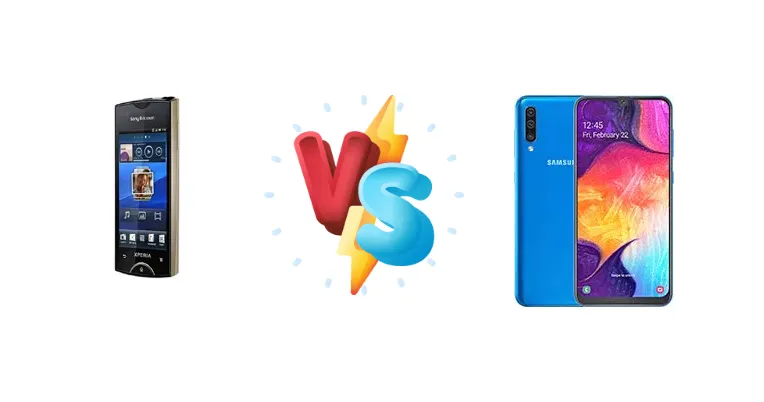
The Sony Ericsson Xperia Ray represents a bygone era of sleek, compact Android phones, while the Samsung Galaxy A50 embodies modern mid-range excellence. This comparison pits a classic against a contemporary, examining which device holds up best in today's mobile landscape. Let's dive in!
🏆 Quick Verdict
The Samsung Galaxy A50 is the clear winner. While the Xperia Ray boasts a unique retro appeal, the A50’s superior performance, significantly better battery life, brighter display, and modern features make it the more practical and compelling choice for most users.
| Network |
|---|
| 2G bands | GSM 850 / 900 / 1800 / 1900 | GSM 850 / 900 / 1800 / 1900 |
| 3G bands | HSDPA 900 / 2100 - ST18i | HSDPA 850 / 900 / 1900 / 2100 |
| 4G bands | 1, 2, 3, 4, 5, 6, 7, 8, 9, 18, 19, 20, 26, 34, 38, 39, 40, 41 - International | 1, 3, 5, 7, 8, 20, 38, 40, 41 |
| 5G bands | 1, 3, 38, 41, 77, 78, 79 SA/NSA - International | - |
| Speed | HSPA 7.2/5.76 Mbps | HSPA, LTE |
| Technology | GSM / HSPA | GSM / HSPA / LTE |
| | HSDPA 850 / 1900 / 2100 - ST18a | 1, 2, 3, 4, 5, 7, 12, 13, 17, 20, 26, 29, 38, 40, 41, 66, 71 - SM-A505U |
| Launch |
|---|
| Announced | 2011, June. Released 2011, August | 2019, February 25. Released 2019, March 18 |
| Status | Discontinued | Discontinued |
| Body |
|---|
| Build | - | Glass front (Gorilla Glass 3), plastic back, plastic frame |
| Dimensions | 111 x 53 x 9.4 mm (4.37 x 2.09 x 0.37 in) | 158.5 x 74.7 x 7.7 mm (6.24 x 2.94 x 0.30 in) |
| SIM | Mini-SIM | · Nano-SIM· Nano-SIM + Nano-SIM |
| Weight | 100 g (3.53 oz) | 166 g (5.86 oz) |
| Display |
|---|
| Protection | Scratch-resistant glass | Corning Gorilla Glass 3 |
| Resolution | 480 x 854 pixels, 16:9 ratio (~297 ppi density) | 1080 x 2340 pixels, 19.5:9 ratio (~403 ppi density) |
| Size | 3.3 inches, 30.0 cm2 (~51.0% screen-to-body ratio) | 6.4 inches, 100.5 cm2 (~84.9% screen-to-body ratio) |
| Type | LED-backlit LCD, | Super AMOLED |
| | Touch sensitive controls | - |
| Platform |
|---|
| CPU | 1.0 GHz Scorpion | Octa-core (4x2.3 GHz Cortex-A73 & 4x1.7 GHz Cortex-A53) |
| Chipset | Qualcomm MSM8255 Snapdragon S2 | Exynos 9610 (10 nm) |
| GPU | Adreno 205 | Mali-G72 MP3 |
| OS | Android 2.3 (Gingerbread), upgradable to 4.0.4 (Ice Cream Sandwich) | Android 9.0 (Pie), upgradable to Android 11, One UI 3.0 |
| Memory |
|---|
| Card slot | microSDHC (dedicated slot), 4 GB included | microSDXC (dedicated slot) |
| Internal | 1GB (300MB user available), 512MB RAM | 64GB 4GB RAM, 64GB 6GB RAM, 128GB 4GB RAM, 128GB 6GB RAM |
| | - | UFS 2.1 |
| Main Camera |
|---|
| Features | LED flash | LED flash, panorama, HDR |
| Quad | 40 MP, f/1.8, 27mm (wide), 1/1.7", PDAF
8 MP, f/3.4, 125mm (Periscope telephoto), PDAF, OIS, 5x optical zoom
8 MP, f/2.4, 17mm (ultrawide)
2 MP, (depth) | - |
| Single | 8 MP, AF | - |
| Triple | - | 25 MP, f/1.7, 26mm (wide), PDAF
8 MP, f/2.2, 13mm (ultrawide), 1/4.0", 1.12µm
Auxiliary lens |
| Video | 720p | 1080p@30fps |
| Selfie camera |
|---|
| Features | HDR | HDR |
| Single | VGA | 25 MP, f/2.0, 25mm (wide), 1/2.8", 0.9µm |
| Video | - | 1080p@30fps |
| Sound |
|---|
| 3.5mm jack | Yes | Yes |
| 35mm jack | Yes | Yes |
| Loudspeaker | Yes | Yes |
| Comms |
|---|
| Bluetooth | 2.1, A2DP, EDR | 5.0, A2DP, LE |
| NFC | Yes | Yes (market dependent) |
| Positioning | GPS, A-GPS | GPS, GLONASS, GALILEO, BDS |
| Radio | Stereo FM radio, RDS | FM radio |
| USB | microUSB 2.0 | USB Type-C 2.0, OTG |
| WLAN | Wi-Fi 802.11 b/g/n, DLNA, hotspot | Wi-Fi 802.11 a/b/g/n/ac, dual-band, Wi-Fi Direct |
| Features |
|---|
| Browser | HTML, Adobe Flash | - |
| Sensors | Accelerometer, proximity, compass | Fingerprint (under display, optical), accelerometer, gyro, proximity, compass |
| | ANT+
MP4/H.264 player
MP3/WAV player
TrackID music recognition
SensMe
Document viewer
Voice memo
Predictive text input | ANT+
Bixby natural language commands and dictation |
| Battery |
|---|
| Charging | 40W wired
5W reverse wired | 15W wired |
| Music play | Up to 36 h | - |
| Stand-by | Up to 430 h (2G) / Up to 440 h (3G) | - |
| Talk time | Up to 6 h 50 min (2G) / Up to 7 h (3G) | - |
| Type | Removable Li-Ion 1500 mAh battery | Li-Po 4000 mAh, non-removable |
| Misc |
|---|
| Colors | Black, Gold, White, Pink | Black, White, Blue, Coral |
| Models | BMH-AN10, BMH-AN20 | SM-A505F, SM-A505FN, SM-A505GN, SM-A505G, SM-A505FM, SM-A505YN, SM-A505W, SM-A505X, SM-A505U, SM-A505GT, SM-A505U1, SM-A505G, SM-A505N, SM-S506DL |
| Price | About 170 EUR | About 270 EUR |
| SAR | - | 1.31 W/kg (head) 0.58 W/kg (body) |
| SAR EU | 0.96 W/kg (head) | 0.27 W/kg (head) 1.39 W/kg (body) |
| Pricing |
|---|
| 128GB 4GB RAM | - | $ 279.99 |
| 64GB 4GB RAM | - | $ 171.00 |
| Tests |
|---|
| Audio quality |
Noise -89.4dB / Crosstalk -91.3dB |
Noise -93.4dB / Crosstalk -92.3dB |
| Battery life | - |
Endurance rating 98h
|
| Camera |
Photo / Video |
Photo / Video |
| Display |
Contrast ratio: 1.955:1 (sunlight) |
Contrast ratio: Infinite (nominal) |
| Loudspeaker |
Voice 64dB / Noise 61dB / Ring 66dB
|
Voice 68dB / Noise 71dB / Ring 82dB
|
| Performance | - |
AnTuTu: 144574 (v7)
GeekBench: 5396 (v4.4)
GFXBench: 8fps (ES 3.1 onscreen) |
Sony Ericsson Xperia ray
- Compact design
- Retro appeal
- Relatively lightweight
- Outdated performance
- Poor battery life
- Dim display
- Limited features
- Difficult to find parts/support
Samsung Galaxy A50
- Excellent battery life
- Bright and vibrant display
- Powerful performance
- Modern features
- Affordable price
- Good camera
- Plastic build (typical for mid-range phones)
- Can be a bit bulky for some
Display Comparison
The Galaxy A50’s 551 nits max brightness and 'infinite' contrast ratio (nominal) offer a vastly superior viewing experience compared to the Xperia Ray’s 1.955:1 sunlight contrast ratio. The A50’s display is noticeably brighter and more vibrant, making it easier to see in direct sunlight. The Ray's display, while decent for its time, simply can't compete.
Camera Comparison
While both phones offer 'Photo / Video' capabilities, the Galaxy A50’s camera system is undoubtedly more advanced. It likely features better image processing, more features, and potentially higher resolution sensors. The Ray's camera was adequate for its time, but falls short by modern standards.
Performance
The Galaxy A50’s Exynos 9610 chipset with its octa-core CPU (4x2.3 GHz Cortex-A73 & 4x1.7 GHz Cortex-A53) provides significantly more processing power than the Xperia Ray’s Qualcomm MSM8255 Snapdragon S2 with a 1.0 GHz Scorpion CPU. Expect smoother multitasking, faster app loading, and better gaming performance on the A50.
Battery Life
The Galaxy A50’s endurance rating of 98h is a massive advantage. The Xperia Ray’s battery life was considerably shorter, typical for phones of that era. The A50 offers significantly longer usage between charges.
Buying Guide
The Xperia Ray is for nostalgia enthusiasts and collectors seeking a compact, classic Android experience. The Galaxy A50 is ideal for users wanting a reliable, feature-rich mid-range phone with a great display, capable camera, and long battery life at an affordable price.
Frequently Asked Questions
❓ Is the Xperia Ray still usable in 2024?
Yes, but it will feel very dated. Performance will be slow, and app compatibility may be an issue. It's best suited for nostalgia or as a secondary device.
❓ Which phone is easier to repair?
The Galaxy A50 is generally easier to repair due to readily available parts and online guides. Finding parts for the Xperia Ray can be challenging.