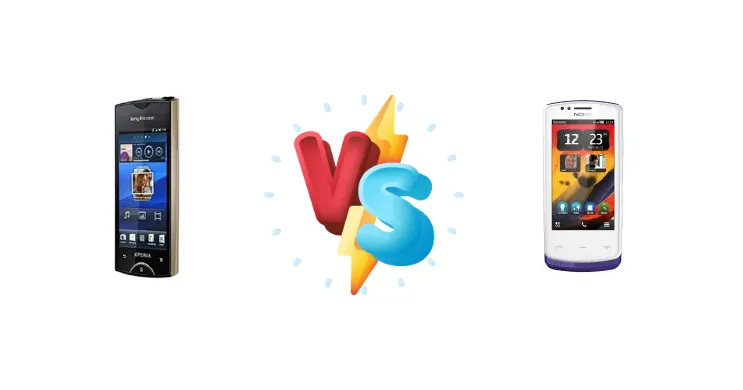
Remember the days of physical keyboards and distinct operating systems? The Sony Ericsson Xperia Ray and Nokia 700 represent that era perfectly. Both were popular devices in their time, but how do they stack up against each other today? Let's dive into a detailed comparison.
🏆 Quick Verdict
The Nokia 700 edges out the Xperia Ray thanks to its surprisingly robust build, slightly better performance after the update, and exceptional sunlight readability. While the Ray boasts a slightly more modern Android experience, the 700's durability and Symbian's unique features give it the advantage.
| Network |
|---|
| 2G bands | GSM 850 / 900 / 1800 / 1900 | GSM 850 / 900 / 1800 / 1900 |
| 3G bands | HSDPA 900 / 2100 - ST18i | HSDPA 850 / 900 / 1700 / 1900 / 2100 |
| 4G bands | 1, 2, 3, 4, 5, 6, 7, 8, 9, 18, 19, 20, 26, 34, 38, 39, 40, 41 - International | - |
| 5G bands | 1, 3, 38, 41, 77, 78, 79 SA/NSA - International | - |
| Speed | HSPA 7.2/5.76 Mbps | HSPA 14.4/5.76 Mbps |
| Technology | GSM / HSPA | GSM / HSPA |
| | HSDPA 850 / 1900 / 2100 - ST18a | - |
| Launch |
|---|
| Announced | 2011, June. Released 2011, August | 2011, August. Released 2011, September |
| Status | Discontinued | Discontinued |
| Body |
|---|
| Dimensions | 111 x 53 x 9.4 mm (4.37 x 2.09 x 0.37 in) | 110 x 50.7 x 9.7 mm, 50 cc (4.33 x 2.00 x 0.38 in) |
| SIM | Mini-SIM | Mini-SIM |
| Weight | 100 g (3.53 oz) | 96 g (3.39 oz) |
| Display |
|---|
| Protection | Scratch-resistant glass | Corning Gorilla Glass |
| Resolution | 480 x 854 pixels, 16:9 ratio (~297 ppi density) | 360 x 640 pixels, 16:9 ratio (~229 ppi density) |
| Size | 3.3 inches, 30.0 cm2 (~51.0% screen-to-body ratio) | 3.2 inches, 28.2 cm2 (~50.6% screen-to-body ratio) |
| Type | LED-backlit LCD, | AMOLED |
| | Touch sensitive controls | Nokia ClearBlack display
|
| Platform |
|---|
| CPU | 1.0 GHz Scorpion | 1.0 GHz ARM11 (1.3GHz after update) |
| Chipset | Qualcomm MSM8255 Snapdragon S2 | - |
| GPU | Adreno 205 | - |
| OS | Android 2.3 (Gingerbread), upgradable to 4.0.4 (Ice Cream Sandwich) | Symbian Belle, upgradable to Belle FP1 |
| Memory |
|---|
| Card slot | microSDHC (dedicated slot), 4 GB included | microSDHC (dedicated slot) |
| Internal | 1GB (300MB user available), 512MB RAM | 2GB 512MB RAM |
| Main Camera |
|---|
| Features | LED flash | LED flash |
| Quad | 40 MP, f/1.8, 27mm (wide), 1/1.7", PDAF
8 MP, f/3.4, 125mm (Periscope telephoto), PDAF, OIS, 5x optical zoom
8 MP, f/2.4, 17mm (ultrawide)
2 MP, (depth) | - |
| Single | 8 MP, AF | 5 MP |
| Video | 720p | 720p@30fps |
| Selfie camera |
|---|
| Features | HDR | - |
| Single | VGA | - |
| | - | No |
| Sound |
|---|
| 3.5mm jack | Yes | Yes |
| 35mm jack | Yes | Yes |
| Loudspeaker | Yes | Yes |
| Comms |
|---|
| Bluetooth | 2.1, A2DP, EDR | 3.0, A2DP, EDR |
| NFC | Yes | Yes |
| Positioning | GPS, A-GPS | GPS, A-GPS; Nokia Maps 3.06 |
| Radio | Stereo FM radio, RDS | Stereo FM radio, RDS |
| USB | microUSB 2.0 | microUSB 2.0 |
| WLAN | Wi-Fi 802.11 b/g/n, DLNA, hotspot | Wi-Fi 802.11 b/g/n |
| Features |
|---|
| Browser | HTML, Adobe Flash | - |
| Sensors | Accelerometer, proximity, compass | Accelerometer, proximity, compass |
| | ANT+
MP4/H.264 player
MP3/WAV player
TrackID music recognition
SensMe
Document viewer
Voice memo
Predictive text input | SNS integration
TV-out
MP4/H.264 player
MP3/WAV/еAAC+/WMA player
Dolby Digital Plus (via FP1 update)
Photo editor
Organizer
Voice command/dial
Predictive text input |
| Battery |
|---|
| Charging | 40W wired
5W reverse wired | - |
| Music play | Up to 36 h | Up to 47 h |
| Stand-by | Up to 430 h (2G) / Up to 440 h (3G) | Up to 465 h (2G) / Up to 450 h (3G) |
| Talk time | Up to 6 h 50 min (2G) / Up to 7 h (3G) | Up to 7 h 10 min (2G) / Up to 4 h 30 min (3G) |
| Type | Removable Li-Ion 1500 mAh battery | Removable Li-Ion 1080 mAh battery (BP-5Z) |
| Misc |
|---|
| Colors | Black, Gold, White, Pink | Cool Grey, Silver/White, Coral Red, Peacock Blue and Purple |
| Models | BMH-AN10, BMH-AN20 | - |
| Price | About 170 EUR | About 140 EUR |
| SAR | - | 1.32 W/kg (head) 1.06 W/kg (body) |
| SAR EU | 0.96 W/kg (head) | 1.43 W/kg (head) |
| Tests |
|---|
| Audio quality |
Noise -89.4dB / Crosstalk -91.3dB |
Noise -89.8dB / Crosstalk -89.3dB |
| Camera |
Photo / Video |
Photo / Video |
| Display |
Contrast ratio: 1.955:1 (sunlight) |
Contrast ratio: Infinite (nominal) |
| Loudspeaker |
Voice 64dB / Noise 61dB / Ring 66dB
|
Voice 62dB / Noise 58dB / Ring 74dB |
Sony Ericsson Xperia ray
- Sleek design
- Android OS (early version)
- Potentially slightly better display sharpness
- Unknown battery life
- Lower performance compared to updated Nokia 700
- Camera quality is limited
Nokia 700
- Excellent sunlight readability
- Durable build quality
- Long battery life
- Updated CPU performance
- Outdated Symbian OS
- Basic feature set
- Camera quality is limited
Display Comparison
Both phones feature relatively small displays for modern standards. The Xperia Ray has a 4.3-inch display with a contrast ratio of 1.955:1 in sunlight, which is decent. However, the Nokia 700 boasts a nominal 'infinite' contrast ratio, which, while not a standard measurement, suggests excellent sunlight readability and vibrant colors. The Ray's display is generally considered sharper, but the 700's visibility in bright conditions is a significant advantage.
Camera Comparison
Both phones offer Photo/Video capabilities, but neither is particularly impressive by modern standards. The Xperia Ray likely has a slightly better sensor, but image quality on both is limited by their age and hardware. Expect grainy photos and mediocre video quality in low light. The Nokia 700's camera is known for its decent performance in bright sunlight.
Performance
The Xperia Ray is powered by a Qualcomm MSM8255 Snapdragon S2 chipset with a 1.0 GHz Scorpion CPU. The Nokia 700 initially had a 1.0 GHz ARM11 CPU, but received an update boosting it to 1.3 GHz. While both are relatively slow by today's standards, the 700's update provides a noticeable performance improvement, making it slightly more responsive for basic tasks. The Ray's Android OS might feel smoother in some areas, but the 700's optimized Symbian experience is surprisingly capable.
Battery Life
The Nokia 700 has a significant advantage here. It features a 1080 mAh battery, known for its excellent battery life, often lasting a full day or more with moderate use. The Xperia Ray's battery capacity is unknown, but generally, Sony Ericsson phones of that era weren't known for exceptional battery performance. The 700's power efficiency is a key selling point.
Buying Guide
The Sony Ericsson Xperia Ray is for those who appreciate early Android and a sleek design. The Nokia 700 is ideal for users seeking a durable, compact phone with a unique operating system and excellent sunlight visibility, and who don't mind a more basic feature set.
Frequently Asked Questions
❓ Which phone is easier to find and in better condition?
Both are retro phones, so availability varies. However, the Nokia 700's robust build often means it's found in slightly better condition than the Xperia Ray.
❓ Is it worth buying either of these phones in 2024?
Only for collectors or those seeking a nostalgic experience. Neither phone offers modern smartphone functionality or performance. They are interesting historical artifacts rather than practical daily drivers.