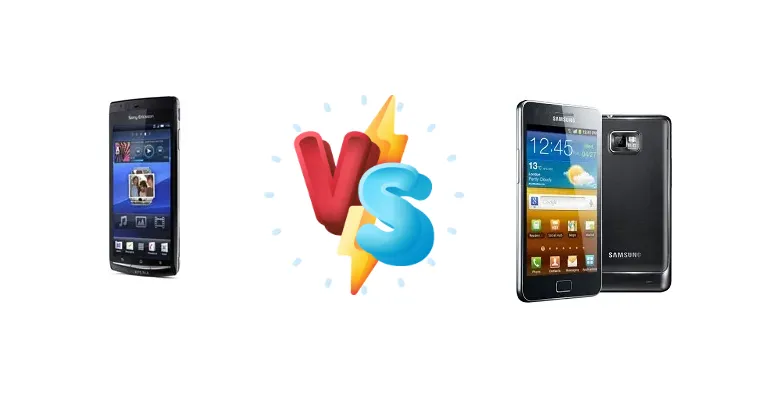
The Sony Ericsson Xperia Arc and Samsung Galaxy S II were titans of the early Android landscape. Both offered compelling features for their time, but significant differences set them apart. Let's revisit these iconic devices and see how they stack up against each other in a detailed comparison.
🏆 Quick Verdict
The Samsung Galaxy S II decisively wins this comparison. Its superior dual-core processor, vastly improved display, and longer battery life provide a significantly better user experience than the Xperia Arc, despite the Arc's sleek design.
| Network |
|---|
| 2G bands | GSM 850 / 900 / 1800 / 1900 | GSM 850 / 900 / 1800 / 1900 |
| 3G bands | HSDPA 900 / 2100 - LT15i | HSDPA 850 / 900 / 1900 / 2100 |
| Speed | HSPA 7.2/5.76 Mbps | HSPA 21.1/5.76 Mbps |
| Technology | GSM / HSPA | GSM / HSPA |
| | HSDPA 850 / 1900 / 2100 / 800 - LT15a | - |
| Launch |
|---|
| Announced | 2011, January. Released 2011, March | 2011, February. Released 2011, April |
| Status | Discontinued | Discontinued |
| Body |
|---|
| Build | - | Glass front (Gorilla Glass), plastic back, plastic frame |
| Dimensions | 125 x 63 x 8.7 mm (4.92 x 2.48 x 0.34 in) | 125.3 x 66.1 x 8.5 mm (4.93 x 2.60 x 0.33 in) |
| SIM | Mini-SIM | Mini-SIM |
| Weight | 117 g (4.13 oz) | 116 g (4.09 oz) |
| Display |
|---|
| Protection | Scratch-resistant glass | Corning Gorilla Glass |
| Resolution | 480 x 854 pixels, 16:9 ratio (~233 ppi density) | 480 x 800 pixels, 5:3 ratio (~217 ppi density) |
| Size | 4.2 inches, 48.6 cm2 (~61.7% screen-to-body ratio) | 4.3 inches, 52.6 cm2 (~63.5% screen-to-body ratio) |
| Type | LED-backlit LCD, | Super AMOLED Plus |
| Platform |
|---|
| CPU | 1.0 GHz Scorpion | Dual-core 1.2 GHz Cortex-A9 |
| Chipset | Qualcomm MSM8255 Snapdragon S2 | Exynos 4210 Dual |
| GPU | Adreno 205 | Mali-400MP4 |
| OS | Android 2.3 (Gingerbread), upgradable to 4.0 (Ice Cream Sandwich) | Android 2.3.4 (Gingerbread), upgradable to 4.1 (Jelly Bean), TouchWiz UI 4 |
| Memory |
|---|
| Card slot | microSDHC (dedicated slot), 8 GB included | microSDHC (dedicated slot) |
| Internal | 320MB 512MB RAM | 16GB 1GB RAM, 32GB 1GB RAM |
| Main Camera |
|---|
| Features | LED flash | LED flash |
| Single | 8 MP, AF | 8 MP, f/2.6, 1/3.2", AF |
| Video | 720p@30fps | 1080p@30fps |
| Selfie camera |
|---|
| Single | - | 2 MP |
| | No | - |
| Sound |
|---|
| 3.5mm jack | Yes | Yes |
| 35mm jack | Yes | Yes |
| Loudspeaker | Yes | Yes |
| Comms |
|---|
| Bluetooth | 2.1, A2DP | 3.0, A2DP, aptX |
| NFC | - | Optional |
| Positioning | GPS, A-GPS | GPS, A-GPS |
| Radio | Stereo FM radio, RDS | Stereo FM radio, RDS |
| USB | microUSB 2.0 | microUSB 2.0 (MHL TV-out), OTG |
| WLAN | Wi-Fi 802.11 b/g/n, DLNA, hotspot | Wi-Fi 802.11 a/b/g/n, dual-band, Wi-Fi Direct, DLNA, hotspot |
| Features |
|---|
| Browser | HTML, Adobe Flash | HTML, Adobe Flash |
| Sensors | Accelerometer, proximity, compass | Accelerometer, gyro, proximity, compass |
| | ANT+
HDMI port
MP4/H.264/WMV player
MP3/eAAC+/WMA/WAV player
TrackID music recognition
NeoReader barcode scanner
Document viewer
Voice memo/dial/commands
Predictive text input | - |
| Battery |
|---|
| Music play | Up to 31 h | - |
| Stand-by | Up to 430 h (2G) / Up to 400 h (3G) | Up to 710 h (2G) / Up to 610 h (3G) |
| Talk time | Up to 7 h (2G) / Up to 7 h (3G) | Up to 18 h 20 min (2G) / Up to 8 h 40 min (3G) |
| Type | Removable Li-Po 1500 mAh battery | Removable Li-Ion 1650 mAh battery |
| Misc |
|---|
| Colors | Midnight Blue, Misty Silver | Black, White, Pink |
| Models | - | GT-I9100, GT-I9100G, GT-I9100T |
| Price | About 180 EUR | About 170 EUR |
| SAR | - | 0.16 W/kg (head) 0.96 W/kg (body) |
| SAR EU | 0.66 W/kg (head) | 0.34 W/kg (head) |
| Tests |
|---|
| Audio quality |
Noise -89.4dB / Crosstalk -91.5dB |
Noise -91.4dB / Crosstalk -89.7dB |
| Battery life | - | Endurance rating 40h |
| Camera |
Photo / Video |
Photo / Video |
| Display |
Contrast ratio: 1207:1 (nominal) |
Contrast ratio: Infinite (nominal) / 2.832:1 (sunlight) |
| Loudspeaker |
Voice 66dB / Noise 66dB / Ring 78dB
|
Voice 70dB / Noise 66dB / Ring 75dB |
Sony Ericsson Xperia Arc
- Sleek design
- Compact size
- Good build quality
- Outdated processor
- Limited storage
- Poor battery life
- Lower screen quality
Samsung I9100 Galaxy S II
- Powerful dual-core processor
- Vibrant Super AMOLED display
- Longer battery life
- Better camera
- Design is less distinctive
- Software is outdated
- Potential for performance slowdown with modern apps
Display Comparison
The Galaxy S II boasts a Super AMOLED display with an 'infinite' contrast ratio (nominally) and a respectable 2.832:1 contrast ratio in sunlight, a huge advantage over the Xperia Arc's 1207:1 contrast ratio. Colors are more vibrant and viewing angles are significantly better on the S II. The Arc's display, while decent, lacks the punch and clarity of the S II's screen.
Camera Comparison
While both phones offer Photo/Video capabilities, the Galaxy S II generally produced better image quality, especially in low-light conditions. The S II's camera also benefited from Samsung's image processing algorithms, which, while sometimes controversial, often resulted in more vibrant and detailed photos. The Arc's camera was adequate but lacked the refinement of the S II.
Performance
The Galaxy S II's dual-core 1.2 GHz Cortex-A9 processor and Exynos 4210 chipset provide a noticeable performance boost over the Xperia Arc's single-core 1.0 GHz Scorpion processor and Qualcomm MSM8255 Snapdragon S2. Apps launch faster, multitasking is smoother, and the overall user experience is more responsive on the S II.
Battery Life
The Galaxy S II's endurance rating of 40h significantly surpasses the Xperia Arc's battery life (specific figures are unavailable, but it was notably shorter). This translates to considerably longer usage time between charges for the S II.
Buying Guide
The Xperia Arc might appeal to those seeking a compact, stylish phone with a focus on Sony's design aesthetic, but its age and limitations make it unsuitable for modern use. The Galaxy S II, while also dated, offers a more capable and enjoyable experience for those looking for a nostalgic Android device.
Frequently Asked Questions
❓ Which phone was released first?
The Sony Ericsson Xperia Arc was released first, in April 2011, followed by the Samsung Galaxy S II in May 2011.
❓ Are these phones still worth using today?
While both phones are incredibly dated, they can be used for basic tasks. However, their performance will struggle with modern apps and operating systems. They are primarily of interest to collectors or those seeking a nostalgic Android experience.