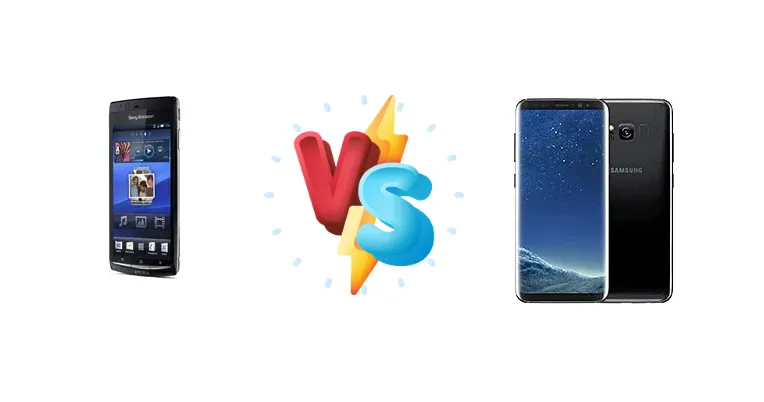
The Sony Ericsson Xperia Arc, a flagship from 2011, represented a peak in Sony's early Android journey. Now, let's pit it against the Samsung Galaxy S8, a powerhouse from 2017, to see how these devices stack up nearly a decade apart. This comparison explores design, performance, camera capabilities, and battery life.
🏆 Quick Verdict
The Samsung Galaxy S8 utterly dominates this comparison. While the Xperia Arc was impressive for its time, the S8's superior processing power, vastly improved camera, stunning display, and exceptional battery life make it the clear winner. It's a testament to how far smartphone technology has advanced.
| Network |
|---|
| 2G bands | GSM 850 / 900 / 1800 / 1900 | GSM 850 / 900 / 1800 / 1900 - SIM 1 & SIM 2 (dual-SIM model only) |
| 3G bands | HSDPA 900 / 2100 - LT15i | HSDPA 850 / 900 / 1700(AWS) / 1900 / 2100 |
| 4G bands | - | 1, 2, 3, 4, 5, 7, 8, 12, 13, 17, 18, 19, 20, 25, 26, 28, 32, 66, 38, 39, 40, 41 |
| Speed | HSPA 7.2/5.76 Mbps | HSPA 42.2/5.76 Mbps, LTE (5CA) Cat16 1024/150 Mbps |
| Technology | GSM / HSPA | GSM / HSPA / LTE |
| | HSDPA 850 / 1900 / 2100 / 800 - LT15a | - |
| Launch |
|---|
| Announced | 2011, January. Released 2011, March | 2017, March 29. Released 2017, April 24 |
| Status | Discontinued | Discontinued |
| Body |
|---|
| Build | - | Glass front (Gorilla Glass 5), glass back (Gorilla Glass 5), aluminum frame |
| Dimensions | 125 x 63 x 8.7 mm (4.92 x 2.48 x 0.34 in) | 148.9 x 68.1 x 8 mm (5.86 x 2.68 x 0.31 in) |
| SIM | Mini-SIM | · Nano-SIM· Nano-SIM + Nano-SIM |
| Weight | 117 g (4.13 oz) | 155 g (5.47 oz) |
| | - | IP68 dust/water resistant (up to 1.5m for 30 mins) |
| Display |
|---|
| Protection | Scratch-resistant glass | Corning Gorilla Glass 5 |
| Resolution | 480 x 854 pixels, 16:9 ratio (~233 ppi density) | 1440 x 2960 pixels, 18.5:9 ratio (~570 ppi density) |
| Size | 4.2 inches, 48.6 cm2 (~61.7% screen-to-body ratio) | 5.8 inches, 84.8 cm2 (~83.6% screen-to-body ratio) |
| Type | LED-backlit LCD, | Super AMOLED, HDR10 |
| | - | 3D Touch (home button only)
Always-on display |
| Platform |
|---|
| CPU | 1.0 GHz Scorpion | Octa-core (4x2.3 GHz Mongoose M2 & 4x1.7 GHz Cortex-A53) - EMEAOcta-core (4x2.35 GHz Kryo & 4x1.9 GHz Kryo) - USA & China |
| Chipset | Qualcomm MSM8255 Snapdragon S2 | Exynos 8895 (10 nm) - EMEAQualcomm MSM8998 Snapdragon 835 (10 nm) - USA & China |
| GPU | Adreno 205 | Mali-G71 MP20 - EMEAAdreno 540 - USA & China |
| OS | Android 2.3 (Gingerbread), upgradable to 4.0 (Ice Cream Sandwich) | Android 7.0 (Nougat), upgradable to Android 9.0 (Pie), One UI |
| Memory |
|---|
| Card slot | microSDHC (dedicated slot), 8 GB included | microSDXC (uses shared SIM slot) - dual SIM model only |
| Internal | 320MB 512MB RAM | 64GB 4GB RAM |
| | - | UFS 2.0 or UFS 2.1 |
| Main Camera |
|---|
| Features | LED flash | LED flash, auto-HDR, panorama |
| Single | 8 MP, AF | 12 MP, f/1.7, 26mm (wide), 1/2.55", 1.4µm, dual pixel PDAF, OIS |
| Video | 720p@30fps | 4K@30fps, 1080p@30/60fps, 720p@240fps, HDR, stereo sound rec., gyro-EIS, OIS |
| Selfie camera |
|---|
| Dual | - | 8 MP, f/1.7, 25mm (wide), 1/3.6", 1.22µm, AF
2 MP (dedicated iris scanner camera) |
| Features | - | HDR |
| Video | - | 1440p@30fps |
| | No | - |
| Sound |
|---|
| 3.5mm jack | Yes | Yes |
| 35mm jack | Yes | Yes |
| Loudspeaker | Yes | Yes |
| | - | 32-bit/384kHz audio
|
| Comms |
|---|
| Bluetooth | 2.1, A2DP | 5.0, A2DP, LE, aptX |
| NFC | - | Yes |
| Positioning | GPS, A-GPS | GPS, GLONASS, BDS, GALILEO |
| Radio | Stereo FM radio, RDS | No |
| USB | microUSB 2.0 | USB Type-C 3.1 |
| WLAN | Wi-Fi 802.11 b/g/n, DLNA, hotspot | Wi-Fi 802.11 a/b/g/n/ac, dual-band, Wi-Fi Direct |
| Features |
|---|
| Browser | HTML, Adobe Flash | - |
| Sensors | Accelerometer, proximity, compass | Iris scanner, fingerprint (rear-mounted), accelerometer, gyro, proximity, compass, barometer, heart rate, SpO2 |
| | ANT+
HDMI port
MP4/H.264/WMV player
MP3/eAAC+/WMA/WAV player
TrackID music recognition
NeoReader barcode scanner
Document viewer
Voice memo/dial/commands
Predictive text input | Samsung DeX (desktop experience support)
ANT+
Bixby natural language commands and dictation
Samsung Pay (Visa, MasterCard certified) |
| Battery |
|---|
| Charging | - | 15W wired, QC2
Wireless (Qi) (market dependent) |
| Music play | Up to 31 h | Up to 67 h |
| Stand-by | Up to 430 h (2G) / Up to 400 h (3G) | - |
| Talk time | Up to 7 h (2G) / Up to 7 h (3G) | Up to 20 h (3G) |
| Type | Removable Li-Po 1500 mAh battery | Li-Ion 3000 mAh, non-removable (11.55 Wh) |
| Misc |
|---|
| Colors | Midnight Blue, Misty Silver | Midnight Black, Orchid Gray, Arctic Silver, Coral Blue, Maple Gold, Rose Pink, Burgundy Red |
| Models | - | SM-G950FD, SM-G950W, SM-G950S, SM-G950K, SM-G950L, SM-G9500, SM-G950A, SM-G950P, SM-G950T, SM-G950U, SM-G950V, SM-G950F, SM-G950U1, SM-G950N, SC-02J, SCV36, SM-G950, G950F |
| Price | About 180 EUR | About 230 EUR |
| SAR | - | 0.44 W/kg (head) 0.75 W/kg (body) |
| SAR EU | 0.66 W/kg (head) | 0.32 W/kg (head) 1.27 W/kg (body) |
| Tests |
|---|
| Audio quality |
Noise -89.4dB / Crosstalk -91.5dB |
Noise -92.5dB / Crosstalk -92.8dB |
| Battery life | - | Endurance rating 84h |
| Camera |
Photo / Video |
Photo / Video |
| Display |
Contrast ratio: 1207:1 (nominal) |
Contrast ratio: Infinite (nominal), 4.768 (sunlight) |
| Loudspeaker |
Voice 66dB / Noise 66dB / Ring 78dB
|
Voice 66dB / Noise 70dB / Ring 72dB |
| Performance | - |
AnTuTu: 199022 (v7)
GeekBench: 6656 (v4.4)
GFXBench: 13fps (ES 3.1 onscreen) |
Sony Ericsson Xperia Arc
- Nostalgic design
- Compact size
- Decent display for its time
- Outdated processor
- Poor camera
- Short battery life
- Limited app compatibility
Samsung Galaxy S8
- Excellent display
- Powerful processor
- Great camera
- Long battery life
- Modern features
- Older model (potential software support issues)
- May show wear and tear depending on condition
Display Comparison
The Galaxy S8 boasts a significantly superior display. Its 'Infinite' contrast ratio (and a respectable 4.768 in sunlight) indicates exceptional brightness and color accuracy, far surpassing the Xperia Arc's 1207:1 ratio. The S8's AMOLED technology provides vibrant colors and deep blacks, a feature absent in the Arc's LCD screen. Resolution and screen size also heavily favor the S8.
Camera Comparison
The Galaxy S8's camera is a clear winner. While both offer 'Photo / Video' capabilities, the S8's sensor, image processing, and features (like optical image stabilization) are vastly superior. Expect sharper images, better low-light performance, and higher-quality video recording from the S8.
Performance
The Galaxy S8's Exynos 8895 or Snapdragon 835 chipset (depending on region) is a generational leap over the Xperia Arc's 1.0 GHz Scorpion processor and Qualcomm MSM8255 Snapdragon S2. The S8's octa-core processor delivers significantly faster processing speeds and smoother multitasking. The Arc struggles with modern apps and demanding tasks.
Battery Life
The Galaxy S8's endurance rating of 84h is remarkable, indicating exceptional battery life. The Xperia Arc's battery life was considerably shorter, typical for phones of that era. The S8's larger battery capacity and more efficient processor contribute to its longevity.
Buying Guide
Who should buy the Sony Ericsson Xperia Arc? Primarily collectors or those seeking a nostalgic experience of early Android. Who should buy the Samsung Galaxy S8? Anyone looking for a reliable, capable, and still-usable smartphone, especially if budget is a concern and a modern experience is desired.
Frequently Asked Questions
❓ Is the Xperia Arc still usable in 2024?
While technically usable, the Xperia Arc's outdated hardware and software make it challenging to use with modern apps and services. It's best suited for nostalgia or specific retro gaming purposes.
❓ Can I find software updates for the Xperia Arc?
No, Sony has ceased software support for the Xperia Arc. It runs an outdated version of Android, posing security risks.