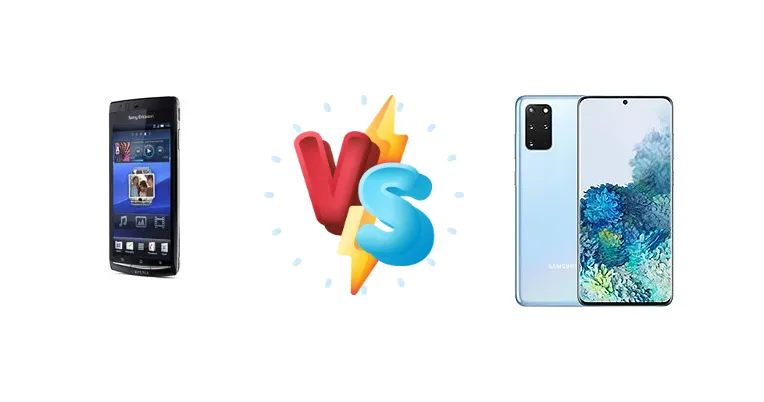
The Sony Ericsson Xperia Arc, a flagship from 2011, represented a peak in Sony's early Android efforts. Now, let's pit it against the Samsung Galaxy S20+, a powerhouse from 2020. This comparison explores how far smartphone technology has advanced and which device offers the better experience today.
🏆 Quick Verdict
The Samsung Galaxy S20+ utterly dominates this comparison. While the Xperia Arc holds nostalgic charm, the S20+'s superior display, performance, camera, and battery life make it the clear winner. It's a generational leap in technology.
| Network |
|---|
| 2G bands | GSM 850 / 900 / 1800 / 1900 | GSM 850 / 900 / 1800 / 1900 |
| 3G bands | HSDPA 900 / 2100 - LT15i | HSDPA 850 / 900 / 1700(AWS) / 1900 / 2100 |
| 4G bands | - | 1, 2, 3, 4, 5, 7, 8, 12, 13, 17, 18, 19, 20, 25, 26, 28, 32, 38, 39, 40, 41, 66 |
| Speed | HSPA 7.2/5.76 Mbps | HSPA 42.2/5.76 Mbps, LTE (7CA) Cat20 2000/200 Mbps |
| Technology | GSM / HSPA | GSM / CDMA / HSPA / EVDO / LTE |
| | HSDPA 850 / 1900 / 2100 / 800 - LT15a | CDMA2000 1xEV-DO |
| Launch |
|---|
| Announced | 2011, January. Released 2011, March | 2020, February 11 |
| Status | Discontinued | Available. Released 2020, March 06 |
| Body |
|---|
| Build | - | Glass front (Gorilla Glass 6), glass back (Gorilla Glass 6), aluminum frame |
| Dimensions | 125 x 63 x 8.7 mm (4.92 x 2.48 x 0.34 in) | 161.9 x 73.7 x 7.8 mm (6.37 x 2.90 x 0.31 in) |
| SIM | Mini-SIM | · Nano-SIM + eSIM· Nano-SIM + Nano-SIM |
| Weight | 117 g (4.13 oz) | 186 g (6.56 oz) |
| | - | IP68 dust/water resistant (up to 1.5m for 30 min) |
| Display |
|---|
| Protection | Scratch-resistant glass | Corning Gorilla Glass 6 |
| Resolution | 480 x 854 pixels, 16:9 ratio (~233 ppi density) | 1440 x 3200 pixels, 20:9 ratio (~525 ppi density) |
| Size | 4.2 inches, 48.6 cm2 (~61.7% screen-to-body ratio) | 6.7 inches, 108.0 cm2 (~90.5% screen-to-body ratio) |
| Type | LED-backlit LCD, | Dynamic AMOLED 2X, 120Hz, HDR10+, 1200 nits (peak) |
| | - | Always-on display
120Hz@FHD/60Hz@QHD refresh rate |
| Platform |
|---|
| CPU | 1.0 GHz Scorpion | Octa-core (2x2.73 GHz Mongoose M5 & 2x2.50 GHz Cortex-A76 & 4x2.0 GHz Cortex-A55) - GlobalOcta-core (1x2.84 GHz Cortex-A77 & 3x2.42 GHz Cortex-A77 & 4x1.80 GHz Cortex-A55) - USA |
| Chipset | Qualcomm MSM8255 Snapdragon S2 | Exynos 990 (7 nm+) - GlobalQualcomm SM8250 Snapdragon 865 5G (7 nm+) - USA |
| GPU | Adreno 205 | Mali-G77 MP11 - GlobalAdreno 650 - USA |
| OS | Android 2.3 (Gingerbread), upgradable to 4.0 (Ice Cream Sandwich) | Android 10, upgradable to Android 13, One UI 5 |
| Memory |
|---|
| Card slot | microSDHC (dedicated slot), 8 GB included | microSDXC (uses shared SIM slot) |
| Internal | 320MB 512MB RAM | 128GB 8GB RAM |
| | - | UFS 3.0 |
| Main Camera |
|---|
| Features | LED flash | LED flash, auto-HDR, panorama |
| Single | 8 MP, AF | - |
| Triple | - | 12 MP, f/1.8, 26mm (wide), 1/1.76", 1.8µm, dual pixel PDAF, OIS
64 MP, f/2.0, 29mm (telephoto), 1/1.72", 0.8µm, PDAF, OIS, 1.1x optical zoom, 3x hybrid zoom
12 MP, f/2.2, 13mm, 120˚ (ultrawide), 1/2.55" 1.4µm, Super Steady video
0.3 MP, TOF 3D, f/1.0, (depth) |
| Video | 720p@30fps | 8K@24fps, 4K@30/60fps, 1080p@30/60/240fps, 720p@960fps, HDR10+, stereo sound rec., gyro-EIS & OIS |
| Selfie camera |
|---|
| Features | - | HDR |
| Single | - | 10 MP, f/2.2, 26mm (wide), 1/3.24", 1.22µm, dual pixel PDAF |
| Video | - | 4K@30/60fps, 1080p@30fps |
| | No | - |
| Sound |
|---|
| 3.5mm jack | Yes | No |
| 35mm jack | Yes | No |
| Loudspeaker | Yes | Yes, with stereo speakers |
| | - | 32-bit/384kHz audio
Tuned by AKG |
| Comms |
|---|
| Bluetooth | 2.1, A2DP | 5.0, A2DP, LE |
| NFC | - | Yes |
| Positioning | GPS, A-GPS | GPS, GLONASS, BDS, GALILEO |
| Radio | Stereo FM radio, RDS | FM radio (Snapdragon model only; market/operator dependent) |
| USB | microUSB 2.0 | USB Type-C 3.2, OTG |
| WLAN | Wi-Fi 802.11 b/g/n, DLNA, hotspot | Wi-Fi 802.11 a/b/g/n/ac/6, dual-band, Wi-Fi Direct |
| Features |
|---|
| Browser | HTML, Adobe Flash | - |
| Sensors | Accelerometer, proximity, compass | Fingerprint (under display, ultrasonic), accelerometer, gyro, proximity, compass, barometer |
| | ANT+
HDMI port
MP4/H.264/WMV player
MP3/eAAC+/WMA/WAV player
TrackID music recognition
NeoReader barcode scanner
Document viewer
Voice memo/dial/commands
Predictive text input | Samsung DeX, Samsung Wireless DeX (desktop experience support)
ANT+
Bixby natural language commands and dictation
Samsung Pay (Visa, MasterCard certified) |
| Battery |
|---|
| Charging | - | 25W wired, PD3.0
15W wireless (Qi)
4.5W reverse wireless |
| Music play | Up to 31 h | - |
| Stand-by | Up to 430 h (2G) / Up to 400 h (3G) | - |
| Talk time | Up to 7 h (2G) / Up to 7 h (3G) | - |
| Type | Removable Li-Po 1500 mAh battery | Li-Ion 4500 mAh |
| Misc |
|---|
| Colors | Midnight Blue, Misty Silver | Cosmic Black, Cosmic Grey, Cloud Blue, Cloud White, Aura Red, Aura Blue |
| Models | - | SM-G985, SM-G985F, SM-G985F/DS |
| Price | About 180 EUR | € 299.97 / $ 189.60 / £ 234.21 |
| SAR | - | 0.72 W/kg (head) 1.03 W/kg (body) |
| SAR EU | 0.66 W/kg (head) | 0.38 W/kg (head) 1.57 W/kg (body) |
| Pricing |
|---|
| 128GB 8GB RAM | - | $ 400.90 |
| RENEWED | - | $ 288.00 |
| Tests |
|---|
| Audio quality |
Noise -89.4dB / Crosstalk -91.5dB | - |
| Battery life | - |
Endurance rating 87h
|
| Camera |
Photo / Video |
Photo / Video |
| Display |
Contrast ratio: 1207:1 (nominal) |
Contrast ratio: Infinite (nominal) |
| Loudspeaker |
Voice 66dB / Noise 66dB / Ring 78dB
|
-24.4 LUFS (Very good)
|
| Performance | - |
AnTuTu: 500114 (v8)
GeekBench: 2703 (v5.1)
GFXBench: 42fps (ES 3.1 onscreen) |
Sony Ericsson Xperia Arc
- Nostalgic design
- Compact size (likely)
- Good build quality (typical of Sony)
- Outdated performance
- Low resolution display
- Poor battery life
- Limited app compatibility
- Basic camera
Samsung Galaxy S20+
- Exceptional display
- Blazing-fast performance
- Versatile camera system
- Long battery life
- Fast charging
- Ample storage and RAM
- Larger size
- Can be expensive (depending on condition)
- Software support may be ending
Display Comparison
The Galaxy S20+ boasts a significantly brighter display (797 nits vs. unknown for Arc) and a vastly superior contrast ratio (Infinite vs. 1207:1). The S20+'s AMOLED technology delivers vibrant colors and deep blacks, a stark contrast to the Arc's likely LCD panel. The S20+ also likely has a higher resolution.
Camera Comparison
While both offer 'Photo / Video' capabilities, the S20+’s camera system is far more advanced. Expect significantly better image quality, more features (like multiple lenses and advanced modes), and superior video recording capabilities on the S20+. The Arc's camera was decent for its time, but it's no match for the S20+'s.
Performance
The S20+'s Octa-core CPU (up to 2.84 GHz) and Snapdragon 865/Exynos 990 chipset leave the Xperia Arc's 1.0 GHz Scorpion processor in the dust. The S20+ handles demanding games and multitasking with ease, while the Arc struggles with modern apps.
Battery Life
The Galaxy S20+ offers an incredible endurance rating of 87 hours, a massive advantage over the Xperia Arc's likely shorter battery life (estimated around 8-10 hours of usage). The S20+ also supports fast charging and wireless charging, features absent in the Arc.
Buying Guide
Who should buy the Sony Ericsson Xperia Arc? Primarily collectors or those seeking a nostalgic experience of early Android. Who should buy the Samsung Galaxy S20+? Anyone needing a modern, high-performing smartphone with a fantastic camera and long battery life.
Frequently Asked Questions
❓ Is the Xperia Arc still usable in 2024?
Yes, but with significant limitations. It can still make calls and browse the web, but app compatibility is a major issue, and performance will be slow.
❓ Why is the Galaxy S20+ so much better?
The S20+ represents a decade of technological advancement. It has a vastly superior processor, display, camera, and battery compared to the Xperia Arc.