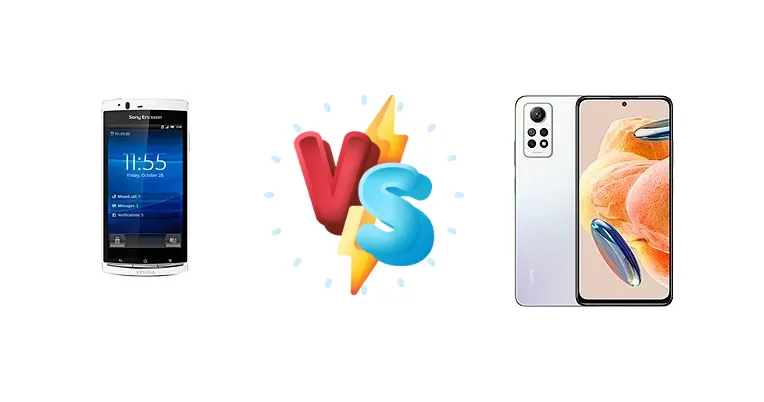
The Sony Ericsson Xperia Arc S represents a bygone era of Android, while the Xiaomi Redmi Note 12 Pro 4G embodies modern mid-range excellence. This comparison explores how these phones stack up, considering their vastly different release dates and technological advancements.
🏆 Quick Verdict
The Xiaomi Redmi Note 12 Pro 4G is the clear winner. While the Xperia Arc S holds nostalgic charm, the Redmi Note 12 Pro’s superior performance, camera, battery, and modern features make it the more practical and compelling choice for today's user.
| Network |
|---|
| 2G bands | GSM 850 / 900 / 1800 / 1900 | GSM 850 / 900 / 1800 / 1900 |
| 3G bands | HSDPA 900 / 2100 - LT18i | HSDPA 850 / 900 / 1700(AWS) / 1900 / 2100 |
| 4G bands | - | 1, 2, 3, 4, 5, 7, 8, 20, 28, 38, 40, 41, 66 |
| EDGE | Yes | - |
| GPRS | Yes | - |
| Speed | HSPA 14.4/5.76 Mbps | HSPA, LTE |
| Technology | GSM / HSPA | GSM / HSPA / LTE |
| | HSDPA 850 / 1900 / 2100 / 800 - LT18a | - |
| Launch |
|---|
| Announced | 2011, August. Released 2011, September | 2023, March 03 |
| Status | Discontinued | Available. Released 2023, April 11 |
| Body |
|---|
| Dimensions | 125 x 63 x 8.7 mm (4.92 x 2.48 x 0.34 in) | 164.2 x 76.1 x 8.1 mm (6.46 x 3.00 x 0.32 in) |
| SIM | Mini-SIM | Nano-SIM + Nano-SIM |
| Weight | 117 g (4.13 oz) | 201.8 g (7.13 oz) |
| Display |
|---|
| Protection | Scratch-resistant glass | - |
| Resolution | 480 x 854 pixels, 16:9 ratio (~233 ppi density) | 1080 x 2400 pixels, 20:9 ratio (~395 ppi density) |
| Size | 4.2 inches, 48.6 cm2 (~61.7% screen-to-body ratio) | 6.67 inches, 107.4 cm2 (~86.0% screen-to-body ratio) |
| Type | LED-backlit LCD, | AMOLED, 120Hz, Dolby Vision, 700 nits (HBM), 1100 nits (peak) |
| Platform |
|---|
| CPU | 1.4 GHz Scorpion | Octa-core (2x2.2 GHz Kryo 470 Gold & 6x1.8 GHz Kryo 470 Silver) |
| Chipset | Qualcomm MSM8255T Snapdragon S2 | Qualcomm SM7150 Snapdragon 732G (8 nm) |
| GPU | Adreno 205 | Adreno 618 |
| OS | Android 2.3.4 (Gingerbread), 4.0.4 (Ice Cream Sandwich), not upgradable to 4.1 (Jelly Bean) | Android 11, MIUI 13 |
| Memory |
|---|
| Card slot | microSDHC (dedicated slot), 8 GB included | microSDXC (uses shared SIM slot) |
| Internal | 1GB (320MB user available), 512MB RAM | 128GB 6GB RAM, 128GB 8GB RAM, 256GB 8GB RAM |
| | - | UFS 2.2 |
| Main Camera |
|---|
| Features | LED flash, panorama | LED flash, HDR, panorama |
| Quad | - | 108 MP, f/1.9, (wide), 1/1.52", 0.7µm, PDAF
8 MP, 120˚, (ultrawide)
2 MP (macro)
Auxiliary lens |
| Single | 8 MP, AF | - |
| Video | 720p@30fps | 4K@30fps, 1080p@30/60fps |
| Selfie camera |
|---|
| Single | - | 16 MP, f/2.4, (wide) |
| Video | - | 1080p@30fps |
| | No | - |
| Sound |
|---|
| 3.5mm jack | Yes | Yes |
| 35mm jack | Yes | Yes |
| Loudspeaker | Yes | Yes, with stereo speakers |
| Comms |
|---|
| Bluetooth | 2.1, A2DP, EDR | 5.0, A2DP, LE |
| Infrared port | - | Yes |
| NFC | No | Yes (market/region dependent) |
| Positioning | GPS, A-GPS; GLONASS | GPS, GLONASS, GALILEO, BDS |
| Radio | Stereo FM radio, RDS | Unspecified |
| USB | microUSB 2.0, OTG | USB Type-C 2.0, OTG |
| WLAN | Wi-Fi 802.11 b/g/n, DLNA, hotspot | Wi-Fi 802.11 a/b/g/n/ac, dual-band |
| Features |
|---|
| Sensors | Accelerometer, proximity, compass | Fingerprint (side-mounted), accelerometer, gyro, compass |
| | ANT+
HDMI port
MP4/H.264/WMV player
MP3/eAAC+/WMA/WAV player
TrackID music recognition
NeoReader barcode scanner
Document viewer
Voice memo/dial/commands
Predictive text input | - |
| Battery |
|---|
| Charging | - | 67W wired |
| Music play | Up to 37 h | - |
| Stand-by | Up to 460 h (2G) / Up to 460 h (3G) | - |
| Talk time | Up to 7 h 25 min (2G) / Up to 7 h 35 min (3G) | - |
| Type | Removable Li-Po 1500 mAh battery | Li-Po 5000 mAh |
| Misc |
|---|
| Colors | Pure White, Midnight Blue, Misty Silver, Gloss Black, Sakura Pink | Star Blue, Graphite Gray, Polar White, Ice blue |
| Models | - | 2209116AG, 2209116AG |
| Price | About 210 EUR | About 150 EUR |
| SAR EU | 0.66 W/kg (head) | - |
| Tests |
|---|
| Audio quality |
Noise -89.3dB / Crosstalk -90.2dB | - |
| Camera |
Photo / Video | - |
| Loudspeaker |
Voice 67dB / Noise 65dB / Ring 76dB
| - |
Sony Ericsson Xperia Arc S
- Compact size
- Nostalgic Android experience
- Relatively durable build
- Outdated performance
- Low-resolution display
- Poor battery life
- Limited app compatibility
Xiaomi Redmi Note 12 Pro 4G
- Excellent performance
- High-resolution AMOLED display
- Versatile camera system
- Fast charging
- Long battery life
- Modern features
- MIUI software can be polarizing
- Plastic build (depending on variant)
Display Comparison
The Redmi Note 12 Pro 4G boasts a significantly larger and higher-resolution AMOLED display (likely 6.67 inches, FHD+) with a smoother refresh rate (typically 120Hz) compared to the Arc S's smaller (4.2 inch) Reality Display. Color accuracy and brightness are also vastly improved on the Redmi.
Camera Comparison
The Redmi Note 12 Pro 4G’s camera system is far more advanced, likely featuring a high-resolution main sensor (50MP or higher) with OIS, ultrawide, and macro lenses. The Arc S’s camera, while decent for its time, simply can’t compete with the Redmi’s image quality, dynamic range, and features.
Performance
The Snapdragon 732G in the Redmi Note 12 Pro 4G offers a massive performance advantage over the Arc S's Snapdragon S2. The Redmi handles multitasking, gaming, and demanding apps with ease, while the Arc S can feel sluggish by modern standards. The octa-core CPU and 8nm process of the Redmi are a huge upgrade.
Battery Life
The Redmi Note 12 Pro 4G’s larger battery (typically 5000mAh) and 67W fast charging provide significantly longer battery life and much quicker charging times than the Arc S, which had a smaller battery and slower charging.
Buying Guide
The Xperia Arc S is for Android enthusiasts seeking a retro experience or a project phone. The Redmi Note 12 Pro 4G is ideal for budget-conscious users who want a reliable, feature-rich smartphone with a great camera and fast charging.
Frequently Asked Questions
❓ Is the Xperia Arc S still usable in 2024?
Yes, but with significant limitations. App compatibility is a major issue, and performance will be noticeably slow compared to modern phones. It's best suited for niche uses or as a retro device.
❓ What is the biggest difference between these two phones?
The biggest difference is the generational gap. The Redmi Note 12 Pro 4G represents modern smartphone technology, while the Arc S is a relic of a much earlier era of Android.