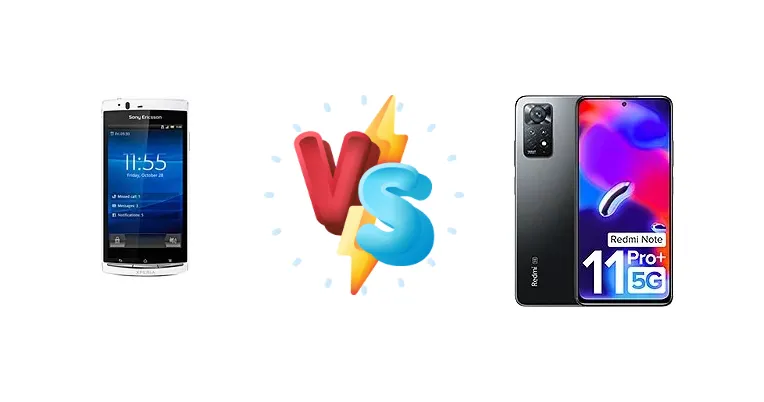
The Sony Ericsson Xperia Arc S represents a bygone era of Android, while the Xiaomi Redmi Note 11 Pro+ 5G embodies modern smartphone technology. This comparison explores how these devices stack up against each other, highlighting the significant advancements in mobile technology over the years.
🏆 Quick Verdict
The Xiaomi Redmi Note 11 Pro+ 5G is the clear winner. While the Xperia Arc S holds nostalgic appeal, the Redmi Note 11 Pro+ 5G offers vastly superior performance, camera capabilities, battery life, and modern features like 5G connectivity, making it the more practical choice.
| Network |
|---|
| 2G bands | GSM 850 / 900 / 1800 / 1900 | GSM 850 / 900 / 1800 / 1900 - SIM 1 & SIM 2 |
| 3G bands | HSDPA 900 / 2100 - LT18i | HSDPA 850 / 900 / 1900 / 2100 |
| 4G bands | - | 1, 3, 5, 8, 40, 41 |
| 5G bands | - | 1, 3, 5, 8, 28, 40, 78 SA/NSA |
| EDGE | Yes | - |
| GPRS | Yes | - |
| Speed | HSPA 14.4/5.76 Mbps | HSPA, LTE-A (CA), 5G |
| Technology | GSM / HSPA | GSM / HSPA / LTE / 5G |
| | HSDPA 850 / 1900 / 2100 / 800 - LT18a | - |
| Launch |
|---|
| Announced | 2011, August. Released 2011, September | 2022, March 09 |
| Status | Discontinued | Available. Released 2022, March 15 |
| Body |
|---|
| Build | - | Glass front (Gorilla Glass 5), glass back |
| Dimensions | 125 x 63 x 8.7 mm (4.92 x 2.48 x 0.34 in) | 164.2 x 76.1 x 8.1 mm (6.46 x 3.00 x 0.32 in) |
| SIM | Mini-SIM | Hybrid Dual SIM (Nano-SIM, dual stand-by) |
| Weight | 117 g (4.13 oz) | 202 g (7.13 oz) |
| | - | IP53, dust and splash resistant |
| Display |
|---|
| Protection | Scratch-resistant glass | Corning Gorilla Glass 5 |
| Resolution | 480 x 854 pixels, 16:9 ratio (~233 ppi density) | 1080 x 2400 pixels, 20:9 ratio (~395 ppi density) |
| Size | 4.2 inches, 48.6 cm2 (~61.7% screen-to-body ratio) | 6.67 inches, 107.4 cm2 (~86.0% screen-to-body ratio) |
| Type | LED-backlit LCD, | Super AMOLED, 120Hz, 700 nits, 1200 nits (peak) |
| Platform |
|---|
| CPU | 1.4 GHz Scorpion | Octa-core (2x2.2 GHz Kryo 660 Gold & 6x1.7 GHz Kryo 660 Silver) |
| Chipset | Qualcomm MSM8255T Snapdragon S2 | Qualcomm SM6375 Snapdragon 695 5G (6 nm) |
| GPU | Adreno 205 | Adreno 619 |
| OS | Android 2.3.4 (Gingerbread), 4.0.4 (Ice Cream Sandwich), not upgradable to 4.1 (Jelly Bean) | Android 11, MIUI 13 |
| Memory |
|---|
| Card slot | microSDHC (dedicated slot), 8 GB included | microSDXC (uses shared SIM slot) |
| Internal | 1GB (320MB user available), 512MB RAM | 64GB 6GB RAM, 128GB 6GB RAM, 128GB 8GB RAM, 256GB 8GB RAM |
| | - | UFS 2.2 |
| Main Camera |
|---|
| Features | LED flash, panorama | LED flash, HDR, panorama |
| Single | 8 MP, AF | - |
| Triple | - | 108 MP, f/1.9, 26mm (wide), 1/1.52", 0.7µm, PDAF
8 MP, f/2.2, 118˚ (ultrawide)
2 MP, f/2.4, (macro) |
| Video | 720p@30fps | 1080p@30fps |
| Selfie camera |
|---|
| Single | - | 16 MP, f/2.5, (wide), 1/3.06" 1.0µm |
| Video | - | 1080p@30fps |
| | No | - |
| Sound |
|---|
| 3.5mm jack | Yes | Yes |
| 35mm jack | Yes | - |
| Loudspeaker | Yes | Yes, with stereo speakers |
| | - | 24-bit/192kHz audio |
| Comms |
|---|
| Bluetooth | 2.1, A2DP, EDR | 5.1, A2DP, LE |
| Infrared port | - | Yes |
| NFC | No | No |
| Positioning | GPS, A-GPS; GLONASS | GPS, GLONASS, BDS, GALILEO |
| Radio | Stereo FM radio, RDS | Unspecified |
| USB | microUSB 2.0, OTG | USB Type-C 2.0, OTG |
| WLAN | Wi-Fi 802.11 b/g/n, DLNA, hotspot | Wi-Fi 802.11 a/b/g/n/ac, dual-band, Wi-Fi Direct |
| Features |
|---|
| Sensors | Accelerometer, proximity, compass | Fingerprint (side-mounted), accelerometer, gyro, proximity, compass |
| | ANT+
HDMI port
MP4/H.264/WMV player
MP3/eAAC+/WMA/WAV player
TrackID music recognition
NeoReader barcode scanner
Document viewer
Voice memo/dial/commands
Predictive text input | - |
| Battery |
|---|
| Charging | - | 67W wired, PD3.0, QC3, 50% in 15 min, 100% in 42 min (advertised) |
| Music play | Up to 37 h | - |
| Stand-by | Up to 460 h (2G) / Up to 460 h (3G) | - |
| Talk time | Up to 7 h 25 min (2G) / Up to 7 h 35 min (3G) | - |
| Type | Removable Li-Po 1500 mAh battery | Li-Po 5000 mAh, non-removable |
| Misc |
|---|
| Colors | Pure White, Midnight Blue, Misty Silver, Gloss Black, Sakura Pink | Mirage Blue, Phantom White, Stealth Black |
| Models | - | 2201116SI |
| Price | About 210 EUR | About 250 EUR |
| SAR EU | 0.66 W/kg (head) | - |
| Tests |
|---|
| Audio quality |
Noise -89.3dB / Crosstalk -90.2dB | - |
| Camera |
Photo / Video | - |
| Loudspeaker |
Voice 67dB / Noise 65dB / Ring 76dB
| - |
Sony Ericsson Xperia Arc S
- Compact size
- Classic Android design
- Nostalgic appeal
- Outdated performance
- Low-resolution display
- Poor battery life
- Limited camera capabilities
- No 5G
Xiaomi Redmi Note 11 Pro+ 5G (India)
- Excellent camera
- Fast charging (67W)
- 5G connectivity
- Large, vibrant display
- Modern performance
- MIUI software can be polarizing
- Potentially less premium build quality than flagship devices
Display Comparison
The Redmi Note 11 Pro+ 5G boasts a significantly larger and higher-resolution AMOLED display (likely 6.67 inches, FHD+) with a 120Hz refresh rate, offering vibrant colors and smooth scrolling. The Xperia Arc S has a smaller LCD screen (4.2 inches, qHD) with a lower resolution and refresh rate, feeling dated by today's standards.
Camera Comparison
The Redmi Note 11 Pro+ 5G features a likely 108MP main camera, offering significantly higher resolution and improved image quality compared to the Xperia Arc S's camera. The Redmi also likely includes additional lenses (ultrawide, macro, depth) and advanced features like OIS. The Arc S's camera is adequate for its time but struggles by modern standards.
Performance
The Redmi Note 11 Pro+ 5G's Snapdragon 695 5G chipset and Octa-core CPU provide a substantial performance boost over the Xperia Arc S's 1.4 GHz Scorpion processor and Qualcomm MSM8255T Snapdragon S2 chipset. Expect smoother multitasking, faster app loading, and better gaming performance on the Redmi Note 11 Pro+ 5G.
Battery Life
The Redmi Note 11 Pro+ 5G's 67W fast charging and larger battery capacity (likely 5000mAh) provide significantly longer battery life and faster charging speeds than the Xperia Arc S (likely around 1500mAh). The Arc S would require significantly longer charging times and offer considerably less runtime.
Buying Guide
The Xperia Arc S is for collectors or those seeking a retro Android experience. The Redmi Note 11 Pro+ 5G is for users wanting a modern, feature-rich smartphone with a great camera, fast charging, and 5G connectivity at a competitive price.
Frequently Asked Questions
❓ Is the Xperia Arc S still usable in 2024?
Yes, but it's severely limited by its outdated hardware and software. It can handle basic tasks, but modern apps and websites may not function properly.
❓ What is the biggest difference between these two phones?
The biggest difference is the generational gap. The Redmi Note 11 Pro+ 5G represents modern smartphone technology, while the Xperia Arc S is a relic of the early Android era.