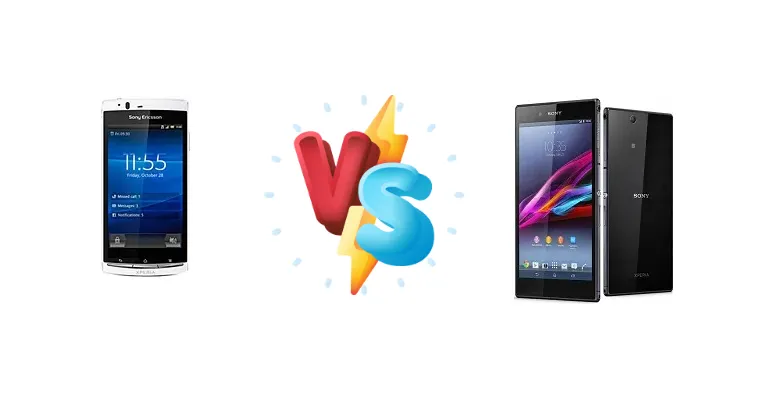
Sony has a rich history in mobile, and these two devices represent vastly different eras. The Xperia Arc S was a flagship of its time, while the Xperia Z Ultra pushed boundaries with its massive display and powerful internals. Let's dive into a detailed comparison to see how they stack up today.
🏆 Quick Verdict
The Xperia Z Ultra is the clear winner. Its significantly faster processor, superior display, and improved camera easily outpace the Arc S. While the Arc S holds nostalgic value, the Z Ultra offers a modern smartphone experience.
| Network |
|---|
| 2G bands | GSM 850 / 900 / 1800 / 1900 | GSM 850 / 900 / 1800 / 1900 - all versions |
| 3G bands | HSDPA 900 / 2100 - LT18i | HSDPA 850 / 900 / 1700 / 1900 / 2100 - all versions |
| 4G bands | - | 1, 2, 4, 5, 7, 8, 17 - C6806 |
| EDGE | Yes | - |
| GPRS | Yes | - |
| Speed | HSPA 14.4/5.76 Mbps | HSPA 42.2/5.76 Mbps, LTE Cat4 150/50 Mbps |
| Technology | GSM / HSPA | GSM / HSPA / LTE |
| | HSDPA 850 / 1900 / 2100 / 800 - LT18a | 1, 2, 3, 4, 5, 7, 8, 20 - C6833 |
| Launch |
|---|
| Announced | 2011, August. Released 2011, September | 2013, June. Released 2013, July |
| Status | Discontinued | Discontinued |
| Body |
|---|
| Dimensions | 125 x 63 x 8.7 mm (4.92 x 2.48 x 0.34 in) | 179.4 x 92.2 x 6.5 mm (7.06 x 3.63 x 0.26 in) |
| SIM | Mini-SIM | Micro-SIM |
| Weight | 117 g (4.13 oz) | 212 g (7.48 oz) |
| | - | IP58 dust proof and water resistant over 1.5 meter and 30 minutes |
| Display |
|---|
| Protection | Scratch-resistant glass | Shatter proof glass |
| Resolution | 480 x 854 pixels, 16:9 ratio (~233 ppi density) | 1080 x 1920 pixels, 16:9 ratio (~344 ppi density) |
| Size | 4.2 inches, 48.6 cm2 (~61.7% screen-to-body ratio) | 6.4 inches, 112.9 cm2 (~68.3% screen-to-body ratio) |
| Type | LED-backlit LCD, | IPS LCD |
| | - | Triluminos display
X-Reality Engine |
| Platform |
|---|
| CPU | 1.4 GHz Scorpion | Quad-core 2.2 GHz Krait 400 |
| Chipset | Qualcomm MSM8255T Snapdragon S2 | Qualcomm MSM8274 or MSM8974 Snapdragon 800 (28 nm) |
| GPU | Adreno 205 | Adreno 330 |
| OS | Android 2.3.4 (Gingerbread), 4.0.4 (Ice Cream Sandwich), not upgradable to 4.1 (Jelly Bean) | Android 4.2 (Jelly Bean), upgradable to 5.1 (Lollipop) |
| Memory |
|---|
| Card slot | microSDHC (dedicated slot), 8 GB included | microSDXC (dedicated slot) |
| Internal | 1GB (320MB user available), 512MB RAM | 16GB 2GB RAM |
| | - | eMMC 4.5 |
| Main Camera |
|---|
| Features | LED flash, panorama | HDR |
| Single | 8 MP, AF | 8 MP, f/2.4, AF |
| Video | 720p@30fps | 1080p@30fps, HDR |
| Selfie camera |
|---|
| Single | - | 2 MP |
| Video | - | 1080p@30fps |
| | No | - |
| Sound |
|---|
| 3.5mm jack | Yes | Yes |
| 35mm jack | Yes | Yes |
| Loudspeaker | Yes | Yes |
| Comms |
|---|
| Bluetooth | 2.1, A2DP, EDR | 4.0, A2DP, aptX |
| NFC | No | Yes |
| Positioning | GPS, A-GPS; GLONASS | GPS, GLONASS |
| Radio | Stereo FM radio, RDS | Stereo FM radio, RDS |
| USB | microUSB 2.0, OTG | microUSB 2.0 (MHL TV-out), OTG |
| WLAN | Wi-Fi 802.11 b/g/n, DLNA, hotspot | Wi-Fi 802.11 a/b/g/n/ac, dual-band, Wi-Fi Direct, DLNA, hotspot |
| Features |
|---|
| Sensors | Accelerometer, proximity, compass | Accelerometer, gyro, proximity, compass |
| | ANT+
HDMI port
MP4/H.264/WMV player
MP3/eAAC+/WMA/WAV player
TrackID music recognition
NeoReader barcode scanner
Document viewer
Voice memo/dial/commands
Predictive text input | ANT+ |
| Battery |
|---|
| Music play | Up to 37 h | Up to 120 h |
| Stand-by | Up to 460 h (2G) / Up to 460 h (3G) | Up to 790 h (2G) / Up to 820 h (3G) |
| Talk time | Up to 7 h 25 min (2G) / Up to 7 h 35 min (3G) | Up to 14 h (2G) / Up to 16 h (3G) |
| Type | Removable Li-Po 1500 mAh battery | Li-Ion 3050 mAh, non-removable |
| Misc |
|---|
| Colors | Pure White, Midnight Blue, Misty Silver, Gloss Black, Sakura Pink | Black, White, Purple |
| Models | - | C6833, C6802, C6806, C6806 |
| Price | About 210 EUR | About 280 EUR |
| SAR | - | 1.01 W/kg (head) 1.54 W/kg (body) |
| SAR EU | 0.66 W/kg (head) | 0.34 W/kg (head) |
| Tests |
|---|
| Audio quality |
Noise -89.3dB / Crosstalk -90.2dB |
Noise -92.5dB / Crosstalk -90.7dB |
| Battery life | - |
Endurance rating 52h
|
| Camera |
Photo / Video |
Photo / Video |
| Display | - |
Contrast ratio: 1001:1 (nominal) / 1.578:1 (sunlight) |
| Loudspeaker |
Voice 67dB / Noise 65dB / Ring 76dB
|
Voice 63dB / Noise 60dB / Ring 59dB
|
| Performance | - |
Basemark X: 11606 |
Sony Ericsson Xperia Arc S
- Compact size
- Decent build quality
- Nostalgic Android experience
- Outdated processor
- Low resolution display
- Limited storage
- Poor low-light camera performance
Sony Xperia Z Ultra
- Massive, vibrant display
- Powerful processor
- Good battery life
- Improved camera
- Large size can be unwieldy
- Older device - limited software updates
- Potential for battery degradation due to age
Display Comparison
The Xperia Z Ultra boasts a massive 6.4-inch display with a remarkable 1001:1 contrast ratio and exceptional sunlight readability (1.578:1). The Arc S, with its 4.2-inch Reality Display, is smaller and offers a decent viewing experience but lacks the Z Ultra's sheer scale and brightness. The Z Ultra's resolution is also significantly higher, resulting in sharper images.
Camera Comparison
Both phones feature 'Photo / Video' capabilities, but the Z Ultra's camera hardware and image processing are considerably more advanced. While specific megapixel counts are not provided, the Z Ultra's newer sensor and processing algorithms result in better image quality, especially in low light. The Z Ultra likely supports more advanced video recording features.
Performance
The Z Ultra's quad-core 2.2 GHz Krait 400 processor and Snapdragon 800 chipset are worlds apart from the Arc S's 1.4 GHz Scorpion and Snapdragon S2. Expect significantly faster app loading, smoother multitasking, and better overall responsiveness on the Z Ultra. The Z Ultra handles modern games far better than the Arc S.
Battery Life
Both devices are listed with an endurance rating of 52h, suggesting comparable battery life despite the Z Ultra's larger screen and more powerful processor. This is likely due to the Z Ultra's more efficient chipset and software optimization.
Buying Guide
The Xperia Arc S is best suited for collectors or those seeking a retro Android experience. The Xperia Z Ultra is for users prioritizing a large, vibrant display, strong performance, and a more modern feature set, understanding it's an older device.
Frequently Asked Questions
❓ Is the Xperia Arc S still usable in 2024?
Yes, but it's limited by its outdated hardware and software. It can handle basic tasks, but modern apps may struggle.
❓ What is the biggest difference between these two phones?
The biggest difference is the processing power and display technology. The Z Ultra offers a significantly faster and more modern experience.