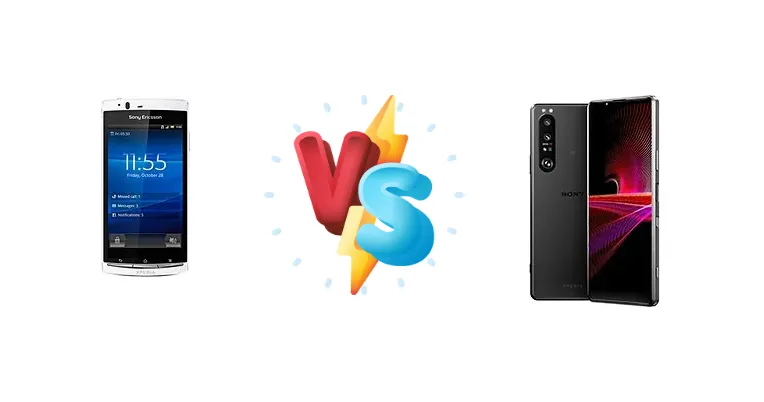
The Sony Ericsson Xperia Arc S, a beloved Android phone from 2011, represents a bygone era of mobile technology. Now, let's pit it against the powerhouse that is the Sony Xperia 1 III, a flagship device packed with cutting-edge features. This comparison explores how far smartphone technology has advanced.
🏆 Quick Verdict
The Sony Xperia 1 III utterly dominates the Xperia Arc S across nearly every metric. While the Arc S holds nostalgic charm, the 1 III's superior performance, camera, display, and battery life make it the clear winner for modern users. It's a generational leap, not a close contest.
| Network |
|---|
| 2G bands | GSM 850 / 900 / 1800 / 1900 | GSM 850 / 900 / 1800 / 1900 |
| 3G bands | HSDPA 900 / 2100 - LT18i | HSDPA 800 / 850 / 900 / 1700(AWS) / 1900 / 2100 |
| 4G bands | - | 1, 2, 3, 4, 5, 7, 8, 12, 13, 17, 19, 20, 25, 26, 28, 29, 32, 34, 38, 39, 40, 41, 46, 66 - Europe |
| 5G bands | - | 1, 3, 5, 7, 8, 20, 28, 38, 40, 41, 77, 78 SA/NSA/Sub6 - Europe |
| EDGE | Yes | - |
| GPRS | Yes | - |
| Speed | HSPA 14.4/5.76 Mbps | HSPA, LTE, 5G |
| Technology | GSM / HSPA | GSM / HSPA / LTE / 5G |
| | HSDPA 850 / 1900 / 2100 / 800 - LT18a | SA/NSA/Sub6/mmWave - USA (specific) |
| Launch |
|---|
| Announced | 2011, August. Released 2011, September | 2021, April 14 |
| Status | Discontinued | Available. Released 2021, August 25 |
| Body |
|---|
| Build | - | Glass front (Gorilla Glass Victus), glass back (Gorilla Glass 6), aluminum frame |
| Dimensions | 125 x 63 x 8.7 mm (4.92 x 2.48 x 0.34 in) | 165 x 71 x 8.2 mm (6.50 x 2.80 x 0.32 in) |
| SIM | Mini-SIM | Nano-SIM + Nano-SIM |
| Weight | 117 g (4.13 oz) | 186 g / 187.1 g (mmWave) (6.56 oz) |
| | - | IP65/IP68 dust/water resistant (up to 1.5m for 30 min) |
| Display |
|---|
| Protection | Scratch-resistant glass | Corning Gorilla Glass Victus |
| Resolution | 480 x 854 pixels, 16:9 ratio (~233 ppi density) | 1644 x 3840 pixels, 21:9 ratio (~643 ppi density) |
| Size | 4.2 inches, 48.6 cm2 (~61.7% screen-to-body ratio) | 6.5 inches, 98.6 cm2 (~84.2% screen-to-body ratio) |
| Type | LED-backlit LCD, | OLED, 1B colors, 120Hz, HDR BT.2020 |
| | - | Runs at 1096 x 2560 pixels except for select use cases |
| Platform |
|---|
| CPU | 1.4 GHz Scorpion | Octa-core (1x2.84 GHz Cortex-X1 & 3x2.42 GHz Cortex-A78 & 4x1.80 GHz Cortex-A55) |
| Chipset | Qualcomm MSM8255T Snapdragon S2 | Qualcomm SM8350 Snapdragon 888 5G (5 nm) |
| GPU | Adreno 205 | Adreno 660 |
| OS | Android 2.3.4 (Gingerbread), 4.0.4 (Ice Cream Sandwich), not upgradable to 4.1 (Jelly Bean) | Android 11, upgradable to Android 13 |
| Memory |
|---|
| Card slot | microSDHC (dedicated slot), 8 GB included | microSDXC (uses shared SIM slot) |
| Internal | 1GB (320MB user available), 512MB RAM | 256GB 12GB RAM, 512GB 12GB RAM |
| | - | UFS 3.X |
| Main Camera |
|---|
| Features | LED flash, panorama | Zeiss optics, Zeiss T* lens coating, color spectrum sensor, LED flash, panorama, HDR, eye tracking |
| Single | 8 MP, AF | 8 MP, f/2.0, 24mm (wide), 1/4", 1.12µm |
| Triple | - | 12 MP, f/1.7, 24mm (wide), 1/1.7", 1.8µm, dual pixel PDAF, OIS
12 MP, f/2.3, 70mm (telephoto), f/2.8, 105mm (telephoto), 1/2.9", dual pixel PDAF, 3x/4.4x optical zoom, OIS
12 MP, f/2.2, 124˚, 16mm (ultrawide), 1/2.6", dual pixel PDAF
0.3 MP, TOF 3D, (depth) |
| Video | 720p@30fps | 4K@24/25/30/60/120fps HDR, 1080p@30/60/120fps; 5-axis gyro-EIS, OIS |
| Selfie camera |
|---|
| Features | - | HDR |
| Single | - | 8 MP, f/2.0, 24mm (wide), 1/4.0", 1.12µm |
| Video | - | 1080p@30fps, 5-axis gyro-EIS |
| | No | - |
| Sound |
|---|
| 3.5mm jack | Yes | Yes |
| 35mm jack | Yes | Yes |
| Loudspeaker | Yes | Yes, with stereo speakers |
| | - | 24-bit/192kHz audio
Dynamic vibration system |
| Comms |
|---|
| Bluetooth | 2.1, A2DP, EDR | 5.2, A2DP, LE, aptX HD, aptX Adaptive |
| NFC | No | Yes |
| Positioning | GPS, A-GPS; GLONASS | GPS, GLONASS, BDS, GALILEO, QZSS |
| Radio | Stereo FM radio, RDS | No |
| USB | microUSB 2.0, OTG | USB Type-C 3.1, OTG, video output |
| WLAN | Wi-Fi 802.11 b/g/n, DLNA, hotspot | Wi-Fi 802.11 a/b/g/n/ac/6, dual-band, Wi-Fi Direct, DLNA |
| Features |
|---|
| Sensors | Accelerometer, proximity, compass | Fingerprint (side-mounted), accelerometer, gyro, proximity, barometer, compass |
| | ANT+
HDMI port
MP4/H.264/WMV player
MP3/eAAC+/WMA/WAV player
TrackID music recognition
NeoReader barcode scanner
Document viewer
Voice memo/dial/commands
Predictive text input | Native Sony Alpha camera support |
| Battery |
|---|
| Charging | - | 30W wired, PD, 50% in 30 min
Wireless
Reverse wireless |
| Music play | Up to 37 h | - |
| Stand-by | Up to 460 h (2G) / Up to 460 h (3G) | - |
| Talk time | Up to 7 h 25 min (2G) / Up to 7 h 35 min (3G) | - |
| Type | Removable Li-Po 1500 mAh battery | Li-Po 4500 mAh |
| Misc |
|---|
| Colors | Pure White, Midnight Blue, Misty Silver, Gloss Black, Sakura Pink | Frosted Black, Frosted Gray, Frosted Purple |
| Models | - | XQBC62/V, XQBC52V.UKCX, SO-51B, SOG03, A101SO, XQ-BC62, XQ-BC72, XQ-BC52, XQ-BC01, XQ-BC11, XQ-BC21, XQ-BC72 |
| Price | About 210 EUR | € 505.26 / $ 903.43 |
| SAR EU | 0.66 W/kg (head) | - |
| Tests |
|---|
| Audio quality |
Noise -89.3dB / Crosstalk -90.2dB | - |
| Battery life | - |
Endurance rating 82h
|
| Camera |
Photo / Video |
Photo / Video |
| Display | - |
Contrast ratio: Infinite (nominal) |
| Loudspeaker |
Voice 67dB / Noise 65dB / Ring 76dB
|
-26.5 LUFS (Good)
|
| Performance | - |
AnTuTu: 607423 (v8)
GeekBench: 3515 (v5.1)
GFXBench: 54fps (ES 3.1 onscreen) |
Sony Ericsson Xperia Arc S
- Compact size
- Nostalgic Android experience
- Relatively affordable (used)
- Outdated performance
- Low-resolution display
- Poor camera quality
- Short battery life
- Limited app compatibility
Sony Xperia 1 III
- Stunning 120Hz OLED display
- Exceptional camera system
- Powerful performance
- Long battery life
- Fast charging
- 5G connectivity
- Expensive
- Large size may not suit everyone
- Software updates can be slow
Display Comparison
The Xperia 1 III boasts a 6.5-inch 120Hz OLED display with a remarkable contrast ratio (effectively infinite) and 620 nits of brightness. The Arc S, by comparison, has a smaller 4.2-inch Reality Display. The difference in size, resolution, refresh rate, and overall visual quality is staggering. The 1 III offers a far more immersive and vibrant viewing experience.
Camera Comparison
The Xperia 1 III's camera system is a major highlight, featuring multiple lenses and advanced computational photography. The Arc S's camera, while capable for basic photos and videos in 2011, is vastly inferior in terms of resolution, dynamic range, and overall image quality. The 1 III offers features like 8K video recording and advanced autofocus that were unimaginable on the Arc S.
Performance
The Xperia 1 III's Octa-core Snapdragon 888 5G chipset is a beast, easily handling demanding games and applications. The Arc S's 1.4 GHz Scorpion processor, while decent for its time, is simply no match. Expect significant lag and performance bottlenecks on the Arc S when compared to the 1 III's smooth and responsive operation.
Battery Life
The Xperia 1 III offers an impressive 82h endurance rating, thanks to its larger battery and efficient processor. The Arc S's battery life was considerably shorter, typically lasting a day with moderate use. The 1 III's fast charging capabilities (30W wired, wireless, and reverse wireless) further enhance its battery advantage.
Buying Guide
Who should buy the Sony Ericsson Xperia Arc S? Primarily collectors or those seeking a retro Android experience. Who should buy the Sony Xperia 1 III? Anyone looking for a premium Android phone with a stunning display, exceptional camera capabilities, and top-tier performance.
Frequently Asked Questions
❓ Is the Xperia Arc S still usable in 2024?
Yes, but with significant limitations. It can still run basic apps, but performance will be slow, and app compatibility may be an issue. It's best suited for nostalgia or very light use.
❓ What Android version does the Xperia Arc S run?
The Xperia Arc S originally shipped with Android 2.3.4 (Gingerbread) and was later updated to Android 4.0.4 (Ice Cream Sandwich).