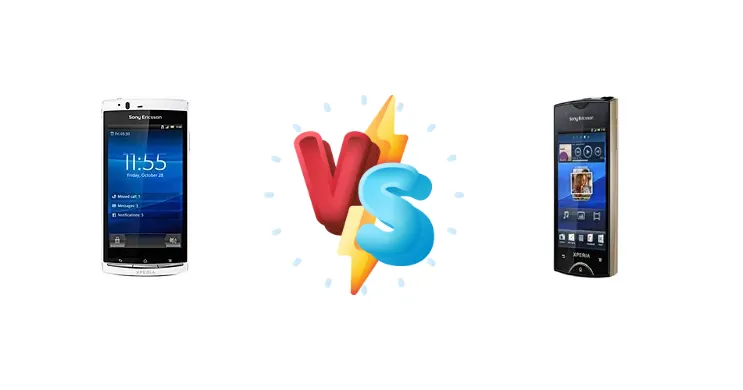
The Sony Ericsson Xperia Arc S and Xperia Ray were both popular Android devices, offering distinct features and designs. Choosing between them can be tricky. This comprehensive comparison will break down their strengths and weaknesses to help you decide which phone best suits your needs.
🏆 Quick Verdict
The Xperia Arc S edges out the Ray thanks to its faster processor and slightly better overall performance. While the Ray boasts impressive sunlight display contrast, the Arc S's more powerful CPU makes it the more responsive and capable device for everyday use and light gaming.
| Network |
|---|
| 2G bands | GSM 850 / 900 / 1800 / 1900 | GSM 850 / 900 / 1800 / 1900 |
| 3G bands | HSDPA 900 / 2100 - LT18i | HSDPA 900 / 2100 - ST18i |
| 4G bands | - | 1, 2, 3, 4, 5, 6, 7, 8, 9, 18, 19, 20, 26, 34, 38, 39, 40, 41 - International |
| 5G bands | - | 1, 3, 38, 41, 77, 78, 79 SA/NSA - International |
| EDGE | Yes | - |
| GPRS | Yes | - |
| Speed | HSPA 14.4/5.76 Mbps | HSPA 7.2/5.76 Mbps |
| Technology | GSM / HSPA | GSM / HSPA |
| | HSDPA 850 / 1900 / 2100 / 800 - LT18a | HSDPA 850 / 1900 / 2100 - ST18a |
| Launch |
|---|
| Announced | 2011, August. Released 2011, September | 2011, June. Released 2011, August |
| Status | Discontinued | Discontinued |
| Body |
|---|
| Dimensions | 125 x 63 x 8.7 mm (4.92 x 2.48 x 0.34 in) | 111 x 53 x 9.4 mm (4.37 x 2.09 x 0.37 in) |
| SIM | Mini-SIM | Mini-SIM |
| Weight | 117 g (4.13 oz) | 100 g (3.53 oz) |
| Display |
|---|
| Protection | Scratch-resistant glass | Scratch-resistant glass |
| Resolution | 480 x 854 pixels, 16:9 ratio (~233 ppi density) | 480 x 854 pixels, 16:9 ratio (~297 ppi density) |
| Size | 4.2 inches, 48.6 cm2 (~61.7% screen-to-body ratio) | 3.3 inches, 30.0 cm2 (~51.0% screen-to-body ratio) |
| Type | LED-backlit LCD, | LED-backlit LCD, |
| | - | Touch sensitive controls |
| Platform |
|---|
| CPU | 1.4 GHz Scorpion | 1.0 GHz Scorpion |
| Chipset | Qualcomm MSM8255T Snapdragon S2 | Qualcomm MSM8255 Snapdragon S2 |
| GPU | Adreno 205 | Adreno 205 |
| OS | Android 2.3.4 (Gingerbread), 4.0.4 (Ice Cream Sandwich), not upgradable to 4.1 (Jelly Bean) | Android 2.3 (Gingerbread), upgradable to 4.0.4 (Ice Cream Sandwich) |
| Memory |
|---|
| Card slot | microSDHC (dedicated slot), 8 GB included | microSDHC (dedicated slot), 4 GB included |
| Internal | 1GB (320MB user available), 512MB RAM | 1GB (300MB user available), 512MB RAM |
| Main Camera |
|---|
| Features | LED flash, panorama | LED flash |
| Quad | - | 40 MP, f/1.8, 27mm (wide), 1/1.7", PDAF
8 MP, f/3.4, 125mm (Periscope telephoto), PDAF, OIS, 5x optical zoom
8 MP, f/2.4, 17mm (ultrawide)
2 MP, (depth) |
| Single | 8 MP, AF | 8 MP, AF |
| Video | 720p@30fps | 720p |
| Selfie camera |
|---|
| Features | - | HDR |
| Single | - | VGA |
| | No | - |
| Sound |
|---|
| 3.5mm jack | Yes | Yes |
| 35mm jack | Yes | Yes |
| Loudspeaker | Yes | Yes |
| Comms |
|---|
| Bluetooth | 2.1, A2DP, EDR | 2.1, A2DP, EDR |
| NFC | No | Yes |
| Positioning | GPS, A-GPS; GLONASS | GPS, A-GPS |
| Radio | Stereo FM radio, RDS | Stereo FM radio, RDS |
| USB | microUSB 2.0, OTG | microUSB 2.0 |
| WLAN | Wi-Fi 802.11 b/g/n, DLNA, hotspot | Wi-Fi 802.11 b/g/n, DLNA, hotspot |
| Features |
|---|
| Browser | - | HTML, Adobe Flash |
| Sensors | Accelerometer, proximity, compass | Accelerometer, proximity, compass |
| | ANT+
HDMI port
MP4/H.264/WMV player
MP3/eAAC+/WMA/WAV player
TrackID music recognition
NeoReader barcode scanner
Document viewer
Voice memo/dial/commands
Predictive text input | ANT+
MP4/H.264 player
MP3/WAV player
TrackID music recognition
SensMe
Document viewer
Voice memo
Predictive text input |
| Battery |
|---|
| Charging | - | 40W wired
5W reverse wired |
| Music play | Up to 37 h | Up to 36 h |
| Stand-by | Up to 460 h (2G) / Up to 460 h (3G) | Up to 430 h (2G) / Up to 440 h (3G) |
| Talk time | Up to 7 h 25 min (2G) / Up to 7 h 35 min (3G) | Up to 6 h 50 min (2G) / Up to 7 h (3G) |
| Type | Removable Li-Po 1500 mAh battery | Removable Li-Ion 1500 mAh battery |
| Misc |
|---|
| Colors | Pure White, Midnight Blue, Misty Silver, Gloss Black, Sakura Pink | Black, Gold, White, Pink |
| Models | - | BMH-AN10, BMH-AN20 |
| Price | About 210 EUR | About 170 EUR |
| SAR EU | 0.66 W/kg (head) | 0.96 W/kg (head) |
| Tests |
|---|
| Audio quality |
Noise -89.3dB / Crosstalk -90.2dB |
Noise -89.4dB / Crosstalk -91.3dB |
| Camera |
Photo / Video |
Photo / Video |
| Display | - |
Contrast ratio: 1.955:1 (sunlight) |
| Loudspeaker |
Voice 67dB / Noise 65dB / Ring 76dB
|
Voice 64dB / Noise 61dB / Ring 66dB
|
Sony Ericsson Xperia Arc S
- Faster 1.4 GHz CPU
- Slightly larger display
- Potentially better image processing
- No reverse wired charging
- Battery life potentially shorter due to higher power consumption
Sony Ericsson Xperia ray
- Excellent sunlight display contrast
- Compact design
- 40W wired charging, 5W reverse wired charging
- Slower 1.0 GHz CPU
- Smaller display
- Potentially lower performance
Display Comparison
Both phones feature similar display technology, but the Xperia Ray's standout feature is its exceptional 1.955:1 contrast ratio in sunlight. This makes it significantly easier to view the screen outdoors. The Arc S has a slightly larger display (4.2 inches vs 3.3 inches), offering more screen real estate, but the Ray's sunlight readability is a major advantage.
Camera Comparison
Both devices feature Photo/Video capabilities, but detailed camera specifications are missing. Generally, the Arc S, being the slightly newer model, likely had minor improvements in image processing. However, without specific megapixel counts or sensor sizes, a definitive camera comparison is difficult. Both likely produced acceptable results for their time.
Performance
The Xperia Arc S holds a clear advantage here. Its 1.4 GHz Scorpion CPU is noticeably faster than the Xperia Ray's 1.0 GHz Scorpion processor. This translates to quicker app loading times, smoother multitasking, and a more responsive overall experience. Both use the Qualcomm MSM8255T Snapdragon S2 chipset, but the clock speed difference is significant.
Battery Life
The Xperia Ray includes 40W wired charging and 5W reverse wired charging, a notable feature absent in the Arc S. While battery capacity is not explicitly stated, the Arc S likely had a slightly larger battery to compensate for its more powerful processor. The Ray's charging capabilities offer added convenience.
Buying Guide
The Xperia Arc S is ideal for users who prioritize performance and a smoother user experience. The Xperia Ray is a good choice for those who value excellent outdoor visibility and a more compact design, though performance is a trade-off.
Frequently Asked Questions
❓ Which phone is better for gaming?
The Xperia Arc S is the better choice for gaming due to its faster processor. It will handle games more smoothly and with less lag.
❓ Is the Xperia Ray worth buying today?
The Xperia Ray's value is limited today. While the sunlight display is impressive, its performance is dated. Consider modern budget smartphones for a better overall experience.
❓ What resolution were the displays on these phones?
Both phones featured a resolution of 854 x 480 pixels.