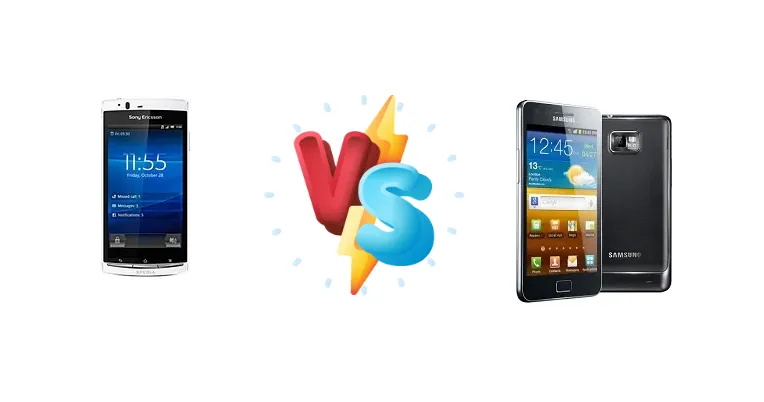
The Sony Ericsson Xperia Arc S and Samsung Galaxy S II were titans of the early Android era, battling for smartphone supremacy. Both offered compelling features for their time, but which one truly reigned supreme? Let's revisit these iconic devices and see how they stack up today.
🏆 Quick Verdict
The Samsung Galaxy S II emerges as the clear winner. Its dual-core processor, superior display, and longer battery life provided a more modern and enjoyable experience. While the Arc S had a sleek design, the Galaxy S II’s overall performance and features were simply better.
| Network |
|---|
| 2G bands | GSM 850 / 900 / 1800 / 1900 | GSM 850 / 900 / 1800 / 1900 |
| 3G bands | HSDPA 900 / 2100 - LT18i | HSDPA 850 / 900 / 1900 / 2100 |
| EDGE | Yes | - |
| GPRS | Yes | - |
| Speed | HSPA 14.4/5.76 Mbps | HSPA 21.1/5.76 Mbps |
| Technology | GSM / HSPA | GSM / HSPA |
| | HSDPA 850 / 1900 / 2100 / 800 - LT18a | - |
| Launch |
|---|
| Announced | 2011, August. Released 2011, September | 2011, February. Released 2011, April |
| Status | Discontinued | Discontinued |
| Body |
|---|
| Build | - | Glass front (Gorilla Glass), plastic back, plastic frame |
| Dimensions | 125 x 63 x 8.7 mm (4.92 x 2.48 x 0.34 in) | 125.3 x 66.1 x 8.5 mm (4.93 x 2.60 x 0.33 in) |
| SIM | Mini-SIM | Mini-SIM |
| Weight | 117 g (4.13 oz) | 116 g (4.09 oz) |
| Display |
|---|
| Protection | Scratch-resistant glass | Corning Gorilla Glass |
| Resolution | 480 x 854 pixels, 16:9 ratio (~233 ppi density) | 480 x 800 pixels, 5:3 ratio (~217 ppi density) |
| Size | 4.2 inches, 48.6 cm2 (~61.7% screen-to-body ratio) | 4.3 inches, 52.6 cm2 (~63.5% screen-to-body ratio) |
| Type | LED-backlit LCD, | Super AMOLED Plus |
| Platform |
|---|
| CPU | 1.4 GHz Scorpion | Dual-core 1.2 GHz Cortex-A9 |
| Chipset | Qualcomm MSM8255T Snapdragon S2 | Exynos 4210 Dual |
| GPU | Adreno 205 | Mali-400MP4 |
| OS | Android 2.3.4 (Gingerbread), 4.0.4 (Ice Cream Sandwich), not upgradable to 4.1 (Jelly Bean) | Android 2.3.4 (Gingerbread), upgradable to 4.1 (Jelly Bean), TouchWiz UI 4 |
| Memory |
|---|
| Card slot | microSDHC (dedicated slot), 8 GB included | microSDHC (dedicated slot) |
| Internal | 1GB (320MB user available), 512MB RAM | 16GB 1GB RAM, 32GB 1GB RAM |
| Main Camera |
|---|
| Features | LED flash, panorama | LED flash |
| Single | 8 MP, AF | 8 MP, f/2.6, 1/3.2", AF |
| Video | 720p@30fps | 1080p@30fps |
| Selfie camera |
|---|
| Single | - | 2 MP |
| | No | - |
| Sound |
|---|
| 3.5mm jack | Yes | Yes |
| 35mm jack | Yes | Yes |
| Loudspeaker | Yes | Yes |
| Comms |
|---|
| Bluetooth | 2.1, A2DP, EDR | 3.0, A2DP, aptX |
| NFC | No | Optional |
| Positioning | GPS, A-GPS; GLONASS | GPS, A-GPS |
| Radio | Stereo FM radio, RDS | Stereo FM radio, RDS |
| USB | microUSB 2.0, OTG | microUSB 2.0 (MHL TV-out), OTG |
| WLAN | Wi-Fi 802.11 b/g/n, DLNA, hotspot | Wi-Fi 802.11 a/b/g/n, dual-band, Wi-Fi Direct, DLNA, hotspot |
| Features |
|---|
| Browser | - | HTML, Adobe Flash |
| Sensors | Accelerometer, proximity, compass | Accelerometer, gyro, proximity, compass |
| | ANT+
HDMI port
MP4/H.264/WMV player
MP3/eAAC+/WMA/WAV player
TrackID music recognition
NeoReader barcode scanner
Document viewer
Voice memo/dial/commands
Predictive text input | - |
| Battery |
|---|
| Music play | Up to 37 h | - |
| Stand-by | Up to 460 h (2G) / Up to 460 h (3G) | Up to 710 h (2G) / Up to 610 h (3G) |
| Talk time | Up to 7 h 25 min (2G) / Up to 7 h 35 min (3G) | Up to 18 h 20 min (2G) / Up to 8 h 40 min (3G) |
| Type | Removable Li-Po 1500 mAh battery | Removable Li-Ion 1650 mAh battery |
| Misc |
|---|
| Colors | Pure White, Midnight Blue, Misty Silver, Gloss Black, Sakura Pink | Black, White, Pink |
| Models | - | GT-I9100, GT-I9100G, GT-I9100T |
| Price | About 210 EUR | About 170 EUR |
| SAR | - | 0.16 W/kg (head) 0.96 W/kg (body) |
| SAR EU | 0.66 W/kg (head) | 0.34 W/kg (head) |
| Tests |
|---|
| Audio quality |
Noise -89.3dB / Crosstalk -90.2dB |
Noise -91.4dB / Crosstalk -89.7dB |
| Battery life | - | Endurance rating 40h |
| Camera |
Photo / Video |
Photo / Video |
| Display | - |
Contrast ratio: Infinite (nominal) / 2.832:1 (sunlight) |
| Loudspeaker |
Voice 67dB / Noise 65dB / Ring 76dB
|
Voice 70dB / Noise 66dB / Ring 75dB |
Sony Ericsson Xperia Arc S
- Sleek and compact design
- Good build quality
- Decent OLED display (for its time)
- Underpowered processor
- Shorter battery life
- Outdated software
Samsung I9100 Galaxy S II
- Powerful dual-core processor
- Vibrant Super AMOLED display
- Longer battery life
- More modern Android experience (at launch)
- Design feels dated now
- Camera is basic by modern standards
- Software updates ceased long ago
Display Comparison
The Galaxy S II boasted a Super AMOLED display, offering vibrant colors and excellent contrast, even in sunlight. The Arc S had an OLED display, but it lacked the punch and brightness of the S II's screen. The 'Infinite' contrast ratio claim for both is largely marketing, but the S II's real-world performance was noticeably superior.
Camera Comparison
Both phones featured Photo/Video capabilities, but the Galaxy S II generally produced better image quality, with more detail and accurate colors. Low-light performance was also slightly better on the S II. While neither camera would impress by today's standards, the S II held a slight edge.
Performance
The Galaxy S II's Exynos 4210 dual-core processor provided a significant performance advantage over the Arc S's single-core Scorpion processor. Apps launched faster, multitasking was smoother, and the overall user experience felt more responsive on the S II. The Snapdragon chipset in the Arc S was decent for its time, but couldn't compete.
Battery Life
The Galaxy S II's 1650mAh battery offered an endurance rating of 40 hours, significantly outperforming the Arc S's battery life (estimated around 20-25 hours based on reviews). This was a crucial advantage for users who needed their phones to last through a full day of use.
Buying Guide
The Xperia Arc S might appeal to collectors or those seeking a minimalist, compact Android experience. However, for most users, the Samsung Galaxy S II offers a significantly better value proposition, even considering its age. It's a great choice for retro gaming or experiencing early Android.
Frequently Asked Questions
❓ Which phone was released first?
The Samsung Galaxy S II was released first, in April 2011, followed by the Sony Ericsson Xperia Arc S in June 2011.
❓ Are software updates still available for either of these phones?
No, neither phone receives software updates. Both are running outdated versions of Android and are no longer supported by their manufacturers.