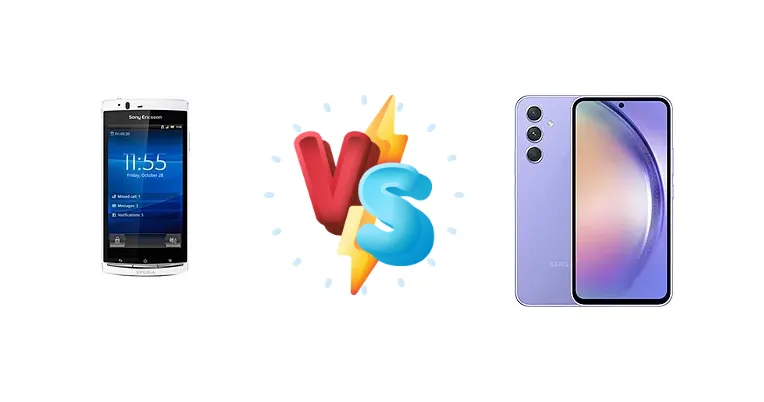
The Sony Ericsson Xperia Arc S represents a bygone era of Android, while the Samsung Galaxy A54 embodies modern smartphone technology. This comparison explores how these devices stack up against each other, considering their strengths and weaknesses across various categories.
🏆 Quick Verdict
The Samsung Galaxy A54 is the clear winner. While the Arc S holds nostalgic appeal, the A54's superior performance, camera, battery life, and modern features make it a far more practical and capable device for today's users. It's a testament to how far smartphone technology has advanced.
| Network |
|---|
| 2G bands | GSM 850 / 900 / 1800 / 1900 | GSM 850 / 900 / 1800 / 1900 |
| 3G bands | HSDPA 900 / 2100 - LT18i | HSDPA 850 / 900 / 1700(AWS) / 1900 / 2100 |
| 4G bands | - | 1, 2, 3, 4, 5, 7, 8, 12, 17, 20, 26, 28, 32, 38, 40, 41, 66 - International |
| 5G bands | - | 1, 3, 7, 8, 20, 28, 38, 40, 41, 77, 78 SA/NSA/Sub6 - International |
| EDGE | Yes | - |
| GPRS | Yes | - |
| Speed | HSPA 14.4/5.76 Mbps | HSPA, LTE, 5G |
| Technology | GSM / HSPA | GSM / HSPA / LTE / 5G |
| | HSDPA 850 / 1900 / 2100 / 800 - LT18a | 25, 41, 66, 71 SA/NSA/Sub6/mmWave - USA |
| Launch |
|---|
| Announced | 2011, August. Released 2011, September | 2023, March 15 |
| Status | Discontinued | Available. Released 2023, March 24 |
| Body |
|---|
| Build | - | Glass front (Gorilla Glass 5), glass back (Gorilla Glass 5), plastic frame |
| Dimensions | 125 x 63 x 8.7 mm (4.92 x 2.48 x 0.34 in) | 158.2 x 76.7 x 8.2 mm (6.23 x 3.02 x 0.32 in) |
| SIM | Mini-SIM | · Nano-SIM + eSIM· Nano-SIM + Nano-SIM |
| Weight | 117 g (4.13 oz) | 202 g (7.13 oz) |
| | - | IP67 dust/water resistant (up to 1m for 30 min) |
| Display |
|---|
| Protection | Scratch-resistant glass | Corning Gorilla Glass 5 |
| Resolution | 480 x 854 pixels, 16:9 ratio (~233 ppi density) | 1080 x 2340 pixels, 19.5:9 ratio (~403 ppi density) |
| Size | 4.2 inches, 48.6 cm2 (~61.7% screen-to-body ratio) | 6.4 inches, 100.5 cm2 (~82.9% screen-to-body ratio) |
| Type | LED-backlit LCD, | Super AMOLED, 120Hz, HDR10+, 1000 nits (HBM) |
| Platform |
|---|
| CPU | 1.4 GHz Scorpion | Octa-core (4x2.4 GHz Cortex-A78 & 4x2.0 GHz Cortex-A55) |
| Chipset | Qualcomm MSM8255T Snapdragon S2 | Exynos 1380 (5 nm) |
| GPU | Adreno 205 | Mali-G68 MP5 |
| OS | Android 2.3.4 (Gingerbread), 4.0.4 (Ice Cream Sandwich), not upgradable to 4.1 (Jelly Bean) | Android 13, up to 4 major Android upgrades, One UI 7 |
| Memory |
|---|
| Card slot | microSDHC (dedicated slot), 8 GB included | microSDXC (uses shared SIM slot) |
| Internal | 1GB (320MB user available), 512MB RAM | 128GB 4GB RAM, 128GB 6GB RAM, 128GB 8GB RAM, 256GB 6GB RAM, 256GB 8GB RAM |
| Main Camera |
|---|
| Features | LED flash, panorama | LED flash, panorama, HDR |
| Single | 8 MP, AF | 32 MP, f/2.2, 26mm (wide), 1/2.8", 0.8µm |
| Triple | - | 50 MP, f/1.8, 23mm (wide), 1/1.56", 1.0µm, PDAF, OIS
12 MP, f/2.2, 13mm, 123˚ (ultrawide), 1/3.X", 1.12µm
5 MP (macro) |
| Video | 720p@30fps | 4K@30fps, 1080p@30/60fps, 720p@480fps, gyro-EIS |
| Selfie camera |
|---|
| Single | - | 32 MP, f/2.2, 26mm (wide), 1/2.8", 0.8µm |
| Video | - | 4K@30fps, 1080p@30/60fps |
| | No | - |
| Sound |
|---|
| 3.5mm jack | Yes | No |
| 35mm jack | Yes | No |
| Loudspeaker | Yes | Yes, with stereo speakers |
| Comms |
|---|
| Bluetooth | 2.1, A2DP, EDR | 5.3, A2DP, LE |
| NFC | No | Yes (market/region dependent) |
| Positioning | GPS, A-GPS; GLONASS | GPS, GLONASS, GALILEO, BDS |
| Radio | Stereo FM radio, RDS | No |
| USB | microUSB 2.0, OTG | USB Type-C 2.0, OTG |
| WLAN | Wi-Fi 802.11 b/g/n, DLNA, hotspot | Wi-Fi 802.11 a/b/g/n/ac/6, dual-band, Wi-Fi Direct |
| Features |
|---|
| Sensors | Accelerometer, proximity, compass | Fingerprint (under display, optical), accelerometer, gyro, compass, barometer (USA only) |
| | ANT+
HDMI port
MP4/H.264/WMV player
MP3/eAAC+/WMA/WAV player
TrackID music recognition
NeoReader barcode scanner
Document viewer
Voice memo/dial/commands
Predictive text input | Virtual proximity sensing |
| Battery |
|---|
| Charging | - | 25W wired |
| Music play | Up to 37 h | - |
| Stand-by | Up to 460 h (2G) / Up to 460 h (3G) | - |
| Talk time | Up to 7 h 25 min (2G) / Up to 7 h 35 min (3G) | - |
| Type | Removable Li-Po 1500 mAh battery | 5000 mAh |
| Misc |
|---|
| Colors | Pure White, Midnight Blue, Misty Silver, Gloss Black, Sakura Pink | Lime, Graphite, Violet, White |
| Models | - | SM-A546V, SM-A546U, SM-A546U1, SM-A546B, SM-A546B/DS, SM-A546E, SM-A546E/DS, SM-A5460, SM-A546M, SM-A546M/DS, SM-A546W |
| Price | About 210 EUR | € 210.00 / $ 119.11 / £ 169.95 / ₹ 28,999 |
| SAR | - | 0.81 W/kg (head) 0.67 W/kg (body) |
| SAR EU | 0.66 W/kg (head) | 0.69 W/kg (head) 1.34 W/kg (body) |
| Tests |
|---|
| Audio quality |
Noise -89.3dB / Crosstalk -90.2dB | - |
| Battery life | - |
Endurance rating 119h
|
| Camera |
Photo / Video |
Photo / Video |
| Display | - |
Contrast ratio: Infinite (nominal) |
| Loudspeaker |
Voice 67dB / Noise 65dB / Ring 76dB
|
-26.6 LUFS (Good)
|
| Performance | - |
AnTuTu: 506678 (v9)
GeekBench: 2703 (v5.1), 2797 (v6)
GFXBench: 25fps (ES 3.1 onscreen) |
Sony Ericsson Xperia Arc S
- Compact size
- Retro design
- Simple Android experience (for its time)
- Outdated performance
- Poor battery life
- Low-resolution display
- Limited app compatibility
- Basic camera
Samsung Galaxy A54
- Excellent battery life
- Bright and vibrant display
- Powerful performance
- Great camera system
- Modern features (5G, NFC)
- Water resistance
- Can be slightly bulky
- Charging speed could be faster (25W)
Display Comparison
The Galaxy A54 boasts a significantly brighter and more vibrant display with a nominal infinite contrast ratio, offering a far superior viewing experience compared to the Arc S's older LCD panel. The A54's 980 nits brightness is a game-changer in outdoor visibility.
Camera Comparison
While both offer 'Photo / Video' capabilities, the Galaxy A54's camera system is vastly more advanced. Expect significantly better image quality, dynamic range, and video recording capabilities from the A54. The Arc S's camera is adequate for its time but falls far short of modern standards.
Performance
The Exynos 1380 in the Galaxy A54 provides a massive performance advantage over the Arc S's 1.4 GHz Scorpion processor. The A54's octa-core CPU handles multitasking and demanding apps with ease, while the Arc S struggles with modern software.
Battery Life
The Galaxy A54's battery life is exceptional, with an endurance rating of 119h (old) and an active use score of 11:15h. The Arc S, by comparison, offered a considerably shorter battery life, typical of older smartphones.
Buying Guide
The Sony Ericsson Xperia Arc S is for collectors, Android enthusiasts seeking a retro experience, or those wanting a simple, compact phone. The Samsung Galaxy A54 is for anyone needing a reliable, feature-rich smartphone with a great camera, long battery life, and a vibrant display – a solid all-around choice.
Frequently Asked Questions
❓ Is the Xperia Arc S worth buying in 2024?
Only for collectors or those seeking a specific retro Android experience. It's not a practical daily driver.
❓ What are the biggest differences between these two phones?
Performance, display quality, camera capabilities, and battery life are the most significant differences. The A54 is a modern, high-performing device, while the Arc S is a relic of the past.