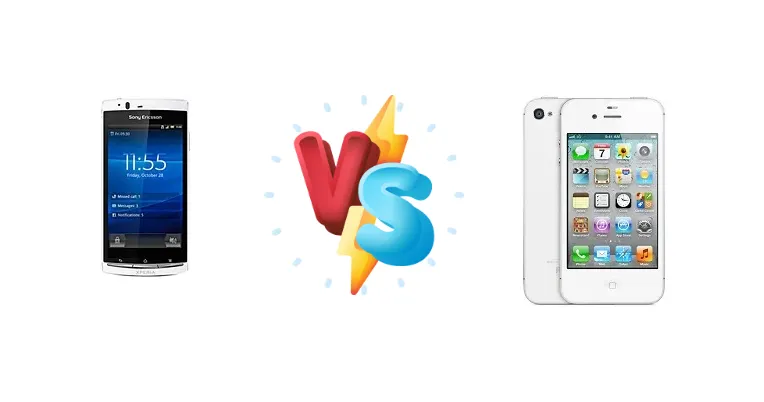
The Xperia Arc S and iPhone 4s represent a fascinating era in smartphone history. Both devices were flagship contenders in their time, boasting innovative features and distinct design philosophies. Let's revisit these classics and see how they stack up against each other in a modern context.
🏆 Quick Verdict
The iPhone 4s edges out the Xperia Arc S due to its superior app ecosystem, smoother iOS experience, and generally more refined software. While the Arc S offered a beautiful display and decent performance, the iPhone 4s's overall polish and longevity give it the slight advantage.
| Network |
|---|
| 2G bands | GSM 850 / 900 / 1800 / 1900 | GSM 850 / 900 / 1800 / 1900 |
| 3G bands | HSDPA 900 / 2100 - LT18i | HSDPA 850 / 900 / 1900 / 2100 |
| EDGE | Yes | - |
| GPRS | Yes | - |
| Speed | HSPA 14.4/5.76 Mbps | HSPA 14.4/5.76 Mbps |
| Technology | GSM / HSPA | GSM / CDMA / HSPA / EVDO |
| | HSDPA 850 / 1900 / 2100 / 800 - LT18a | CDMA2000 1xEV-DO |
| Launch |
|---|
| Announced | 2011, August. Released 2011, September | 2011, October 04. Released 2011, October 14 |
| Status | Discontinued | Discontinued |
| Body |
|---|
| Build | - | Glass front (Corning-made glass), glass back, stainless steel frame |
| Dimensions | 125 x 63 x 8.7 mm (4.92 x 2.48 x 0.34 in) | 115.2 x 58.6 x 9.3 mm (4.54 x 2.31 x 0.37 in) |
| SIM | Mini-SIM | Micro-SIM |
| Weight | 117 g (4.13 oz) | 140 g (4.94 oz) |
| | - | Scratch-resistant glass back panel |
| Display |
|---|
| Protection | Scratch-resistant glass | Corning Gorilla Glass, oleophobic coating |
| Resolution | 480 x 854 pixels, 16:9 ratio (~233 ppi density) | 640 x 960 pixels, 3:2 ratio (~330 ppi density) |
| Size | 4.2 inches, 48.6 cm2 (~61.7% screen-to-body ratio) | 3.5 inches, 36.5 cm2 (~54.0% screen-to-body ratio) |
| Type | LED-backlit LCD, | IPS LCD |
| Platform |
|---|
| CPU | 1.4 GHz Scorpion | Dual-core 1.0 GHz Cortex-A9 |
| Chipset | Qualcomm MSM8255T Snapdragon S2 | Apple A5 (45 nm) |
| GPU | Adreno 205 | PowerVR SGX543MP2 |
| OS | Android 2.3.4 (Gingerbread), 4.0.4 (Ice Cream Sandwich), not upgradable to 4.1 (Jelly Bean) | iOS 5, upgradable to iOS 9.3.6 |
| Memory |
|---|
| Card slot | microSDHC (dedicated slot), 8 GB included | No |
| Internal | 1GB (320MB user available), 512MB RAM | 8GB 512MB RAM, 16GB 512MB RAM, 32GB 512MB RAM, 64GB 512MB RAM |
| Main Camera |
|---|
| Features | LED flash, panorama | LED flash, panorama, HDR |
| Single | 8 MP, AF | 8 MP, f/2.4, 35mm (standard), 1/3.2", 1.4µm, AF |
| Video | 720p@30fps | 1080p@30fps |
| Selfie camera |
|---|
| Single | - | VGA, videocalling over Wi-Fi and 3G |
| Video | - | 480p@30fps |
| | No | - |
| Sound |
|---|
| 3.5mm jack | Yes | Yes |
| 35mm jack | Yes | Yes |
| Loudspeaker | Yes | Yes |
| Comms |
|---|
| Bluetooth | 2.1, A2DP, EDR | 4.0, A2DP, LE |
| NFC | No | - |
| Positioning | GPS, A-GPS; GLONASS | GPS, A-GPS, GLONASS |
| Radio | Stereo FM radio, RDS | No |
| USB | microUSB 2.0, OTG | 2.0 |
| WLAN | Wi-Fi 802.11 b/g/n, DLNA, hotspot | Wi-Fi 802.11 b/g/n, hotspot |
| Features |
|---|
| Sensors | Accelerometer, proximity, compass | Accelerometer, gyro, proximity, compass |
| | ANT+
HDMI port
MP4/H.264/WMV player
MP3/eAAC+/WMA/WAV player
TrackID music recognition
NeoReader barcode scanner
Document viewer
Voice memo/dial/commands
Predictive text input | - |
| Battery |
|---|
| Music play | Up to 37 h | - |
| Stand-by | Up to 460 h (2G) / Up to 460 h (3G) | Up to 200 h (3G) |
| Talk time | Up to 7 h 25 min (2G) / Up to 7 h 35 min (3G) | Up to 8 h (3G) |
| Type | Removable Li-Po 1500 mAh battery | Li-Po 1432 mAh, non-removable (5.3 Wh) |
| Misc |
|---|
| Colors | Pure White, Midnight Blue, Misty Silver, Gloss Black, Sakura Pink | Black, White |
| Models | - | A1431, A1387, iPhone4,1 |
| Price | About 210 EUR | About 190 EUR |
| SAR | - | 1.18 W/kg (head) 0.98 W/kg (body) |
| SAR EU | 0.66 W/kg (head) | 0.99 W/kg (head) 0.99 W/kg (body) |
| Tests |
|---|
| Audio quality |
Noise -89.3dB / Crosstalk -90.2dB |
Noise -91.2dB / Crosstalk -93.0dB |
| Battery life | - |
Endurance rating 45h
|
| Camera |
Photo / Video |
Photo / Video |
| Display | - |
Contrast ratio: 1261:1 (nominal) / 2.269:1 (sunlight) |
| Loudspeaker |
Voice 67dB / Noise 65dB / Ring 76dB
|
Voice 65dB / Noise 64dB / Ring 74dB
|
Sony Ericsson Xperia Arc S
- Beautiful Reality Display
- Sleek and minimalist design
- Android customization
- Decent camera with manual controls
- Shorter battery life
- Less powerful processor compared to iPhone 4s
- Software updates ceased long ago
- Less polished user experience
Apple iPhone 4s
- Smooth iOS experience
- Strong app ecosystem
- Excellent battery life
- Refined hardware and software integration
- Generally more reliable
- Older technology
- Smaller screen compared to Arc S
- Limited storage options in some models
- No expandable storage
Display Comparison
The Xperia Arc S boasted a vibrant 4.2-inch Reality Display with Mobile BRAVIA Engine, known for its excellent contrast and color reproduction. The iPhone 4s featured a 3.5-inch Retina display, also lauded for its clarity and sharpness. While both offered impressive contrast ratios (1261:1 nominal, 2.269:1 sunlight), the Arc S's larger size gives it a slight edge for media consumption.
Camera Comparison
Both phones featured 8MP cameras. The iPhone 4s's camera was known for its consistent image quality and ease of use. The Xperia Arc S offered slightly more manual controls, but image processing wasn't as refined. Video recording capabilities were comparable, both offering 1080p recording.
Performance
The iPhone 4s's dual-core 1.0 GHz Cortex-A9 chip, paired with Apple's A5 chipset, generally provided a smoother and more responsive experience than the Xperia Arc S's 1.4 GHz Scorpion processor and Qualcomm MSM8255T Snapdragon S2 chipset. iOS was optimized for the hardware, leading to better overall performance, especially in multitasking.
Battery Life
The iPhone 4s held a significant advantage in battery life, with an endurance rating of 45 hours. The Xperia Arc S's battery life was considerably shorter, typically lasting a day with moderate use.
Buying Guide
The Sony Ericsson Xperia Arc S is for enthusiasts who appreciate Android's customization options and a sleek, minimalist design. The iPhone 4s is ideal for users seeking a reliable, user-friendly experience with access to a vast app library and strong brand recognition, even in the used market.
Frequently Asked Questions
❓ Are spare parts readily available for these phones?
Spare parts for both phones can be found online, but availability is decreasing as they are older models. Expect to pay a premium for quality parts.
❓ Can I still use these phones with a modern mobile network?
Both phones support 3G networks. 4G/LTE support is limited or non-existent, so you may experience slower data speeds on modern networks.