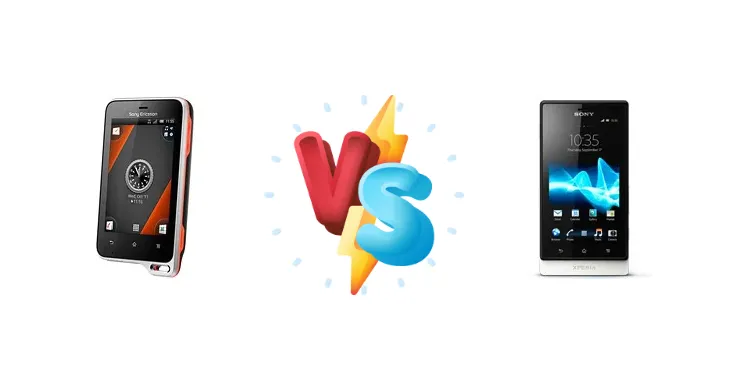
The Sony Ericsson Xperia active and Xperia sola were both mid-range Android phones released around the same time, targeting different user needs. The active focused on durability, while the sola aimed for a slightly more premium experience. Let's dive into a head-to-head comparison to see which one holds up better today.
🏆 Quick Verdict
The Xperia sola edges out the active thanks to its dual-core processor and generally smoother performance. While the active boasts ruggedness, the sola's improved speed and slightly better display make it the more appealing choice for most users, especially considering their age.
| Network |
|---|
| 2G bands | GSM 850 / 900 / 1800 / 1900 | GSM 850 / 900 / 1800 / 1900 |
| 3G bands | HSDPA 900 / 2100 | HSDPA 850 / 900 / 1900 / 2100 |
| EDGE | No | - |
| GPRS | Yes | - |
| Speed | HSPA 7.2/5.76 Mbps | HSPA 14.4/5.76 Mbps |
| Technology | GSM / HSPA | GSM / HSPA |
| | HSDPA 1900 / 2100 / 800 | - |
| Launch |
|---|
| Announced | 2011, June. Released 2011, October | 2012, March. Released 2012, May |
| Status | Discontinued | Discontinued |
| Body |
|---|
| Dimensions | 92 x 55 x 16.5 mm (3.62 x 2.17 x 0.65 in) | 116 x 59 x 9.9 mm (4.57 x 2.32 x 0.39 in) |
| SIM | Mini-SIM | Mini-SIM |
| Weight | 110.8 g (3.88 oz) | 107 g (3.77 oz) |
| | IP67 dust/water resistant (up to 1m for 30 min)
Flashlight | - |
| Display |
|---|
| Protection | Scratch-resistant glass | Scratch-resistant glass |
| Resolution | 320 x 480 pixels, 3:2 ratio (~192 ppi density) | 480 x 854 pixels, 16:9 ratio (~265 ppi density) |
| Size | 3.0 inches, 26.8 cm2 (~53.0% screen-to-body ratio) | 3.7 inches, 37.7 cm2 (~55.1% screen-to-body ratio) |
| Type | LED-backlit LCD, | LED-backlit LCD, |
| | Touch sensitive controls | Floating touch display |
| Platform |
|---|
| CPU | 1.0 GHz Scorpion | Dual-core 1.0 GHz Cortex-A9 |
| Chipset | Qualcomm MSM8255 Snapdragon S2 | NovaThor U8500 |
| GPU | Adreno 205 | Mali-400 |
| OS | Android 2.3 (Gingerbread), upgradable to 4.0 (Ice Cream Sandwich) | Android 2.3 (Gingerbread), upgradable to 4.0 (Ice Cream Sandwich) |
| Memory |
|---|
| Call records | Yes | - |
| Card slot | microSDHC (dedicated slot), 2 GB included | microSDHC (dedicated slot) |
| Internal | 1GB (320MB user available), 512MB RAM | 8GB (5GB user available), 512MB RAM |
| Phonebook | Yes, up to 500 entries | - |
| Main Camera |
|---|
| Features | LED flash | LED flash, panorama |
| Single | 5 MP, AF | 5 MP, AF |
| Video | 720p | 720p@30fps |
| Sound |
|---|
| 3.5mm jack | Yes | Yes |
| 35mm jack | Yes | Yes |
| Alert types | Vibration; Polyphonic, MP3, WAV ringtones | - |
| Loudspeaker | Yes | Yes |
| | - | 3D surround sound
|
| Comms |
|---|
| Bluetooth | 2.1, A2DP, EDR | 3.0, A2DP, EDR |
| NFC | - | Yes |
| Positioning | GPS, A-GPS | GPS, A-GPS |
| Radio | Stereo FM radio, RDS | Stereo FM radio, RDS |
| USB | microUSB 2.0 | microUSB 2.0, OTG |
| WLAN | Wi-Fi 802.11 b/g/n, DLNA, hotspot | Wi-Fi 802.11 b/g/n, DLNA, hotspot |
| Features |
|---|
| Browser | HTML, Adobe Flash | - |
| Games | Yes | - |
| Java | No | - |
| Messaging | SMS | - |
| Sensors | Accelerometer, proximity, compass | Accelerometer, proximity, compass |
| | ANT+
MP4/H.264 player
MP3/eAAC+/WAV player
TrackID music recognition
Document viewer
Voice memo
Predictive text input | MP4/H.264/WMV player
MP3/eAAC+/WMA/WAV player
Document viewer
Voice memo/dial/commands
Predictive text input |
| Battery |
|---|
| Music play | Up to 25 h | Up to 40 h |
| Stand-by | Up to 351 h (2G) / Up to 335 h (3G) | Up to 470 h (2G) / Up to 475 h (3G) |
| Talk time | Up to 4 h 53 min (2G) / Up to 5 h 31 min (3G) | Up to 6 h (2G) / Up to 5 h (3G) |
| Type | Removable Li-Ion 1200 mAh battery | Non-removable Li-Ion 1320 mAh battery |
| Misc |
|---|
| Colors | Orange/Black, White/Black | Black, White, Red |
| Price | About 170 EUR | About 120 EUR |
| SAR | 1.12 W/kg (head) 1.07 W/kg (body) | - |
| SAR EU | - | 1.25 W/kg (head) |
| Tests |
|---|
| Audio quality |
Noise -89.5dB / Crosstalk -91.4dB |
Noise -81.6dB / Crosstalk -83.5dB |
| Camera |
Photo / Video |
Photo / Video |
| Display | - |
Contrast ratio: 1002:1 (nominal) |
| Loudspeaker |
Voice 70dB / Noise 64dB / Ring 68dB
|
Voice 60dB / Noise 59dB / Ring 61dB
|
Sony Ericsson Xperia active
- Rugged and durable design
- Water and dust resistant
- Compact size
- Outdated single-core processor
- Lower performance
- Likely inferior display quality
- Limited app compatibility
Sony Xperia sola
- Dual-core processor for better performance
- Potentially better display quality
- Slightly more modern design
- Generally smoother user experience
- Less rugged than the active
- Battery life potentially shorter
- Outdated hardware by today's standards
- Limited app compatibility
Display Comparison
Both phones feature a nominal contrast ratio of 1002:1, suggesting decent black levels. However, the Xperia sola likely has a slightly better overall display quality due to potentially better color accuracy and brightness, although specific display panel details are scarce. The active's screen is functional but less impressive.
Camera Comparison
Both phones feature 'Photo / Video' cameras, but specific megapixel counts and features are not provided. Generally, the Xperia sola's more powerful processor might allow for slightly better image processing, but both cameras are likely to produce comparable results given their age and limitations. Expect decent photos in good lighting conditions, but struggles in low light.
Performance
This is where the Xperia sola shines. Its dual-core 1.0 GHz Cortex-A9 processor significantly outperforms the Xperia active's single-core 1.0 GHz Scorpion. Expect smoother multitasking, faster app loading, and a more responsive user experience on the sola. The active can feel sluggish by today's standards.
Battery Life
Battery capacity information is missing for both devices. However, considering the Xperia sola's more powerful processor, it likely consumes more power. The Xperia active, with its less demanding hardware, *might* offer slightly better battery life, but this is speculative without concrete data.
Buying Guide
The Xperia active is ideal for those prioritizing durability and a rugged design, perhaps for outdoor enthusiasts or those prone to accidents. The Xperia sola is a better fit for users seeking a slightly more refined experience with improved performance for everyday tasks and a better display.
Frequently Asked Questions
❓ Are these phones still worth buying?
Given their age, neither phone is recommended for primary use. They lack modern features and app compatibility. However, they could be interesting for collectors or as secondary devices for very basic tasks.
❓ Which phone is more durable?
The Xperia active is significantly more durable due to its ruggedized design and water/dust resistance.