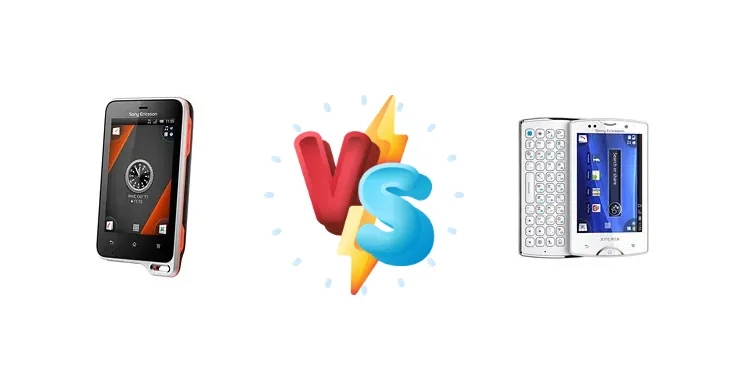
The Sony Ericsson Xperia Active and Mini Pro were both solid Android devices from a bygone era. Both offered unique features, but catered to slightly different users. This comparison dives deep into their strengths and weaknesses to help you understand which phone was the better choice back in the day, and what their legacy represents.
🏆 Quick Verdict
The Xperia Mini Pro edges out the Active due to its physical keyboard, offering a superior typing experience. While both share similar processing power, the Mini Pro's display and overall design give it a slight advantage. Both are dated now, but the Mini Pro retains a niche appeal for keyboard enthusiasts.
| Network |
|---|
| 2G bands | GSM 850 / 900 / 1800 / 1900 | GSM 850 / 900 / 1800 / 1900 |
| 3G bands | HSDPA 900 / 2100 | HSDPA 900 / 2100 |
| EDGE | No | - |
| GPRS | Yes | - |
| Speed | HSPA 7.2/5.76 Mbps | HSPA 7.2/5.76 Mbps |
| Technology | GSM / HSPA | GSM / HSPA |
| | HSDPA 1900 / 2100 / 800 | HSDPA 850 / 1900 / 2100 |
| Launch |
|---|
| Announced | 2011, June. Released 2011, October | 2011, May. Released 2011, August |
| Status | Discontinued | Discontinued |
| Body |
|---|
| Dimensions | 92 x 55 x 16.5 mm (3.62 x 2.17 x 0.65 in) | 92 x 53 x 18 mm (3.62 x 2.09 x 0.71 in) |
| Keyboard | - | QWERTY |
| SIM | Mini-SIM | Mini-SIM |
| Weight | 110.8 g (3.88 oz) | 136 g (4.80 oz) |
| | IP67 dust/water resistant (up to 1m for 30 min)
Flashlight | - |
| Display |
|---|
| Protection | Scratch-resistant glass | Scratch-resistant glass |
| Resolution | 320 x 480 pixels, 3:2 ratio (~192 ppi density) | 320 x 480 pixels, 3:2 ratio (~192 ppi density) |
| Size | 3.0 inches, 26.8 cm2 (~53.0% screen-to-body ratio) | 3.0 inches, 26.8 cm2 (~55.0% screen-to-body ratio) |
| Type | LED-backlit LCD, | LED-backlit LCD, |
| | Touch sensitive controls | - |
| Platform |
|---|
| CPU | 1.0 GHz Scorpion | 1.0 GHz Scorpion |
| Chipset | Qualcomm MSM8255 Snapdragon S2 | Qualcomm MSM8255 Snapdragon S2 |
| GPU | Adreno 205 | Adreno 205 |
| OS | Android 2.3 (Gingerbread), upgradable to 4.0 (Ice Cream Sandwich) | Android 2.3 (Gingerbread), 4.0 (Ice Cream Sandwich), not upgradable to 4.1 (Jelly Bean) |
| Memory |
|---|
| Call records | Yes | - |
| Card slot | microSDHC (dedicated slot), 2 GB included | microSDHC (dedicated slot), 2 GB included |
| Internal | 1GB (320MB user available), 512MB RAM | 512MB RAM, 400MB |
| Phonebook | Yes, up to 500 entries | - |
| Main Camera |
|---|
| Features | LED flash | LED flash |
| Single | 5 MP, AF | 5 MP, AF |
| Video | 720p | 720p |
| Selfie camera |
|---|
| Single | - | VGA |
| | No | - |
| Sound |
|---|
| 3.5mm jack | Yes | Yes |
| 35mm jack | Yes | Yes |
| Alert types | Vibration; Polyphonic, MP3, WAV ringtones | - |
| Loudspeaker | Yes | Yes |
| Comms |
|---|
| Bluetooth | 2.1, A2DP, EDR | 2.1, A2DP |
| Positioning | GPS, A-GPS | GPS, A-GPS |
| Radio | Stereo FM radio, RDS | Stereo FM radio, RDS |
| USB | microUSB 2.0 | microUSB 2.0 |
| WLAN | Wi-Fi 802.11 b/g/n, DLNA, hotspot | Wi-Fi 802.11 b/g/n, DLNA, hotspot |
| Features |
|---|
| Browser | HTML, Adobe Flash | HTML, Adobe Flash |
| Games | Yes | - |
| Java | No | - |
| Messaging | SMS | - |
| Sensors | Accelerometer, proximity, compass | Accelerometer, proximity, compass |
| | ANT+
MP4/H.264 player
MP3/eAAC+/WAV player
TrackID music recognition
Document viewer
Voice memo
Predictive text input | ANT+
MP4/H.264/WMV player
MP3/eAAC+/WMA/WAV player
TrackID music recognition
Document viewer
Voice memo
Predictive text input |
| Battery |
|---|
| Music play | Up to 25 h | Up to 29 h |
| Stand-by | Up to 351 h (2G) / Up to 335 h (3G) | Up to 331 h (2G) / Up to 340 h (3G) |
| Talk time | Up to 4 h 53 min (2G) / Up to 5 h 31 min (3G) | Up to 5 h 40 min (2G) / Up to 5 h 25 min (3G) |
| Type | Removable Li-Ion 1200 mAh battery | Removable Li-Ion 1200 mAh battery |
| Misc |
|---|
| Colors | Orange/Black, White/Black | Black, White, Pink, Turquoise |
| Price | About 170 EUR | About 140 EUR |
| SAR | 1.12 W/kg (head) 1.07 W/kg (body) | - |
| SAR EU | - | 0.46 W/kg (head) |
| Tests |
|---|
| Audio quality |
Noise -89.5dB / Crosstalk -91.4dB |
Noise -89.7dB / Crosstalk -91.0dB |
| Camera |
Photo / Video |
Photo / Video |
| Display | - |
Contrast ratio: 714:1 (nominal) |
| Loudspeaker |
Voice 70dB / Noise 64dB / Ring 68dB
|
Voice 70dB / Noise 62dB / Ring 70dB |
Sony Ericsson Xperia active
- Rugged and durable design
- Compact size
- Slightly better battery life (potentially)
- Water and dust resistant
- Subpar display quality
- Limited multitasking performance
- Basic camera
- Less refined design
Sony Ericsson Xperia mini pro
- Physical QWERTY keyboard
- Slightly better display contrast
- More refined design
- Compact size
- Smaller battery capacity
- Limited multitasking performance
- Basic camera
- Keyboard can feel cramped for larger hands
Display Comparison
The Xperia Mini Pro boasts a slightly better display, primarily due to its contrast ratio of 714:1 (nominal). While both phones featured relatively small screens (Active: 3.0" HVGA, Mini Pro: 3.2" HVGA), the Mini Pro's display generally offered slightly better viewing angles and color reproduction. The Active's screen was known to be a bit washed out in direct sunlight.
Camera Comparison
Both phones featured a standard 8MP camera. Image quality was generally acceptable for the time, but lacked detail and dynamic range. Low-light performance was poor on both devices. Video recording capabilities were also limited, typically offering 480p resolution.
Performance
Both devices are powered by the same Qualcomm MSM8255 Snapdragon S2 chipset with a 1.0 GHz Scorpion CPU. Performance is therefore very similar. Expect adequate performance for basic tasks like browsing, email, and light gaming, but don't expect blazing speeds. Multitasking can be a bit sluggish.
Battery Life
The Xperia Active generally had a slightly larger battery capacity (1200 mAh) compared to the Mini Pro (1150 mAh). This often translated to slightly better battery life on the Active, particularly when used for outdoor activities where GPS might be utilized. However, usage patterns heavily influenced battery performance on both devices.
Buying Guide
The Xperia Active is for those who prioritize ruggedness and a compact form factor for outdoor activities. The Xperia Mini Pro is ideal for users who value a physical keyboard for quick typing and messaging, and appreciate a slightly more refined design.
Frequently Asked Questions
❓ Which phone is more durable?
The Xperia Active is generally considered more durable due to its ruggedized design and water/dust resistance.
❓ Is the physical keyboard on the Mini Pro worth it?
If you frequently type messages or emails, the physical keyboard can significantly improve your typing speed and accuracy.
❓ Are these phones still usable today?
While technically usable, both phones are quite outdated. They run older versions of Android and lack modern features and security updates. They are best considered historical artifacts rather than practical daily drivers.