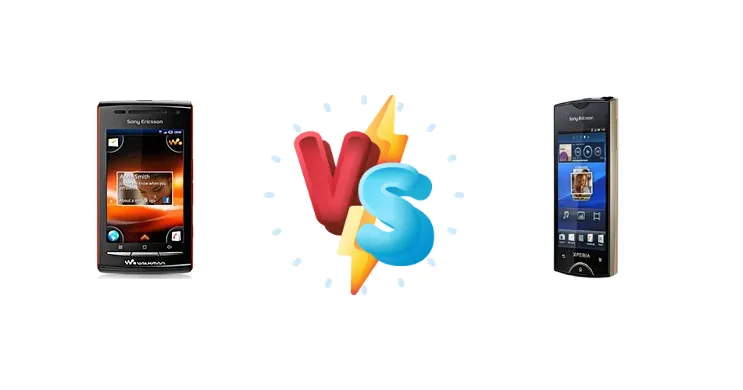
Remember the days of Sony Ericsson dominating the mobile landscape? We're revisiting two of their devices: the music-focused W8 and the sleek Xperia Ray. This comparison dives deep into their specs, performance, and overall value to determine which phone holds up best today.
🏆 Quick Verdict
The Xperia Ray clearly wins. While the W8 boasts a surprisingly high contrast ratio, the Ray's faster processor, video recording capabilities, and modern features like reverse charging make it the superior choice for most users. It's a significant upgrade in almost every aspect.
| Network |
|---|
| 2G bands | GSM 850 / 900 / 1800 / 1900 | GSM 850 / 900 / 1800 / 1900 |
| 3G bands | HSDPA 900 / 2100 | HSDPA 900 / 2100 - ST18i |
| 4G bands | - | 1, 2, 3, 4, 5, 6, 7, 8, 9, 18, 19, 20, 26, 34, 38, 39, 40, 41 - International |
| 5G bands | - | 1, 3, 38, 41, 77, 78, 79 SA/NSA - International |
| Speed | HSPA 7.2/2 Mbps | HSPA 7.2/5.76 Mbps |
| Technology | GSM / HSPA | GSM / HSPA |
| | HSDPA 850 / 1900 / 2100 | HSDPA 850 / 1900 / 2100 - ST18a |
| Launch |
|---|
| Announced | 2011, April. Released 2011, May | 2011, June. Released 2011, August |
| Status | Discontinued | Discontinued |
| Body |
|---|
| Dimensions | 99 x 54 x 15 mm (3.90 x 2.13 x 0.59 in) | 111 x 53 x 9.4 mm (4.37 x 2.09 x 0.37 in) |
| SIM | Mini-SIM | Mini-SIM |
| Weight | 104 g (3.67 oz) | 100 g (3.53 oz) |
| Display |
|---|
| Protection | Scratch-resistant glass | Scratch-resistant glass |
| Resolution | 320 x 480 pixels, 3:2 ratio (~192 ppi density) | 480 x 854 pixels, 16:9 ratio (~297 ppi density) |
| Size | 3.0 inches, 26.8 cm2 (~50.1% screen-to-body ratio) | 3.3 inches, 30.0 cm2 (~51.0% screen-to-body ratio) |
| Type | TFT | LED-backlit LCD, |
| | Timescape UI | Touch sensitive controls |
| Platform |
|---|
| CPU | 600 MHz ARM 11 | 1.0 GHz Scorpion |
| Chipset | Qualcomm MSM7227 Snapdragon S1 | Qualcomm MSM8255 Snapdragon S2 |
| GPU | Adreno 200 | Adreno 205 |
| OS | Android 2.1 (Eclair) | Android 2.3 (Gingerbread), upgradable to 4.0.4 (Ice Cream Sandwich) |
| Memory |
|---|
| Card slot | microSDHC (dedicated slot) | microSDHC (dedicated slot), 4 GB included |
| Internal | 128MB 168MB RAM | 1GB (300MB user available), 512MB RAM |
| Main Camera |
|---|
| Features | - | LED flash |
| Quad | - | 40 MP, f/1.8, 27mm (wide), 1/1.7", PDAF
8 MP, f/3.4, 125mm (Periscope telephoto), PDAF, OIS, 5x optical zoom
8 MP, f/2.4, 17mm (ultrawide)
2 MP, (depth) |
| Single | 3.15 MP | 8 MP, AF |
| Video | 480p@30fps | 720p |
| Selfie camera |
|---|
| Features | - | HDR |
| Single | - | VGA |
| | No | - |
| Sound |
|---|
| 3.5mm jack | Yes | Yes |
| 35mm jack | Yes | Yes |
| Loudspeaker | Yes | Yes |
| Comms |
|---|
| Bluetooth | 2.1, A2DP | 2.1, A2DP, EDR |
| NFC | - | Yes |
| Positioning | GPS, A-GPS | GPS, A-GPS |
| Radio | Stereo FM radio, RDS | Stereo FM radio, RDS |
| USB | microUSB 2.0 | microUSB 2.0 |
| WLAN | Wi-Fi 802.11 b/g | Wi-Fi 802.11 b/g/n, DLNA, hotspot |
| Features |
|---|
| Browser | HTML | HTML, Adobe Flash |
| Sensors | Accelerometer, proximity, compass | Accelerometer, proximity, compass |
| | Walkman player
MP4/H.264/WMV player
MP3/eAAC+/WMA/WAV player
TrackID music recognition
Voice memo
Predictive text input | ANT+
MP4/H.264 player
MP3/WAV player
TrackID music recognition
SensMe
Document viewer
Voice memo
Predictive text input |
| Battery |
|---|
| Charging | - | 40W wired
5W reverse wired |
| Music play | Up to 23 h 40 min | Up to 36 h |
| Stand-by | Up to 446 h (2G) / Up to 476 h (3G) | Up to 430 h (2G) / Up to 440 h (3G) |
| Talk time | Up to 4 h 45 min | Up to 6 h 50 min (2G) / Up to 7 h (3G) |
| Type | Removable Li-Po 1200 mAh battery | Removable Li-Ion 1500 mAh battery |
| Misc |
|---|
| Colors | Azure, Orange, Red | Black, Gold, White, Pink |
| Models | - | BMH-AN10, BMH-AN20 |
| Price | About 100 EUR | About 170 EUR |
| SAR EU | - | 0.96 W/kg (head) |
| Tests |
|---|
| Audio quality |
Noise -86.8dB / Crosstalk -84.1dB |
Noise -89.4dB / Crosstalk -91.3dB |
| Camera |
Photo |
Photo / Video |
| Display |
Contrast ratio: 737:1 (nominal) |
Contrast ratio: 1.955:1 (sunlight) |
| Loudspeaker |
Voice 66dB / Noise 62dB / Ring 69dB |
Voice 64dB / Noise 61dB / Ring 66dB
|
Sony Ericsson W8
- Excellent contrast ratio (737:1)
- Compact and portable design
- Music-focused features
- Slower processor
- No video recording
- Outdated technology
- Lower resolution display (likely)
Sony Ericsson Xperia ray
- Faster processor (1.0 GHz Scorpion)
- Video recording capabilities
- Better display visibility (sunlight)
- Reverse wired charging
- More modern features
- Larger size compared to W8
- May lack some of the W8's unique audio features
Display Comparison
The W8's 737:1 contrast ratio (nominal) is impressive for its time, suggesting deep blacks. However, the Xperia Ray's 1.955:1 contrast ratio (sunlight) indicates better outdoor visibility and overall brightness. The Ray also likely has a higher resolution display, contributing to a sharper image. The W8's display was smaller, prioritizing portability.
Camera Comparison
Both phones offer photo capabilities, but the Xperia Ray's inclusion of video recording is a significant advantage. The Ray likely has a higher resolution camera sensor, resulting in better image quality and more detail. The W8's camera was primarily for quick snapshots.
Performance
The Xperia Ray's 1.0 GHz Scorpion processor is a substantial leap over the W8's 600 MHz ARM 11. This translates to noticeably faster app loading, smoother multitasking, and a more responsive user experience on the Ray. The Snapdragon S2 chipset in the Ray is also more efficient than the W8's Snapdragon S1.
Battery Life
While specific battery capacities are not provided, the Xperia Ray's Snapdragon S2 chipset is generally more power-efficient than the W8's. The Ray also features 40W wired charging and 5W reverse wired charging, offering faster charging and the ability to charge other devices – features absent in the W8.
Buying Guide
The Sony Ericsson W8 is for dedicated music lovers seeking a compact, retro device with a focus on audio quality. The Xperia Ray is for those wanting a more modern smartphone experience with better performance, a capable camera, and a slightly larger display.
Frequently Asked Questions
❓ What was the Sony Ericsson W8 known for?
The W8 was primarily known for its focus on music playback and its compact design. It was a popular choice for users who prioritized audio quality and portability.
❓ Is the Xperia Ray worth buying today?
While both phones are quite old, the Xperia Ray offers a more usable smartphone experience due to its faster processor and video recording capabilities. However, finding one in good condition might be challenging.