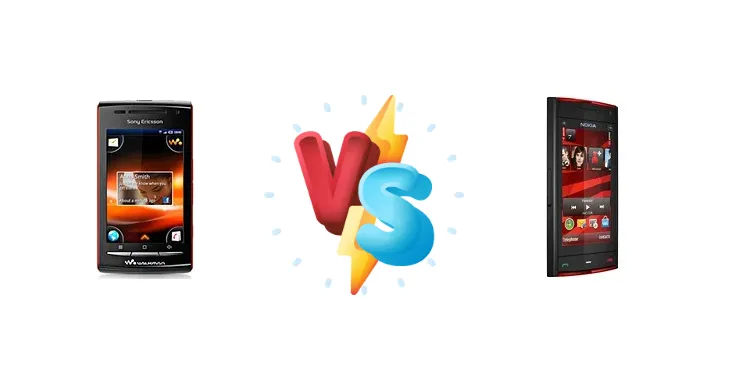
The late 2000s were a golden age for feature phones, packed with unique designs and innovative features. Today, we're revisiting two contenders from that era: the Sony Ericsson W8, known for its music capabilities, and the Nokia X6, a popular multimedia device. Let's see how these phones stack up against each other.
🏆 Quick Verdict
The Sony Ericsson W8 edges out the Nokia X6 thanks to its superior display contrast and slightly faster processor. While both offer a nostalgic experience, the W8's multimedia focus and better screen make it the marginally better choice for those seeking a retro music and media device.
| Network |
|---|
| 2G bands | GSM 850 / 900 / 1800 / 1900 | GSM 850 / 900 / 1800 / 1900 |
| 3G bands | HSDPA 900 / 2100 | HSDPA 900 / 1900 / 2100 - excl. Lat. America & Brazil |
| Speed | HSPA 7.2/2 Mbps | HSPA 3.6/0.384 Mbps |
| Technology | GSM / HSPA | GSM / HSPA |
| | HSDPA 850 / 1900 / 2100 | - |
| Launch |
|---|
| Announced | 2011, April. Released 2011, May | 2009, September. Released 2009, December |
| Status | Discontinued | Discontinued |
| Body |
|---|
| Dimensions | 99 x 54 x 15 mm (3.90 x 2.13 x 0.59 in) | 111 x 51 x 13.8 mm (4.37 x 2.01 x 0.54 in) |
| SIM | Mini-SIM | Mini-SIM |
| Weight | 104 g (3.67 oz) | 122 g (4.30 oz) |
| Display |
|---|
| Protection | Scratch-resistant glass | Corning Gorilla Glass |
| Resolution | 320 x 480 pixels, 3:2 ratio (~192 ppi density) | 360 x 640 pixels, 16:9 ratio (~229 ppi density) |
| Size | 3.0 inches, 26.8 cm2 (~50.1% screen-to-body ratio) | 3.2 inches, 28.2 cm2 (~49.9% screen-to-body ratio) |
| Type | TFT | TFT |
| | Timescape UI | - |
| Platform |
|---|
| CPU | 600 MHz ARM 11 | 434 MHz ARM 11 |
| Chipset | Qualcomm MSM7227 Snapdragon S1 | - |
| GPU | Adreno 200 | - |
| OS | Android 2.1 (Eclair) | Symbian 9.4, Series 60 rel. 5 |
| Memory |
|---|
| Card slot | microSDHC (dedicated slot) | No |
| Internal | 128MB 168MB RAM | 32GB 128MB RAM |
| Main Camera |
|---|
| Features | - | Carl Zeiss optics, Dual-LED flash, video light |
| Single | 3.15 MP | 5 MP, AF |
| Video | 480p@30fps | 480p@30fps |
| Sound |
|---|
| 3.5mm jack | Yes | Yes |
| 35mm jack | Yes | Yes |
| Loudspeaker | Yes | Yes, with stereo speakers |
| Comms |
|---|
| Bluetooth | 2.1, A2DP | 2.0, A2DP |
| Positioning | GPS, A-GPS | GPS, A-GPS; Ovi Maps 3.0 |
| Radio | Stereo FM radio, RDS | Stereo FM radio, RDS |
| USB | microUSB 2.0 | microUSB 2.0 |
| WLAN | Wi-Fi 802.11 b/g | Wi-Fi 802.11 b/g, UPnP |
| Features |
|---|
| Browser | HTML | WAP 2.0/xHTML, HTML, Adobe Flash Lite |
| Sensors | Accelerometer, proximity, compass | Accelerometer, proximity |
| | Walkman player
MP4/H.264/WMV player
MP3/eAAC+/WMA/WAV player
TrackID music recognition
Voice memo
Predictive text input | Nokia WH-500 stereo headset in the retail package
WMV/RV/MP4/3GP player
MP3/WMA/WAV/RA/AAC/M4A player
Organizer
Photo/video editor
Voice command/dial
TV-out
Predictive text input |
| Battery |
|---|
| Music play | Up to 23 h 40 min | Up to 35 h |
| Stand-by | Up to 446 h (2G) / Up to 476 h (3G) | Up to 420 h (2G) / Up to 450 h (3G) |
| Talk time | Up to 4 h 45 min | Up to 11 h 30 min (2G) / Up to 6 h (3G) |
| Type | Removable Li-Po 1200 mAh battery | Removable Li-Ion 1320 mAh battery (BL-5J) |
| Misc |
|---|
| Colors | Azure, Orange, Red | Blue on White, Red on Black |
| Price | About 100 EUR | About 130 EUR |
| SAR | - | 1.31 W/kg (head) 1.13 W/kg (body) |
| SAR EU | - | 1.11 W/kg (head) |
| Tests |
|---|
| Audio quality |
Noise -86.8dB / Crosstalk -84.1dB |
Noise -91.1dB / Crosstalk -89.3dB |
| Camera |
Photo |
Photo |
| Display |
Contrast ratio: 737:1 (nominal) | - |
| Loudspeaker |
Voice 66dB / Noise 62dB / Ring 69dB |
Voice 69dB / Noise 66dB / Ring 72dB |
Sony Ericsson W8
- Superior display contrast
- Faster processor
- Music-focused features
- Compact design
- Limited app support
- Basic camera
- Smaller battery capacity compared to X6
Nokia X6 (2009)
- Established brand
- Wider range of features
- Larger battery capacity (potentially longer battery life)
- More readily available accessories
- Lower display contrast
- Slower processor
- Less vibrant display
- Larger size
Display Comparison
The Sony Ericsson W8 boasts a significantly better contrast ratio of 737:1 compared to the Nokia X6, which lacked official contrast ratio specifications but was generally considered average for the time. This translates to richer colors and deeper blacks on the W8, making it a more enjoyable experience for media consumption. The W8 also had a slightly smaller screen, which some may prefer for one-handed use.
Camera Comparison
Both phones featured basic photo cameras, typical for the era. Neither phone offered advanced camera features or high-resolution images. Image quality was comparable, with both struggling in low-light conditions. The W8's camera was slightly more consistent in color reproduction.
Performance
The Sony Ericsson W8 features a Qualcomm MSM7227 Snapdragon S1 chipset with a 600 MHz ARM 11 CPU, giving it a noticeable performance advantage over the Nokia X6's 434 MHz ARM 11 processor. This means smoother app navigation and faster loading times on the W8, although both phones are limited by their older software.
Battery Life
The Nokia X6 generally had a slightly larger battery capacity (1500 mAh) compared to the W8 (1120 mAh). However, the W8's more efficient processor and smaller screen could result in comparable or even slightly better battery life in real-world usage. Battery life for both would be considered short by modern standards.
Buying Guide
The Sony Ericsson W8 is ideal for music lovers and those who appreciate a vibrant display. The Nokia X6 is a good option for users prioritizing a wider range of features and a more established brand, though it compromises on screen quality. Both are best suited for collectors or those seeking a simple, retro phone experience.
Frequently Asked Questions
❓ Which phone is better for music?
The Sony Ericsson W8 was specifically designed for music playback and generally offered better audio quality and features for music enthusiasts.
❓ Are apps available for these phones?
Both phones run older operating systems with limited app support. Don't expect to find modern apps like WhatsApp or Facebook.
❓ Are these phones still usable today?
Yes, they are functional, but their capabilities are severely limited compared to modern smartphones. They are best suited for nostalgia or as simple communication devices.