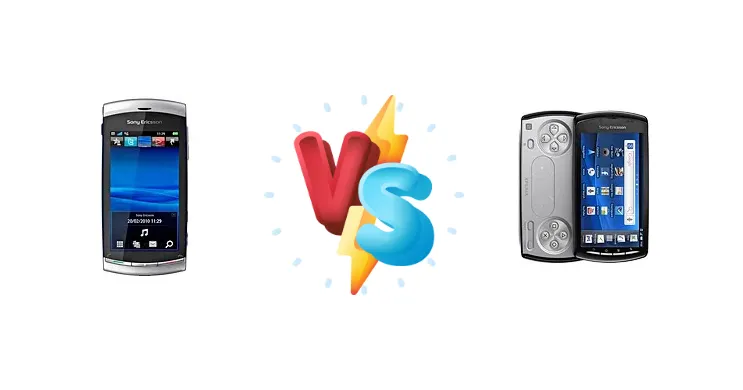
The mid-to-late 2000s were a wild time for mobile phones. Sony Ericsson, a dominant force, released some memorable devices, including the Vivaz and the Xperia PLAY. Both aimed to deliver a premium experience, but with different approaches. Let's dive into a detailed comparison to see which one holds up best today.
🏆 Quick Verdict
The Xperia PLAY clearly wins. While the Vivaz offered a sleek design and decent features for its time, the Xperia PLAY's dedicated gaming controls and more powerful processor gave it a significant edge, making it the more compelling choice for enthusiasts.
| Network |
|---|
| 2G bands | GSM 850 / 900 / 1800 / 1900 | GSM 850 / 900 / 1800 / 1900 |
| 3G bands | HSDPA 900 / 2100 | HSDPA 900 / 2100 |
| 4G bands | - | 2, 4, 5, 7, 12, 38, 66, 71 |
| Speed | HSPA 10.2/2 Mbps | HSPA 7.2/5.76 Mbps |
| Technology | GSM / HSPA | GSM / HSPA |
| | HSDPA 850 / 1900 / 2100 | HSDPA 850 / 1900 / 2100 / 800 |
| Launch |
|---|
| Announced | 2010, January. Released 2010, March | 2011, February. Released 2011, March |
| Status | Discontinued | Discontinued |
| Body |
|---|
| Dimensions | 107 x 51.7 x 12.5 mm (4.21 x 2.04 x 0.49 in) | 119 x 62 x 16 mm (4.69 x 2.44 x 0.63 in) |
| SIM | Mini-SIM | Mini-SIM |
| Weight | 97 g (3.42 oz) | 175 g (6.17 oz) |
| Display |
|---|
| Resolution | 360 x 640 pixels, 16:9 ratio (~229 ppi density) | 480 x 854 pixels, 16:9 ratio (~245 ppi density) |
| Size | 3.2 inches, 28.2 cm2 (~51.0% screen-to-body ratio) | 4.0 inches, 44.1 cm2 (~59.8% screen-to-body ratio) |
| Type | TFT resistive touchscreen, 16M colors | LED-backlit LCD, |
| | Handwriting recognition | Touch-sensitive gaming controls
PSP like gaming buttons
Timescape UI |
| Platform |
|---|
| CPU | 720 MHz, PowerVR SGX GPU | 1.0 GHz Scorpion |
| Chipset | - | Qualcomm MSM8255 Snapdragon S2 |
| GPU | - | Adreno 205 |
| OS | Symbian Series 60, 5th edition | Android 2.3.4 (Gingerbread) |
| Memory |
|---|
| Card slot | microSDHC (dedicated slot), 8 GB included | microSDHC (dedicated slot), 8 GB included |
| Internal | 75MB | 400MB 512MB RAM |
| Main Camera |
|---|
| Features | LED flash | LED flash |
| Single | 8 MP, AF | 5 MP, AF |
| Video | 720p@24fps | 720p |
| Selfie camera |
|---|
| Features | - | LED flash |
| Single | - | VGA |
| | No | - |
| Sound |
|---|
| 3.5mm jack | Yes | Yes |
| 35mm jack | Yes | Yes |
| Loudspeaker | Yes | Yes, with stereo speakers |
| Comms |
|---|
| Bluetooth | 2.1, A2DP | 2.1, A2DP, EDR |
| NFC | - | No |
| Positioning | GPS, A-GPS; Wisepilot navigation | GPS, A-GPS, GLONASS |
| Radio | Stereo FM radio | No |
| USB | microUSB 2.0 | microUSB 2.0, OTG |
| WLAN | Wi-Fi 802.11 b/g, DLNA | Wi-Fi 802.11 b/g/n, DLNA, hotspot |
| Features |
|---|
| Browser | WAP 2.0 / xHTML (NetFront) | WAP 2.0/xHTML, HTML5, Adobe Flash |
| Sensors | Accelerometer | Accelerometer, proximity, compass |
| | Facebook and Twitter apps
WMV/RV/MP4/3GP player
MP3/WMA/WAV/RA/AAC/M4A player
TrackID music recognition
TV out (VGA resolution)
Organizer
Document viewer
Gesture control
Voice memo
Predictive text input | Dedicated game store
MP4/H.264/WMV player
MP3/eAAC+/WMA/WAV player
Organizer
Document viewer/editor
Voice memo/dial/commands
Predictive text input (Swype) |
| Battery |
|---|
| Charging | - | 10W wired |
| Music play | - | Up to 31 h |
| Stand-by | Up to 430 h (2G) / Up to 440 h (3G) | Up to 425 h (2G) / Up to 413 h (3G) |
| Talk time | Up to 13 h (2G) / Up to 5 h 20 min (3G) | Up to 8 h 25 min (2G) / Up to 6 h 25 min (3G) |
| Type | Removable Li-Po 1200 mAh battery | Removable Li-Ion 1500 mAh battery |
| Misc |
|---|
| Colors | Pink, Silver Moon, Cosmic Black, Galaxy Blue, Venus Ruby | Black, White, Stealth Blue (for Play 4G), Orange |
| Price | About 80 EUR | About 140 EUR |
| SAR EU | 1.04 W/kg (head) | 0.36 W/kg (head) |
| Tests |
|---|
| Audio quality |
Noise -86.2dB / Crosstalk -85.7dB |
Noise -89.6dB / Crosstalk -91.0dB |
| Camera |
Photo |
Photo |
| Loudspeaker |
Voice 64dB / Noise 59dB / Ring 69dB |
Voice 66dB / Noise 62dB / Ring 79dB
|
Sony Ericsson Vivaz
- Excellent OLED display
- Sleek and stylish design
- Decent multimedia features
- Underpowered processor
- Average camera performance
- Limited app support now
Sony Ericsson Xperia PLAY
- Dedicated gaming controls
- More powerful processor
- Larger screen
- Better battery life
- LCD display not as vibrant as OLED
- Bulky design
- Limited app support now
Display Comparison
The Vivaz featured a 3.2-inch OLED display, known for its vibrant colors and deep blacks, a significant advantage over many LCD screens of the era. The Xperia PLAY had a slightly larger 4.0-inch Reality Display, but its LCD technology wasn't as visually impressive as the Vivaz's OLED. However, the Xperia PLAY's larger size offered more screen real estate.
Camera Comparison
Both phones featured a 8.1MP camera, but image quality was generally average for the time. The Vivaz's camera software offered some additional features, but the Xperia PLAY's hardware was slightly more capable, resulting in marginally better photos in optimal conditions. Video recording capabilities were similar on both devices.
Performance
Here's where the Xperia PLAY shines. Its 1.0 GHz Scorpion processor and Qualcomm Snapdragon chipset provided a noticeable performance boost compared to the Vivaz's 720 MHz processor and PowerVR SGX GPU. This translated to smoother gameplay and faster app loading times on the Xperia PLAY.
Battery Life
The Vivaz had a 1200 mAh battery, while the Xperia PLAY boasted a 1500 mAh battery. This gave the Xperia PLAY a slight advantage in terms of battery life, especially when gaming.
Buying Guide
Who should buy the Sony Ericsson Vivaz? Collectors seeking a stylish, classic Sony Ericsson phone with a focus on multimedia. Who should buy the Sony Ericsson Xperia PLAY? Retro gaming enthusiasts and those interested in a unique, early attempt at a dedicated gaming smartphone.
Frequently Asked Questions
❓ Were these phones 4G capable?
No, neither the Vivaz nor the Xperia PLAY supported 4G. They were both 3G devices, reflecting the technology of their time.
❓ Can I still use these phones with a modern SIM card?
Likely not. These phones used older SIM card technologies and network protocols that are no longer widely supported by modern carriers. They are primarily collector's items now.