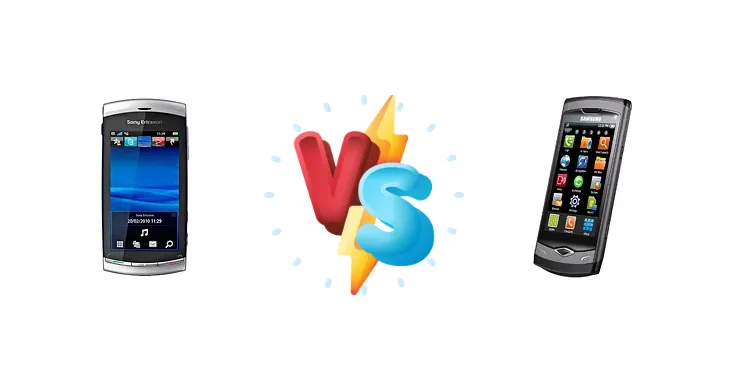
Remember the early days of Android? The Sony Ericsson Vivaz and Samsung Wave were key players, each vying for smartphone supremacy. This comparison dives deep into their features, performance, and overall value, revisiting these iconic devices from 2010.
🏆 Quick Verdict
The Samsung Wave edges out the Vivaz thanks to its faster processor, superior video recording capabilities, and slightly better overall user experience. While both are relics of the past, the Wave offers a marginally more compelling package for those seeking a nostalgic Android experience.
| Network |
|---|
| 2G bands | GSM 850 / 900 / 1800 / 1900 | GSM 850 / 900 / 1800 / 1900 |
| 3G bands | HSDPA 900 / 2100 | HSDPA 900 / 2100 |
| Speed | HSPA 10.2/2 Mbps | HSPA 3.6/2 Mbps |
| Technology | GSM / HSPA | GSM / HSPA |
| | HSDPA 850 / 1900 / 2100 | HSDPA 850 / 1900 - North America |
| Launch |
|---|
| Announced | 2010, January. Released 2010, March | 2010, February. Released 2010, April |
| Status | Discontinued | Discontinued |
| Body |
|---|
| Dimensions | 107 x 51.7 x 12.5 mm (4.21 x 2.04 x 0.49 in) | 118 x 56 x 10.9 mm (4.65 x 2.20 x 0.43 in) |
| SIM | Mini-SIM | Mini-SIM |
| Weight | 97 g (3.42 oz) | 118 g (4.16 oz) |
| Display |
|---|
| Protection | - | Corning Gorilla Glass |
| Resolution | 360 x 640 pixels, 16:9 ratio (~229 ppi density) | 480 x 800 pixels, 5:3 ratio (~283 ppi density) |
| Size | 3.2 inches, 28.2 cm2 (~51.0% screen-to-body ratio) | 3.3 inches, 31.0 cm2 (~46.9% screen-to-body ratio) |
| Type | TFT resistive touchscreen, 16M colors | Super AMOLED |
| | Handwriting recognition | Handwriting recognition |
| Platform |
|---|
| CPU | 720 MHz, PowerVR SGX GPU | 1.0 GHz Cortex-A8 |
| Chipset | - | Hummingbird |
| GPU | - | PowerVR SGX540 |
| OS | Symbian Series 60, 5th edition | Bada, upgradable to 2.0, TouchWiz UI 3 |
| Memory |
|---|
| Card slot | microSDHC (dedicated slot), 8 GB included | microSDHC (dedicated slot) |
| Internal | 75MB | 390MB |
| Main Camera |
|---|
| Features | LED flash | LED flash |
| Single | 8 MP, AF | 5 MP, AF |
| Video | 720p@24fps | 720p@30fps |
| Selfie camera |
|---|
| Single | - | Yes |
| | No | - |
| Sound |
|---|
| 3.5mm jack | Yes | Yes |
| 35mm jack | Yes | Yes |
| Loudspeaker | Yes | Yes |
| Comms |
|---|
| Bluetooth | 2.1, A2DP | 3.0, A2DP |
| Positioning | GPS, A-GPS; Wisepilot navigation | GPS, A-GPS, Samsung Mobile Navigator |
| Radio | Stereo FM radio | Stereo FM radio, RDS, recording |
| USB | microUSB 2.0 | microUSB 2.0 |
| WLAN | Wi-Fi 802.11 b/g, DLNA | Wi-Fi 802.11 b/g/n, hotspot |
| Features |
|---|
| Browser | WAP 2.0 / xHTML (NetFront) | WAP 2.0/xHTML, HTML |
| Sensors | Accelerometer | Accelerometer, proximity, compass |
| | Facebook and Twitter apps
WMV/RV/MP4/3GP player
MP3/WMA/WAV/RA/AAC/M4A player
TrackID music recognition
TV out (VGA resolution)
Organizer
Document viewer
Gesture control
Voice memo
Predictive text input | TV-Out
MP3/WAV/WMA/eAAC+ player
MP4/H.264/WMV/Xvid/DivX player
Organizer
Picsel document viewer
Photo editor
Voice memo
Predictive text input (T9 Trace) |
| Battery |
|---|
| Music play | - | Up to 35 h |
| Stand-by | Up to 430 h (2G) / Up to 440 h (3G) | Up to 600 h (2G) / Up to 550 h (3G) |
| Talk time | Up to 13 h (2G) / Up to 5 h 20 min (3G) | Up to 15 h (2G) / Up to 7 h (3G) |
| Type | Removable Li-Po 1200 mAh battery | Removable Li-Ion 1500 mAh battery |
| Misc |
|---|
| Colors | Pink, Silver Moon, Cosmic Black, Galaxy Blue, Venus Ruby | Ebony Gray |
| Price | About 80 EUR | About 160 EUR |
| SAR EU | 1.04 W/kg (head) | 0.99 W/kg (head) |
| Tests |
|---|
| Audio quality |
Noise -86.2dB / Crosstalk -85.7dB |
Noise -90.9dB / Crosstalk -92.5dB |
| Camera |
Photo |
Photo / Video |
| Loudspeaker |
Voice 64dB / Noise 59dB / Ring 69dB |
Voice 69dB / Noise 66dB / Ring 75dB
|
Sony Ericsson Vivaz
- Compact design
- Decent still photography
- Good build quality (typical Sony Ericsson)
- Slower processor
- No video recording
- Outdated Android version
- Smaller screen
Samsung S8500 Wave
- Faster processor
- 720p HD video recording
- Super AMOLED display
- Slightly better battery life
- Lower megapixel camera (compared to Vivaz)
- Outdated Android version
- Plastic build quality
Display Comparison
Both phones featured relatively small displays by today's standards (3.2-inch for Vivaz, 3.7-inch for Wave). The Wave's Super AMOLED display offered noticeably better color reproduction and viewing angles compared to the Vivaz's standard LCD screen. The Wave's slightly larger size also provided a bit more screen real estate.
Camera Comparison
The Vivaz boasted a 8.1MP camera, while the Wave had a 5MP camera. While the Vivaz had a higher megapixel count, image quality was comparable. The Wave's key advantage was its ability to record 720p HD video, a feature absent on the Vivaz. Both cameras struggled in low-light conditions.
Performance
The Samsung Wave's 1.0 GHz Cortex-A8 processor significantly outperformed the Vivaz's 720 MHz CPU. This resulted in smoother multitasking, faster app loading times, and a generally more responsive user interface on the Wave. The Wave's Hummingbird chipset also provided better overall system efficiency.
Battery Life
Battery life was a weak point for both devices. The Vivaz's battery was rated at 1200 mAh, while the Wave's was 1500 mAh. However, the Wave's more efficient Hummingbird chipset helped it achieve slightly better battery life in real-world usage.
Buying Guide
The Sony Ericsson Vivaz might appeal to those specifically seeking a compact device with a decent camera for still photography. The Samsung Wave is a better choice for users who value performance, video recording, and a slightly more modern Android feel (for 2010, of course).
Frequently Asked Questions
❓ Which phone had the better Android version?
Both phones launched with early versions of Android (Vivaz with 2.0, Wave with 2.1). Neither received significant updates.
❓ Are these phones still usable today?
While technically usable, these phones are severely outdated. They lack modern features, security updates, and app compatibility. They are primarily of interest for nostalgic purposes.