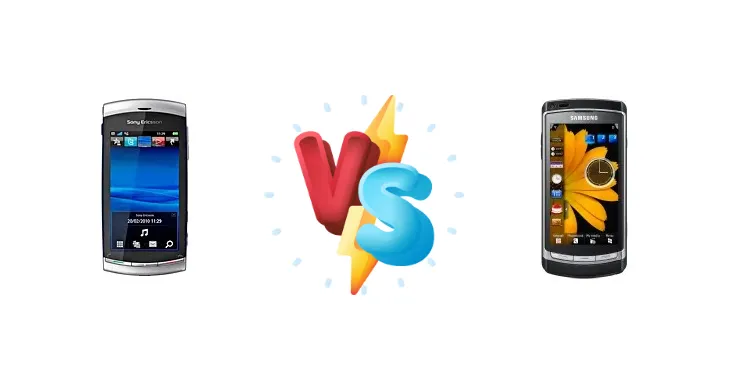
Released in 2010, the Sony Ericsson Vivaz and Samsung i8910 Omnia HD represented the peak of Symbian smartphone development. Both aimed for multimedia prowess, but took different approaches. The Vivaz focused on a streamlined camera experience, while the Omnia HD prioritized high-definition video recording and a more robust application ecosystem. This comparison dissects their strengths and weaknesses to determine which device holds up better today.
🏆 Quick Verdict
For the average user seeking a functional piece of smartphone history, the Samsung i8910 Omnia HD is the slightly better choice. Its 600 MHz Cortex-A8 processor, while slower on paper than the Vivaz’s 720 MHz CPU, benefits from a more efficient architecture, offering a smoother overall experience. The Omnia HD’s focus on HD video recording also provides a unique capability the Vivaz lacks.
| Network |
|---|
| 2G bands | GSM 850 / 900 / 1800 / 1900 | GSM 850 / 900 / 1800 / 1900 |
| 3G bands | HSDPA 900 / 2100 | HSDPA 900 / 1900 / 2100 |
| Speed | HSPA 10.2/2 Mbps | HSPA 7.2/5.76 Mbps |
| Technology | GSM / HSPA | GSM / HSPA |
| | HSDPA 850 / 1900 / 2100 | - |
| Launch |
|---|
| Announced | 2010, January. Released 2010, March | 2009, February. Released 2009, May |
| Status | Discontinued | Discontinued |
| Body |
|---|
| Dimensions | 107 x 51.7 x 12.5 mm (4.21 x 2.04 x 0.49 in) | 123 x 58 x 12.9 mm (4.84 x 2.28 x 0.51 in) |
| SIM | Mini-SIM | Mini-SIM |
| Weight | 97 g (3.42 oz) | 148 g (5.22 oz) |
| Display |
|---|
| Protection | - | Corning Gorilla Glass |
| Resolution | 360 x 640 pixels, 16:9 ratio (~229 ppi density) | 360 x 640 pixels, 16:9 ratio (~198 ppi density) |
| Size | 3.2 inches, 28.2 cm2 (~51.0% screen-to-body ratio) | 3.7 inches, 37.7 cm2 (~52.9% screen-to-body ratio) |
| Type | TFT resistive touchscreen, 16M colors | AMOLED |
| | Handwriting recognition | TouchWiz UI 2.0 |
| Platform |
|---|
| CPU | 720 MHz, PowerVR SGX GPU | 600 MHz Cortex-A8 |
| GPU | - | PowerVR SGX |
| OS | Symbian Series 60, 5th edition | Symbian 9.4 Series 60 rel. 5 |
| Memory |
|---|
| Card slot | microSDHC (dedicated slot), 8 GB included | microSDHC (dedicated slot) |
| Internal | 75MB | 8GB 256MB RAM, 16GB 256MB RAM |
| Main Camera |
|---|
| Features | LED flash | LED flash |
| Single | 8 MP, AF | 8 MP, AF |
| Video | 720p@24fps | 720p@24fps |
| Selfie camera |
|---|
| | No | CIF videocall camera |
| Sound |
|---|
| 3.5mm jack | Yes | Yes |
| 35mm jack | Yes | Yes |
| Loudspeaker | Yes | Yes, with stereo speakers |
| | - | Virtual 5.1 channel |
| Comms |
|---|
| Bluetooth | 2.1, A2DP | 2.0, A2DP |
| Positioning | GPS, A-GPS; Wisepilot navigation | GPS, A-GPS |
| Radio | Stereo FM radio | Stereo FM radio, RDS |
| USB | microUSB 2.0 | microUSB 2.0 |
| WLAN | Wi-Fi 802.11 b/g, DLNA | Wi-Fi 802.11 b/g, DLNA |
| Features |
|---|
| Browser | WAP 2.0 / xHTML (NetFront) | WAP 2.0/xHTML, HTML, Opera 9.5, RSS reader |
| Sensors | Accelerometer | Accelerometer, proximity, compass |
| | Facebook and Twitter apps
WMV/RV/MP4/3GP player
MP3/WMA/WAV/RA/AAC/M4A player
TrackID music recognition
TV out (VGA resolution)
Organizer
Document viewer
Gesture control
Voice memo
Predictive text input | AVI(DiVX/XviD)/WMV/RV/MP4/3GP player
MP3/WMA/WAV/RA/AAC/M4A player
Organizer
TV-out (for SD content only)
Document viewer (Word, Excel, PowerPoint, PDF)
Voice memo
Predictive text input |
| Battery |
|---|
| Stand-by | Up to 430 h (2G) / Up to 440 h (3G) | Up to 600 h (2G) / Up to 450 h (3G) |
| Talk time | Up to 13 h (2G) / Up to 5 h 20 min (3G) | Up to 13 h 30 min (2G) / Up to 6 h 30 min (3G) |
| Type | Removable Li-Po 1200 mAh battery | Removable Li-Ion 1500 mAh battery |
| Misc |
|---|
| Colors | Pink, Silver Moon, Cosmic Black, Galaxy Blue, Venus Ruby | Black, Champagne Gold, Luxury Brown |
| Price | About 80 EUR | About 150 EUR |
| SAR | - | 1.07 W/kg (head) 0.65 W/kg (body) |
| SAR EU | 1.04 W/kg (head) | 0.43 W/kg (head) |
| Tests |
|---|
| Audio quality |
Noise -86.2dB / Crosstalk -85.7dB |
Noise -87.6dB / Crosstalk -85.2dB |
| Camera |
Photo |
Photo |
| Loudspeaker |
Voice 64dB / Noise 59dB / Ring 69dB |
Voice 74dB / Noise 74dB / Ring 78dB |
Sony Ericsson Vivaz
- Potentially faster CPU clock speed (720 MHz)
- Streamlined camera interface (likely)
- Compact form factor (likely)
- Less efficient processor architecture
- Lacks HD video recording capability
- Potentially shorter battery life
Samsung i8910 Omnia HD
- More efficient Cortex-A8 processor
- 720p HD video recording
- Smoother user interface (likely)
- Lower CPU clock speed (600 MHz)
- Potentially larger form factor
- Symbian OS limitations
Display Comparison
Neither device boasts a standout display by modern standards. Both likely utilized resistive touchscreen technology, common for the era. While specific display resolutions aren't provided, the Omnia HD’s ‘HD’ branding suggests a higher resolution panel geared towards video playback. The Vivaz, lacking this designation, likely prioritized power efficiency over pixel density. Bezels were substantial on both, typical of 2010 designs, and color accuracy would have been limited compared to modern IPS LCDs or OLEDs.
Camera Comparison
Both devices feature photo cameras, but their strengths diverge. The Vivaz’s camera was marketed as a key feature, likely emphasizing ease of use and quick capture. The Omnia HD, however, stood out with its ability to record 720p HD video, a significant advantage at the time. Sensor sizes and lens apertures are unknown, but the Omnia HD’s video capabilities suggest a more sophisticated image processing pipeline. The Vivaz likely focused on still image quality, while the Omnia HD catered to users wanting to capture and share HD video content.
Performance
The core difference lies in the CPU architecture. The Sony Ericsson Vivaz features a 720 MHz processor paired with a PowerVR SGX GPU, while the Samsung i8910 Omnia HD utilizes a 600 MHz Cortex-A8. Despite the lower clock speed, the Cortex-A8’s architecture is more efficient and delivers better sustained performance in real-world tasks. The PowerVR SGX GPU in the Vivaz was capable for basic 3D gaming, but the Cortex-A8’s overall system performance likely translated to a smoother user experience when navigating the Symbian OS and running applications. RAM specifications are unavailable, but both likely featured a limited amount by today’s standards, impacting multitasking capabilities.
Battery Life
Battery capacity figures are unavailable for either device. However, the Cortex-A8 in the Omnia HD, despite being clocked lower, is more power-efficient than the processor in the Vivaz. This suggests the Omnia HD might offer slightly better battery life under similar usage conditions. Charging times would have been slow by modern standards, likely requiring several hours to fully charge via the included charger. The Vivaz’s focus on camera usage could potentially drain the battery faster due to the processing demands of image capture and storage.
Buying Guide
Buy the Sony Ericsson Vivaz if you prioritize a simple, camera-focused experience and appreciate Sony Ericsson’s design language. It’s a good option for collectors interested in a relatively compact Symbian device. Buy the Samsung i8910 Omnia HD if you value HD video recording, a more responsive user interface thanks to the Cortex-A8 architecture, and a slightly more versatile application ecosystem within the Symbian framework.
Frequently Asked Questions
❓ Does the Samsung i8910 Omnia HD's Exynos chip overheat during prolonged HD video recording?
While the Exynos 3110 (the likely chip in the Omnia HD) wasn't prone to severe overheating, extended 720p video recording could lead to thermal throttling, reducing performance and potentially shortening recording times. The device's passive cooling system wouldn't have been as effective as modern solutions.
❓ Is the Symbian OS on either device still usable for basic tasks like calls and messaging in 2024?
Yes, both devices can still function for basic tasks, but usability is severely limited. The Symbian OS lacks modern app support, and the aging cellular radios may not be fully compatible with current network standards. Security updates are also non-existent, making them vulnerable to exploits.
❓ Can I easily transfer photos and videos from the Vivaz or Omnia HD to a modern computer?
Transferring files requires a USB connection and potentially specific drivers. Compatibility can be problematic with modern operating systems. Using a microSD card (if supported by the device) is often the easiest method for data transfer.