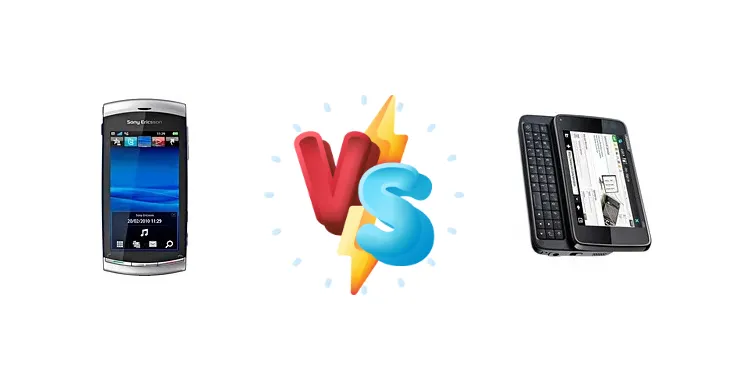
The mid-to-late 2000s were a wild time for mobile phones. The Sony Ericsson Vivaz and Nokia N900 represented different approaches to the burgeoning smartphone market. Let's revisit these iconic devices and see how they stack up today.
🏆 Quick Verdict
The Nokia N900 edges out the Vivaz thanks to its open-source nature, superior web browsing, and more robust software ecosystem. While the Vivaz boasts a slightly better screen, the N900’s flexibility and longevity make it the more compelling choice for enthusiasts.
| Network |
|---|
| 2G bands | GSM 850 / 900 / 1800 / 1900 | GSM 850 / 900 / 1800 / 1900 |
| 3G bands | HSDPA 900 / 2100 | HSDPA 900 / 1700 / 2100 |
| Speed | HSPA 10.2/2 Mbps | HSPA 10.2/2 Mbps |
| Technology | GSM / HSPA | GSM / HSPA |
| | HSDPA 850 / 1900 / 2100 | - |
| Launch |
|---|
| Announced | 2010, January. Released 2010, March | 2009, August. Released 2009, November |
| Status | Discontinued | Discontinued |
| Body |
|---|
| Dimensions | 107 x 51.7 x 12.5 mm (4.21 x 2.04 x 0.49 in) | 110.9 x 59.8 x 18 mm, 113 cc (4.37 x 2.35 x 0.71 in) |
| Keyboard | - | QWERTY |
| SIM | Mini-SIM | Mini-SIM |
| Weight | 97 g (3.42 oz) | 181 g (6.38 oz) |
| Display |
|---|
| Resolution | 360 x 640 pixels, 16:9 ratio (~229 ppi density) | 800 x 480 pixels, 5:3 ratio (~267 ppi density) |
| Size | 3.2 inches, 28.2 cm2 (~51.0% screen-to-body ratio) | 3.5 inches, 34.9 cm2 (~52.6% screen-to-body ratio) |
| Type | TFT resistive touchscreen, 16M colors | TFT resistive touchscreen, 65K colors |
| | Handwriting recognition | - |
| Platform |
|---|
| CPU | 720 MHz, PowerVR SGX GPU | 600 MHz Cortex-A8 |
| Chipset | - | TI OMAP 3430 |
| GPU | - | PowerVR SGX530 |
| OS | Symbian Series 60, 5th edition | Maemo 5 |
| Memory |
|---|
| Card slot | microSDHC (dedicated slot), 8 GB included | microSDHC (dedicated slot) |
| Internal | 75MB | 32GB 256MB RAM |
| Main Camera |
|---|
| Features | LED flash | Carl Zeiss optics, Dual-LED flash |
| Single | 8 MP, AF | 5 MP, AF |
| Video | 720p@24fps | 480p@25fps |
| Selfie camera |
|---|
| Single | - | VGA |
| | No | - |
| Sound |
|---|
| 3.5mm jack | Yes | Yes |
| 35mm jack | Yes | Yes |
| Loudspeaker | Yes | Yes, with stereo speakers |
| Comms |
|---|
| Bluetooth | 2.1, A2DP | 2.1, A2DP |
| Infrared port | - | Yes |
| Positioning | GPS, A-GPS; Wisepilot navigation | GPS, A-GPS; Ovi Maps |
| Radio | Stereo FM radio | Stereo FM radio (via third party software); FM transmitter |
| USB | microUSB 2.0 | microUSB 2.0 |
| WLAN | Wi-Fi 802.11 b/g, DLNA | Wi-Fi 802.11 b/g, DLNA |
| Features |
|---|
| Browser | WAP 2.0 / xHTML (NetFront) | xHTML, HTML, Adobe Flash |
| Sensors | Accelerometer | Accelerometer, proximity |
| | Facebook and Twitter apps
WMV/RV/MP4/3GP player
MP3/WMA/WAV/RA/AAC/M4A player
TrackID music recognition
TV out (VGA resolution)
Organizer
Document viewer
Gesture control
Voice memo
Predictive text input | MP3/WMA/WAV/eAAC+ player
WMV/RealVideo/MP4/AVI/XviD/DivX player
TV-out
PDF document viewer
Photo editor
|
| Battery |
|---|
| Music play | - | Up to 24 h 30 min |
| Stand-by | Up to 430 h (2G) / Up to 440 h (3G) | Up to 278 h (2G) / Up to 250 h (3G) |
| Talk time | Up to 13 h (2G) / Up to 5 h 20 min (3G) | Up to 6 h 30 min (2G) / Up to 4 h 30 min (3G) |
| Type | Removable Li-Po 1200 mAh battery | Removable Li-Ion 1320 mAh battery (BL-5J) |
| Misc |
|---|
| Colors | Pink, Silver Moon, Cosmic Black, Galaxy Blue, Venus Ruby | Black |
| Price | About 80 EUR | About 160 EUR |
| SAR | - | 0.92 W/kg (head) 0.82 W/kg (body) |
| SAR EU | 1.04 W/kg (head) | 0.80 W/kg (head) |
| Tests |
|---|
| Audio quality |
Noise -86.2dB / Crosstalk -85.7dB |
Noise -93.7dB / Crosstalk -86.9dB |
| Camera |
Photo |
Photo |
| Loudspeaker |
Voice 64dB / Noise 59dB / Ring 69dB |
Voice 66dB / Noise 66dB / Ring 70dB |
Sony Ericsson Vivaz
- Slightly better screen resolution
- Stylish design
- Decent media playback
- Limited software updates
- Mediocre battery life
- Underwhelming camera
Nokia N900
- Open-source Maemo OS
- Excellent web browsing experience
- Good battery life
- Customizable
- Dated design
- Slow software updates
- Can feel sluggish at times
Display Comparison
The Vivaz features a 3.2-inch 360x480 pixel display, offering slightly better resolution and color reproduction than the N900's 3.2-inch 640x480 pixel screen. However, the N900's higher resolution provides a sharper image, especially noticeable when browsing the web.
Camera Comparison
Both phones feature a 8MP camera, but image quality is comparable and generally underwhelming by modern standards. The Vivaz might have slightly better color accuracy in ideal lighting conditions, but both struggle in low light. Video recording capabilities are similarly limited on both devices.
Performance
The Vivaz's 720 MHz processor paired with a PowerVR SGX GPU offers a slight edge in raw graphical power. However, the N900's 600 MHz Cortex-A8 processor, a more modern architecture, often translates to smoother overall performance and better multitasking, especially when running web applications. The N900's Maemo OS, while dated, was optimized for web browsing.
Battery Life
The Nokia N900 typically offers better battery life due to its more efficient chipset and software optimization. The Vivaz's battery life is adequate but can drain quickly with heavy usage, particularly when streaming media.
Buying Guide
The Sony Ericsson Vivaz is for those seeking a stylish, media-focused phone with a decent screen. The Nokia N900 is for tech enthusiasts and developers who appreciate open-source software and customization options, even with its quirks.
Frequently Asked Questions
❓ What operating systems did these phones use?
The Sony Ericsson Vivaz ran Sony Ericsson's proprietary UI on top of Android. The Nokia N900 ran Maemo, Nokia's open-source Linux-based operating system.
❓ Are there still software updates available for either phone?
No, neither phone receives official software updates. However, the N900's open-source nature means that community-developed firmware is still available.