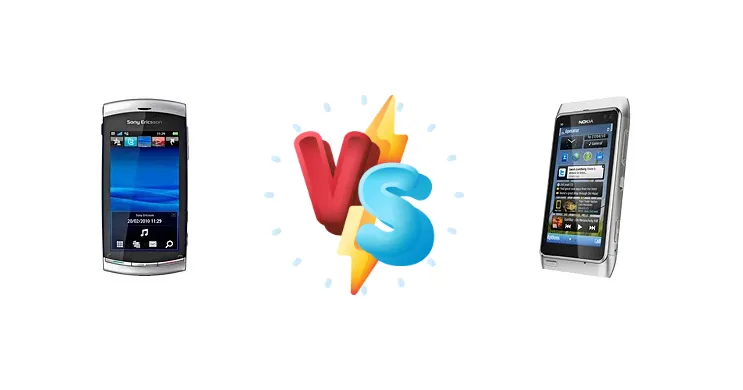
The Sony Ericsson Vivaz and Nokia N8 were flagship smartphones from 2010, each boasting impressive features for their time. Both aimed to deliver a premium experience, but with different strengths. This review dives deep into a head-to-head comparison to determine which phone ultimately holds up best today.
🏆 Quick Verdict
The Nokia N8 emerges as the overall winner thanks to its superior camera, exceptional display contrast, and slightly better overall build quality. While the Vivaz offered a unique UI and early Android experience, the N8's strengths outweigh its weaknesses for most users.
| Network |
|---|
| 2G bands | GSM 850 / 900 / 1800 / 1900 | GSM 850 / 900 / 1800 / 1900 |
| 3G bands | HSDPA 900 / 2100 | HSDPA 850 / 900 / 1700 / 1900 / 2100 |
| Speed | HSPA 10.2/2 Mbps | HSPA 10.2/2 Mbps |
| Technology | GSM / HSPA | GSM / HSPA |
| | HSDPA 850 / 1900 / 2100 | - |
| Launch |
|---|
| Announced | 2010, January. Released 2010, March | 2010, April. Released 2010, October |
| Status | Discontinued | Discontinued |
| Body |
|---|
| Dimensions | 107 x 51.7 x 12.5 mm (4.21 x 2.04 x 0.49 in) | 113.5 x 59.1 x 12.9 mm, 86 cc (4.47 x 2.33 x 0.51 in) |
| SIM | Mini-SIM | Mini-SIM |
| Weight | 97 g (3.42 oz) | 135 g (4.76 oz) |
| Display |
|---|
| Protection | - | Corning Gorilla Glass |
| Resolution | 360 x 640 pixels, 16:9 ratio (~229 ppi density) | 360 x 640 pixels, 16:9 ratio (~210 ppi density) |
| Size | 3.2 inches, 28.2 cm2 (~51.0% screen-to-body ratio) | 3.5 inches, 33.8 cm2 (~50.3% screen-to-body ratio) |
| Type | TFT resistive touchscreen, 16M colors | AMOLED |
| | Handwriting recognition | - |
| Platform |
|---|
| CPU | 720 MHz, PowerVR SGX GPU | 680 MHz ARM 11 |
| GPU | - | Broadcom BCM2727 |
| OS | Symbian Series 60, 5th edition | Symbian^3, upgradable to Nokia Belle Refresh |
| Memory |
|---|
| Card slot | microSDHC (dedicated slot), 8 GB included | microSDHC (dedicated slot) |
| Internal | 75MB | 16GB 256MB RAM |
| Main Camera |
|---|
| Features | LED flash | Carl Zeiss optics, Xenon flash, ND filter |
| Single | 8 MP, AF | 12 MP, 1/1.83", AF |
| Video | 720p@24fps | 720p@25fps, 720p@30fps (via SW update) |
| Selfie camera |
|---|
| Single | - | VGA videocall camera |
| | No | - |
| Sound |
|---|
| 3.5mm jack | Yes | Yes |
| 35mm jack | Yes | Yes |
| Loudspeaker | Yes | Yes |
| Comms |
|---|
| Bluetooth | 2.1, A2DP | 3.0, A2DP |
| Positioning | GPS, A-GPS; Wisepilot navigation | GPS, A-GPS; Ovi Maps 3.0 |
| Radio | Stereo FM radio | Stereo FM radio, RDS; FM transmitter |
| USB | microUSB 2.0 | microUSB 2.0, OTG |
| WLAN | Wi-Fi 802.11 b/g, DLNA | Wi-Fi 802.11 b/g/n, UPnP technology |
| Features |
|---|
| Browser | WAP 2.0 / xHTML (NetFront) | WAP 2.0/xHTML, HTML, Adobe Flash Lite |
| Sensors | Accelerometer | Accelerometer, proximity, compass |
| | Facebook and Twitter apps
WMV/RV/MP4/3GP player
MP3/WMA/WAV/RA/AAC/M4A player
TrackID music recognition
TV out (VGA resolution)
Organizer
Document viewer
Gesture control
Voice memo
Predictive text input | TV-out (720p video) via HDMI with Dolby Digital Plus sound
Anodized aluminum casing |
| Battery |
|---|
| Music play | - | Up to 50 h |
| Stand-by | Up to 430 h (2G) / Up to 440 h (3G) | Up to 390 h (2G) / Up to 400 h (3G) |
| Talk time | Up to 13 h (2G) / Up to 5 h 20 min (3G) | Up to 12 h (2G) / Up to 5 h 50 min (3G) |
| Type | Removable Li-Po 1200 mAh battery | Non-removable Li-Ion 1200 mAh battery (BL-4D) |
| Misc |
|---|
| Colors | Pink, Silver Moon, Cosmic Black, Galaxy Blue, Venus Ruby | Dark Grey, Silver White, Green, Blue, Orange, Pink, Bronze |
| Price | About 80 EUR | About 140 EUR |
| SAR | - | 1.09 W/kg (head) 0.85 W/kg (body) |
| SAR EU | 1.04 W/kg (head) | 1.02 W/kg (head) |
| Tests |
|---|
| Audio quality |
Noise -86.2dB / Crosstalk -85.7dB |
Noise -89.9dB / Crosstalk -90.9dB |
| Camera |
Photo |
Photo / Video |
| Display | - |
Contrast ratio: 2.144:1 (sunlight) |
| Loudspeaker |
Voice 64dB / Noise 59dB / Ring 69dB |
Voice 75dB / Noise 66dB / Ring 82dB |
Sony Ericsson Vivaz
- Early Android experience
- Slightly faster processor
- Decent UI
- Weaker camera
- Lower display quality
- Shorter battery life
- Less robust build
Nokia N8
- Exceptional camera
- Outstanding display contrast
- Longer battery life
- Robust build quality
- Carl Zeiss optics
- Slower processor
- Symbian OS (outdated)
- Less intuitive UI compared to Android
Display Comparison
The Nokia N8's display is a clear winner. Its 3.5-inch AMOLED screen boasts an incredible 2144:1 contrast ratio, making colors vibrant and blacks deep, even in direct sunlight. The Vivaz's LCD screen, while decent, simply can't match this level of contrast and color accuracy. Viewing angles are also better on the N8.
Camera Comparison
The Nokia N8's camera is its standout feature. Its 12MP sensor with Carl Zeiss optics delivers exceptional image quality, particularly in low light. It also supports 720p video recording. The Vivaz's 8.1MP camera is capable, but lacks the N8's detail and dynamic range. The N8's camera app also offered more manual controls.
Performance
The Vivaz's 720 MHz processor and PowerVR SGX GPU provide a slightly faster experience for gaming and general app usage compared to the N8's 680 MHz ARM 11 processor. However, the difference isn't massive, and both phones can feel sluggish by modern standards. The N8's Symbian OS is generally more optimized for its hardware.
Battery Life
The Nokia N8 generally offers better battery life due to its larger battery capacity (1200 mAh vs Vivaz's 1500 mAh) and more efficient Symbian OS. While both phones struggled to last a full day with heavy use, the N8 consistently provided slightly longer runtime.
Buying Guide
The Sony Ericsson Vivaz is a nostalgic choice for those wanting to experience early Android. The Nokia N8 is ideal for photography enthusiasts and users prioritizing a robust, well-built device with a fantastic display.
Frequently Asked Questions
❓ Which phone had the better operating system?
The Vivaz ran Android, while the N8 used Symbian. Android offered more app availability at the time, but Symbian was generally more optimized for the N8's hardware.
❓ Is it worth buying either of these phones today?
For collectors or those interested in retro tech, yes. However, both phones are significantly outdated and won't offer a modern smartphone experience. The N8 is the slightly better choice due to its camera and display.