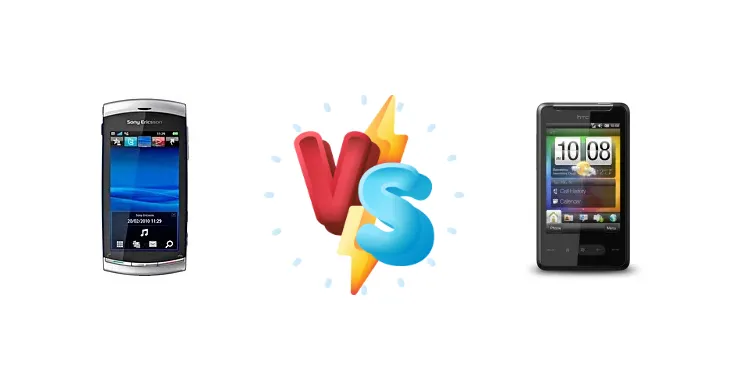
The Sony Ericsson Vivaz and HTC HD mini represent a pivotal moment in early Android development. Released around the same time, they targeted different aspects of the burgeoning smartphone market – the Vivaz emphasizing multimedia capabilities, while the HD mini aimed for a more compact and accessible Snapdragon experience. This comparison dissects their core components to determine which device offered the better overall package for the discerning 2010 user.
🏆 Quick Verdict
For the average user seeking a more responsive experience and a glimpse into the future of mobile processing, the HTC HD mini emerges as the slightly better choice. While both phones feature basic photo capabilities, the Qualcomm Snapdragon S1 chipset provides a noticeable performance advantage over the Vivaz’s PowerVR SGX, making it more suitable for emerging app usage.
| Network |
|---|
| 2G bands | GSM 850 / 900 / 1800 / 1900 | GSM 850 / 900 / 1800 / 1900 |
| 3G bands | HSDPA 900 / 2100 | HSDPA 900 / 2100 |
| Speed | HSPA 10.2/2 Mbps | HSPA 7.2/2 Mbps |
| Technology | GSM / HSPA | GSM / HSPA |
| | HSDPA 850 / 1900 / 2100 | - |
| Launch |
|---|
| Announced | 2010, January. Released 2010, March | 2010, February. Released 2010, April |
| Status | Discontinued | Discontinued |
| Body |
|---|
| Dimensions | 107 x 51.7 x 12.5 mm (4.21 x 2.04 x 0.49 in) | 103.8 x 57.7 x 11.7 mm (4.09 x 2.27 x 0.46 in) |
| SIM | Mini-SIM | Mini-SIM |
| Weight | 97 g (3.42 oz) | 110 g (3.88 oz) |
| Display |
|---|
| Protection | - | Corning Gorilla Glass |
| Resolution | 360 x 640 pixels, 16:9 ratio (~229 ppi density) | 320 x 480 pixels, 3:2 ratio (~180 ppi density) |
| Size | 3.2 inches, 28.2 cm2 (~51.0% screen-to-body ratio) | 3.2 inches, 30.5 cm2 (~50.9% screen-to-body ratio) |
| Type | TFT resistive touchscreen, 16M colors | TFT, 65K colors |
| | Handwriting recognition | - |
| Platform |
|---|
| CPU | 720 MHz, PowerVR SGX GPU | 600 MHz ARM 11 |
| Chipset | - | Qualcomm MSM7227 Snapdragon S1 |
| GPU | - | Adreno 200 |
| OS | Symbian Series 60, 5th edition | Microsoft Windows Mobile 6.5.3 Professional, Sense UI |
| Memory |
|---|
| Card slot | microSDHC (dedicated slot), 8 GB included | microSDHC (dedicated slot) |
| Internal | 75MB | 384MB RAM, 512MB ROM |
| Main Camera |
|---|
| Features | LED flash | - |
| Single | 8 MP, AF | 5 MP, AF |
| Video | 720p@24fps | 480p@30fps |
| Sound |
|---|
| 3.5mm jack | Yes | Yes |
| 35mm jack | Yes | Yes |
| Loudspeaker | Yes | Yes |
| Comms |
|---|
| Bluetooth | 2.1, A2DP | 2.1, A2DP |
| Positioning | GPS, A-GPS; Wisepilot navigation | GPS, A-GPS |
| Radio | Stereo FM radio | Stereo FM radio, RDS |
| USB | microUSB 2.0 | microUSB 2.0 |
| WLAN | Wi-Fi 802.11 b/g, DLNA | Wi-Fi 802.11 b/g, Wi-Fi router |
| Features |
|---|
| Browser | WAP 2.0 / xHTML (NetFront) | HTML |
| Sensors | Accelerometer | Accelerometer, proximity |
| | Facebook and Twitter apps
WMV/RV/MP4/3GP player
MP3/WMA/WAV/RA/AAC/M4A player
TrackID music recognition
TV out (VGA resolution)
Organizer
Document viewer
Gesture control
Voice memo
Predictive text input | MP3/AAC+/WAV/WMA9 player
MP4/H.264 player
Pocket Office
Facebook, Twitter integration
HTC Peep, HTC Footprints
YouTube client
Voice memo |
| Battery |
|---|
| Music play | - | Up to 12 h |
| Stand-by | Up to 430 h (2G) / Up to 440 h (3G) | Up to 340 h (2G) / Up to 500 h (3G) |
| Talk time | Up to 13 h (2G) / Up to 5 h 20 min (3G) | Up to 6 h 40 min (2G) / Up to 7 h 15 min (3G) |
| Type | Removable Li-Po 1200 mAh battery | Removable Li-Ion 1200 mAh battery |
| Misc |
|---|
| Colors | Pink, Silver Moon, Cosmic Black, Galaxy Blue, Venus Ruby | Black |
| Price | About 80 EUR | About 120 EUR |
| SAR EU | 1.04 W/kg (head) | - |
| Tests |
|---|
| Audio quality |
Noise -86.2dB / Crosstalk -85.7dB |
Noise -83.7dB / Crosstalk -84.1dB |
| Camera |
Photo |
Photo |
| Loudspeaker |
Voice 64dB / Noise 59dB / Ring 69dB |
Voice 74dB / Noise 75dB / Ring 84dB
|
Sony Ericsson Vivaz
- Potentially better image processing due to Sony’s camera expertise.
- Higher processor clock speed (720 MHz vs 600 MHz).
- Brand recognition for multimedia features.
- Less efficient processor architecture (PowerVR SGX vs Snapdragon S1).
- Likely less responsive user interface.
- Limited future-proofing.
HTC HD mini
- More efficient Qualcomm Snapdragon S1 chipset.
- Compact form factor.
- Better overall performance and responsiveness.
- Lower processor clock speed (600 MHz).
- Less established camera reputation compared to Sony Ericsson.
- Potentially smaller display.
Display Comparison
Neither device’s display specifications are detailed in the provided data. However, given the era, both likely featured resistive touchscreen technology. The HD mini’s smaller form factor suggests a potentially higher pixel density, but without knowing the screen sizes or resolutions, a definitive comparison is impossible. Both would have suffered from limited viewing angles and lower brightness compared to modern displays.
Camera Comparison
Both devices are listed as having a 'Photo' camera, offering no specifics. Considering the timeframe, both likely featured 5-megapixel sensors. However, the image processing capabilities and lens quality would have been the differentiating factors. Sony Ericsson had a strong reputation for camera technology, so the Vivaz likely benefited from more refined image processing algorithms. Without detailed sensor size or aperture information, it’s difficult to declare a clear winner, but Sony’s brand history suggests a slight edge in image quality.
Performance
The core difference lies in the chipsets. The HTC HD mini boasts the Qualcomm MSM7227 Snapdragon S1, featuring a 600 MHz ARM 11 processor. This architecture, while early, offered a significant leap over the ARM processors common at the time. The Sony Ericsson Vivaz, conversely, utilizes a 720 MHz processor paired with a PowerVR SGX GPU. While the Vivaz has a higher clock speed, the ARM 11 in the Snapdragon S1 is a more efficient architecture, translating to better real-world performance and responsiveness. The PowerVR SGX GPU in the Vivaz was geared towards basic 3D graphics, but the Snapdragon’s integrated GPU offered a more capable experience for emerging mobile games.
Battery Life
Battery capacity data is absent for both devices. Given the processing power and display technology of the era, battery life would have been a significant concern for both. The Snapdragon S1, being a more efficient chipset, likely contributed to slightly better battery performance in the HD mini. However, usage patterns – particularly multimedia consumption on the Vivaz – would have heavily influenced real-world battery life.
Buying Guide
Buy the Sony Ericsson Vivaz if you prioritize a brand known for multimedia features and are less concerned with raw processing power. Its focus was on delivering a visually rich experience, albeit with limitations. Buy the HTC HD mini if you prefer a more compact form factor coupled with the early benefits of Qualcomm’s Snapdragon platform, offering a smoother and more future-proof experience for the time.
Frequently Asked Questions
❓ Is the Qualcomm Snapdragon S1 in the HTC HD mini capable of running modern Android apps?
No. While groundbreaking for its time, the Snapdragon S1 is severely underpowered by today’s standards. It would struggle to run even basic modern Android applications due to limited processing power and memory.
❓ Does the Sony Ericsson Vivaz offer any significant advantages for video recording compared to the HTC HD mini?
Given Sony Ericsson’s focus on multimedia, the Vivaz likely offered slightly better video recording capabilities, potentially with more refined stabilization and audio recording. However, without specific video resolution or frame rate data, the difference would likely be marginal.
❓ Which phone would be better for playing early Android games?
The HTC HD mini, with its Snapdragon S1 chipset and more efficient GPU, would provide a smoother gaming experience for the limited selection of games available at the time. The Vivaz’s PowerVR SGX GPU would struggle with more demanding titles.