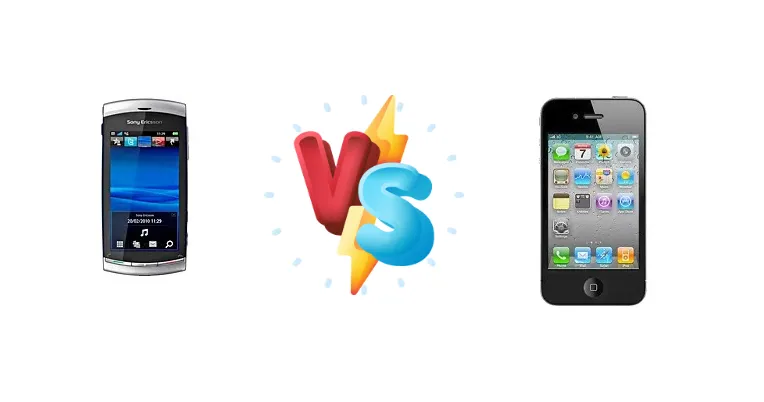
The year is 2010. Smartphones are rapidly evolving, and two contenders emerged: the Sony Ericsson Vivaz and the Apple iPhone 4. Both promised cutting-edge features, but which one truly delivered? Let's revisit this classic smartphone showdown.
🏆 Quick Verdict
The iPhone 4 decisively wins this comparison. While the Vivaz offered a decent experience, the iPhone 4's superior display, app ecosystem, and overall polish established it as a landmark device, setting the standard for smartphones to come.
| Network |
|---|
| 2G bands | GSM 850 / 900 / 1800 / 1900 | GSM 850 / 900 / 1800 / 1900 |
| 3G bands | HSDPA 900 / 2100 | HSDPA 850 / 900 / 1900 / 2100 |
| Speed | HSPA 10.2/2 Mbps | HSPA 7.2/5.76 Mbps |
| Technology | GSM / HSPA | GSM / HSPA |
| | HSDPA 850 / 1900 / 2100 | - |
| Launch |
|---|
| Announced | 2010, January. Released 2010, March | 2010, June. Released 2010, June |
| Status | Discontinued | Discontinued |
| Body |
|---|
| Build | - | Glass front (Corning-made glass), glass back, stainless steel frame |
| Dimensions | 107 x 51.7 x 12.5 mm (4.21 x 2.04 x 0.49 in) | 115.2 x 58.6 x 9.3 mm (4.54 x 2.31 x 0.37 in) |
| SIM | Mini-SIM | Micro-SIM |
| Weight | 97 g (3.42 oz) | 137 g (4.83 oz) |
| | - | Scratch-resistant glass back panel |
| Display |
|---|
| Protection | - | Corning Gorilla Glass, oleophobic coating |
| Resolution | 360 x 640 pixels, 16:9 ratio (~229 ppi density) | 640 x 960 pixels, 3:2 ratio (~330 ppi density) |
| Size | 3.2 inches, 28.2 cm2 (~51.0% screen-to-body ratio) | 3.5 inches, 36.5 cm2 (~54.0% screen-to-body ratio) |
| Type | TFT resistive touchscreen, 16M colors | IPS LCD |
| | Handwriting recognition | - |
| Platform |
|---|
| CPU | 720 MHz, PowerVR SGX GPU | 1.0 GHz Cortex-A8 |
| Chipset | - | Apple A4 (45 nm) |
| GPU | - | PowerVR SGX535 |
| OS | Symbian Series 60, 5th edition | iOS 4, upgradable to iOS 7.1.2 |
| Memory |
|---|
| Card slot | microSDHC (dedicated slot), 8 GB included | No |
| Internal | 75MB | 8GB 512MB RAM, 16GB 512MB RAM, 32GB 512MB RAM |
| Main Camera |
|---|
| Features | LED flash | LED flash, HDR |
| Single | 8 MP, AF | 5 MP, f/2.8, 1/3.2", 1.75µm, AF |
| Video | 720p@24fps | 720p@30fps |
| Selfie camera |
|---|
| Single | - | VGA, videocalling over Wi-Fi only |
| Video | - | 480p@30fps |
| | No | - |
| Sound |
|---|
| 3.5mm jack | Yes | Yes |
| 35mm jack | Yes | Yes |
| Loudspeaker | Yes | Yes |
| Comms |
|---|
| Bluetooth | 2.1, A2DP | 2.1, A2DP |
| Positioning | GPS, A-GPS; Wisepilot navigation | GPS, A-GPS |
| Radio | Stereo FM radio | No |
| USB | microUSB 2.0 | 2.0 |
| WLAN | Wi-Fi 802.11 b/g, DLNA | Wi-Fi 802.11 b/g/n, hotspot |
| Features |
|---|
| Browser | WAP 2.0 / xHTML (NetFront) | HTML5 (Safari) |
| Sensors | Accelerometer | Accelerometer, gyro, proximity, compass |
| | Facebook and Twitter apps
WMV/RV/MP4/3GP player
MP3/WMA/WAV/RA/AAC/M4A player
TrackID music recognition
TV out (VGA resolution)
Organizer
Document viewer
Gesture control
Voice memo
Predictive text input | - |
| Battery |
|---|
| Stand-by | Up to 430 h (2G) / Up to 440 h (3G) | Up to 300 h (3G) |
| Talk time | Up to 13 h (2G) / Up to 5 h 20 min (3G) | Up to 7 h (3G) |
| Type | Removable Li-Po 1200 mAh battery | Li-Po 1420 mAh, non-removable |
| Misc |
|---|
| Colors | Pink, Silver Moon, Cosmic Black, Galaxy Blue, Venus Ruby | Black, White |
| Models | - | A1349, A1332, iPhone 3,1 |
| Price | About 80 EUR | About 200 EUR |
| SAR | - | 1.17 W/kg (head) 1.11 W/kg (body) |
| SAR EU | 1.04 W/kg (head) | 0.93 W/kg (head) 0.74 W/kg (body) |
| Tests |
|---|
| Audio quality |
Noise -86.2dB / Crosstalk -85.7dB |
Noise -90.1dB / Crosstalk -89.6dB |
| Camera |
Photo |
Photo / Video |
| Display | - |
Contrast ratio: 1242:1 (nominal) / 2.016:1 (sunlight) |
| Loudspeaker |
Voice 64dB / Noise 59dB / Ring 69dB |
Voice 65dB / Noise 60dB / Ring 66dB |
Sony Ericsson Vivaz
- Stylish design
- Decent multimedia playback
- Physical keyboard (for some)
- Underpowered processor
- Limited app ecosystem
- No video recording
- Inferior display
Apple iPhone 4
- Revolutionary Retina display
- Powerful processor and chipset
- Extensive app ecosystem (App Store)
- Excellent camera with video recording
- Premium build quality
- Antennagate (initial reception issues)
- Relatively expensive at launch
- Limited customization compared to Android
Display Comparison
The iPhone 4 boasted a significantly better display. Its Retina display offered incredible sharpness and vibrant colors, a huge leap over the Vivaz's standard LCD. The contrast ratios, while nominally similar, performed much better in sunlight on the iPhone 4, making it far more usable outdoors.
Camera Comparison
While both phones offered photo capabilities, the iPhone 4's camera was generally considered superior. It offered better image quality, especially in low light, and crucially, it supported video recording, a feature absent on the Vivaz. The iPhone 4's camera app was also more intuitive and feature-rich.
Performance
The iPhone 4's 1.0 GHz Cortex-A8 processor and Apple A4 chipset provided a noticeable performance advantage over the Vivaz's 720 MHz CPU. Apps launched faster, multitasking was smoother, and the overall user experience felt more responsive on the iPhone 4.
Battery Life
Battery life was comparable between the two devices, generally offering a full day of moderate use. However, the iPhone 4's more efficient chipset and software optimization often resulted in slightly better real-world battery performance.
Buying Guide
The Sony Ericsson Vivaz might appeal to those nostalgic for Sony Ericsson's design aesthetic or seeking a simpler, less app-dependent experience. However, the Apple iPhone 4 is the clear choice for anyone wanting a robust app ecosystem, a premium user experience, and a device that significantly impacted the mobile landscape.
Frequently Asked Questions
❓ What was 'Antennagate'?
Antennagate referred to an issue with the iPhone 4's antenna design, where gripping the phone in a certain way could weaken the cellular signal. Apple addressed this with a free bumper case.
❓ Which phone had a better operating system?
The iPhone 4's iOS was significantly more polished and user-friendly than the Vivaz's Symbian OS. iOS also benefited from Apple's tight control over hardware and software integration.