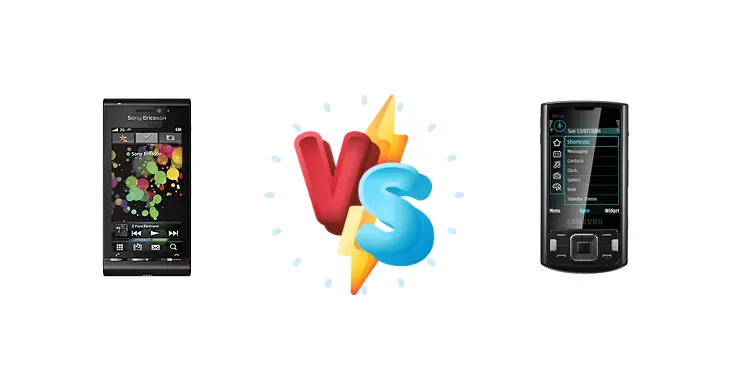
The late 2000s were a golden age for mobile innovation. Two titans, the Sony Ericsson Satio (also known as Idou) and the Samsung i8510 INNOV8, battled for smartphone supremacy. Let's revisit these iconic devices and see how they stack up today.
🏆 Quick Verdict
The Satio (Idou) edges out the INNOV8 thanks to its superior processing power and more appealing design. While the INNOV8 boasted a larger screen, the Satio's faster CPU and generally better user experience give it the slight advantage, despite both being dated by modern standards.
| Network |
|---|
| 2G bands | GSM 850 / 900 / 1800 / 1900 | GSM 850 / 900 / 1800 / 1900 |
| 3G bands | HSDPA 900 / 2100 | HSDPA 900 / 2100 |
| Speed | HSPA 7.2/3.6 Mbps | HSPA 7.2/0.384 Mbps |
| Technology | GSM / HSPA | GSM / HSPA |
| | HSDPA 850 / 1900 / 2100 - Satio(a) for the Americas | HSDPA 850 / 1900 - American version |
| Launch |
|---|
| Announced | 2009, February. Released 2009, October | 2008, July. Released 2008, September |
| Status | Discontinued | Discontinued |
| Body |
|---|
| Dimensions | 112 x 55 x 13 mm (4.41 x 2.17 x 0.51 in) | 106.5 x 53.9 x 17.2 mm (4.19 x 2.12 x 0.68 in) |
| SIM | Mini-SIM | Mini-SIM |
| Weight | 126 g (4.44 oz) | 136 g (4.80 oz) |
| | - | Optical trackpad |
| Display |
|---|
| Resolution | 360 x 640 pixels, 16:9 ratio (~210 ppi density) | 240 x 320 pixels, 4:3 ratio (~143 ppi density) |
| Size | 3.5 inches, 33.8 cm2 (~54.8% screen-to-body ratio) | 2.8 inches, 24.3 cm2 (~42.3% screen-to-body ratio) |
| Type | TFT resistive touchscreen, 16M colors | TFT, 16M colors |
| Platform |
|---|
| CPU | 600 MHz Cortex-A8 | 330 MHz ARM 11 |
| GPU | PowerVR SGX | - |
| OS | Symbian 9.4, Series 60 rel. 5 | Symbian 9.3, Series 60 rel. 3.2 |
| Memory |
|---|
| Card slot | microSDHC (dedicated slot), 8 GB included | microSDHC (dedicated slot) |
| Internal | 128MB; 256MB RAM | 8GB 128MB RAM, 16GB 128MB RAM |
| Main Camera |
|---|
| Features | xenon flash, video LED flash | LED flash |
| Single | 12 MP, AF | 8 MP, AF |
| Video | w480p@30fps (via SW update) | 480p@30fps, 320p@120fps |
| Selfie camera |
|---|
| Single | VGA videocall camera | Videocall camera |
| Sound |
|---|
| 3.5mm jack | No | Yes |
| 35mm jack | No | Yes |
| Alert types | - | Vibration; Downloadable polyphonic, MP3 ringtones |
| Loudspeaker | Yes | Yes, with stereo speakers |
| Comms |
|---|
| Bluetooth | 2.0, A2DP | 2.0, A2DP |
| Positioning | GPS, A-GPS | GPS, A-GPS |
| Radio | Stereo FM radio | Stereo FM radio, RDS |
| USB | 2.0 | microUSB 2.0 |
| WLAN | Wi-Fi 802.11 b/g, DLNA | Wi-Fi 802.11 b/g, DLNA |
| Features |
|---|
| Browser | WAP 2.0/HTML, RSS reader | WAP 2.0/xHTML, HTML |
| Sensors | Accelerometer, proximity | Accelerometer |
| | Gesture control
MP4/H.264/WMV player
MP3/WAV/WMA/eAAC+ player
TV-out
Office document viewer
Organizer
Predictive text input | Business card scanner
AVI(DiVX/XviD)/WMV/RV/MP4/3GP player
MP3/WMA/WAV/RA/AAC/M4A player
Video editing
TV-out
Organizer
Document viewer (Word, Excel, PowerPoint, PDF)
Predictive text input
Voice memo |
| Battery |
|---|
| Stand-by | Up to 360 h (2G) / Up to 340 h (3G) | Up to 310 h (2G) / 330 h (3G) |
| Talk time | Up to 11 h (2G) / Up to 4 h 50 min (3G) | Up to 8 h 30 min (2G) / 2 h 30 min (3G) |
| Type | Removable Li-Po 1000 mAh battery | Removable Li-Ion 1200 mAh battery |
| Misc |
|---|
| Colors | Black, Silver, Bordeaux | Black |
| Price | About 180 EUR | About 200 EUR |
| SAR | - | 0.28 W/kg (head) 0.50 W/kg (body) |
| SAR EU | 1.58 W/kg (head) | 0.41 W/kg (head) |
| Tests |
|---|
| Audio quality |
Noise -87.0dB / Crosstalk -84.3dB |
Noise -87.6dB / Crosstalk -84.6dB |
| Camera |
Photo | - |
| Loudspeaker |
Voice 71dB / Noise 66dB / Ring 78dB |
Voice 78dB / Noise 75dB / Ring 77dB
|
Sony Ericsson Satio (Idou)
- Faster Processor (Cortex-A8)
- Stylish Design
- Better Camera Quality
- More Responsive User Interface
- Shorter Battery Life
- Smaller Screen
- Limited App Ecosystem
Samsung i8510 INNOV8
- Larger Screen
- Decent Battery Life (relative to Satio)
- Good Build Quality
- Slower Processor (ARM 11)
- Sluggish Performance
- Less Appealing Design (subjective)
Display Comparison
The Samsung INNOV8 featured a larger 3.8-inch AMOLED display, a significant advantage over the Satio's 3.2-inch screen. However, the Satio's display offered slightly better color accuracy. The INNOV8's AMOLED provided vibrant colors, but could suffer from color shifting at angles.
Camera Comparison
Both phones featured impressive cameras for their time. The INNOV8 had an 8MP camera, while the Satio had a 12.1MP camera. While megapixels aren't everything, the Satio generally produced slightly better image quality, particularly in low light, thanks to its more advanced image processing. Both struggled with video recording by today's standards.
Performance
Here, the Satio shines. Its 600 MHz Cortex-A8 processor significantly outperformed the INNOV8's 330 MHz ARM 11. This translated to noticeably smoother multitasking and faster app loading on the Satio. The INNOV8 often felt sluggish by comparison.
Battery Life
The INNOV8 generally offered slightly better battery life due to its less demanding processor. However, both phones suffered from relatively short battery life compared to modern smartphones. Expect a day's use at best with moderate usage.
Buying Guide
The Sony Ericsson Satio (Idou) is for nostalgia enthusiasts and those appreciating a stylish design with decent multimedia capabilities. The Samsung i8510 INNOV8 might appeal to those prioritizing a larger screen for media consumption, but its performance limitations are significant.
Frequently Asked Questions
❓ Which phone was released first?
The Sony Ericsson Satio (Idou) was released first, in Q3 2008, followed by the Samsung INNOV8 in Q4 2008.
❓ Are these phones still usable today?
While technically usable, both phones are severely outdated. They lack modern features, have limited app support, and are vulnerable to security risks. They are best suited for collectors or nostalgic users.