
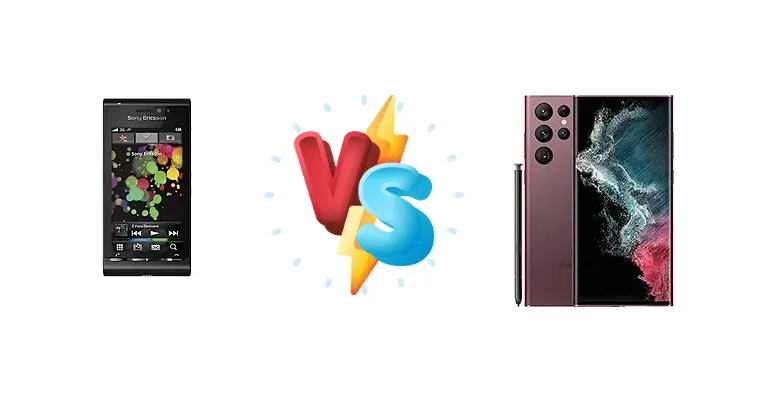
Sony Ericsson Satio (Idou) vs. Samsung Galaxy S22 Ultra 5G: A Clash of Eras
| Phones Images | |||||
|---|---|---|---|---|---|
|
🏆 Quick Verdict
The Samsung Galaxy S22 Ultra 5G utterly dominates this comparison. While the Satio holds nostalgic value, the S22 Ultra's superior display, performance, camera capabilities, and battery life make it the clear winner for any modern user. It's a David vs. Goliath scenario.
| PHONES | ||
|---|---|---|
| Phone Names | Sony Ericsson Satio (Idou) | Samsung Galaxy S22 Ultra 5G |
| Network | ||
|---|---|---|
| 2G bands | GSM 850 / 900 / 1800 / 1900 | GSM 850 / 900 / 1800 / 1900 |
| 3G bands | HSDPA 900 / 2100 | HSDPA 850 / 900 / 1700(AWS) / 1900 / 2100 |
| 4G bands | - | 1, 2, 3, 4, 5, 7, 8, 12, 13, 17, 18, 19, 20, 25, 26, 28, 32, 38, 39, 40, 41, 66 - International |
| 5G bands | - | 1, 2, 3, 5, 7, 8, 12, 20, 25, 28, 38, 40, 41, 66, 75, 77, 78 SA/NSA/Sub6 - International |
| Speed | HSPA 7.2/3.6 Mbps | HSPA 42.2/5.76 Mbps, LTE (7CA) Cat20 2000/200 Mbps, 5G (5+ Gbps DL) |
| Technology | GSM / HSPA | GSM / CDMA / HSPA / EVDO / LTE / 5G |
| HSDPA 850 / 1900 / 2100 - Satio(a) for the Americas | 1, 3, 5, 7, 8, 20, 28, 38, 41, 66, 71, 260, 261 SA/NSA/Sub6/mmWave - USA | |
| Launch | ||
|---|---|---|
| Announced | 2009, February. Released 2009, October | 2022, February 09 |
| Status | Discontinued | Available. Released 2022, February 25 |
| Body | ||
|---|---|---|
| Build | - | Glass front (Gorilla Glass Victus+), glass back (Gorilla Glass Victus+), aluminum frame |
| Dimensions | 112 x 55 x 13 mm (4.41 x 2.17 x 0.51 in) | 163.3 x 77.9 x 8.9 mm (6.43 x 3.07 x 0.35 in) |
| SIM | Mini-SIM | · Nano-SIM + eSIM· Nano-SIM + Nano-SIM + eSIM (max 2 at a time) |
| Weight | 126 g (4.44 oz) | 228 g / 229 g (mmWave) (8.04 oz) |
| - | IP68 dust/water resistant (up to 1.5m for 30 min) Armor aluminum frame with tougher drop and scratch resistance (advertised) Stylus, 2.8ms latency (Bluetooth integration, accelerometer, gyro) | |
| Display | ||
|---|---|---|
| Protection | - | Corning Gorilla Glass Victus+ |
| Resolution | 360 x 640 pixels, 16:9 ratio (~210 ppi density) | 1440 x 3088 pixels, 19.3:9 ratio (~500 ppi density) |
| Size | 3.5 inches, 33.8 cm2 (~54.8% screen-to-body ratio) | 6.8 inches, 114.7 cm2 (~90.2% screen-to-body ratio) |
| Type | TFT resistive touchscreen, 16M colors | Dynamic AMOLED 2X, 120Hz, HDR10+, 1750 nits (peak) |
| - | Always-on display | |
| Platform | ||
|---|---|---|
| CPU | 600 MHz Cortex-A8 | Octa-core (1x2.8 GHz Cortex-X2 & 3x2.50 GHz Cortex-A710 & 4x1.8 GHz Cortex-A510) - EuropeOcta-core (1x3.00 GHz Cortex-X2 & 3x2.50 GHz Cortex-A710 & 4x1.80 GHz Cortex-A510) - ROW |
| Chipset | - | Exynos 2200 (4 nm) - EuropeQualcomm SM8450 Snapdragon 8 Gen 1 (4 nm) - ROW |
| GPU | PowerVR SGX | Xclipse 920 - EuropeAdreno 730 - ROW |
| OS | Symbian 9.4, Series 60 rel. 5 | Android 12, up to 4 major Android upgrades, One UI 8 |
| Memory | ||
|---|---|---|
| Card slot | microSDHC (dedicated slot), 8 GB included | No |
| Internal | 128MB; 256MB RAM | 128GB 8GB RAM, 256GB 12GB RAM, 512GB 12GB RAM, 1TB 12GB RAM |
| - | UFS 3.1 | |
| Main Camera | ||
|---|---|---|
| Features | xenon flash, video LED flash | Laser AF, LED flash, auto-HDR, panorama |
| Quad | - | 108 MP, f/1.8, 23mm (wide), 1/1.33", 0.8µm, PDAF, OIS 10 MP, f/2.4, 70mm (telephoto), 1/3.52", 1.12µm, PDAF, OIS, 3x optical zoom 10 MP, f/4.9, 230mm (periscope telephoto), 1/3.52", 1.12µm, PDAF, OIS, 10x optical zoom 12 MP, f/2.2, 13mm, 120˚ (ultrawide), 1/2.55", 1.4µm, dual pixel PDAF, Super Steady video |
| Single | 12 MP, AF | - |
| Video | w480p@30fps (via SW update) | 8K@24fps, 4K@30/60fps, 1080p@30/60/120/240fps, HDR10+, stereo sound rec., gyro-EIS |
| Selfie camera | ||
|---|---|---|
| Features | - | HDR |
| Single | VGA videocall camera | 40 MP, f/2.2, 26mm (wide), 1/2.82", 0.7µm, PDAF |
| Video | - | 4K@30/60fps, 1080p@30fps |
| Sound | ||
|---|---|---|
| 3.5mm jack | No | No |
| 35mm jack | No | No |
| Loudspeaker | Yes | Yes, with stereo speakers |
| - | 32-bit/384kHz audio Tuned by AKG | |
| Comms | ||
|---|---|---|
| Bluetooth | 2.0, A2DP | 5.2, A2DP, LE |
| NFC | - | Yes |
| Positioning | GPS, A-GPS | GPS, GLONASS, BDS, GALILEO |
| Radio | Stereo FM radio | No |
| USB | 2.0 | USB Type-C 3.2, OTG |
| WLAN | Wi-Fi 802.11 b/g, DLNA | Wi-Fi 802.11 a/b/g/n/ac/6e, dual-band, Wi-Fi Direct |
| Features | ||
|---|---|---|
| Browser | WAP 2.0/HTML, RSS reader | - |
| Sensors | Accelerometer, proximity | Fingerprint (under display, ultrasonic), accelerometer, gyro, proximity, compass, barometer |
| Gesture control MP4/H.264/WMV player MP3/WAV/WMA/eAAC+ player TV-out Office document viewer Organizer Predictive text input | Samsung DeX, Samsung Wireless DeX (desktop experience support) Bixby natural language commands and dictation Samsung Pay (Visa, MasterCard certified) Ultra Wideband (UWB) support | |
| Battery | ||
|---|---|---|
| Charging | - | 45W wired, PD3.0 15W wireless (Qi) 4.5W reverse wireless |
| Stand-by | Up to 360 h (2G) / Up to 340 h (3G) | - |
| Talk time | Up to 11 h (2G) / Up to 4 h 50 min (3G) | - |
| Type | Removable Li-Po 1000 mAh battery | Li-Ion 5000 mAh |
| Misc | ||
|---|---|---|
| Colors | Black, Silver, Bordeaux | Phantom Black, White, Burgundy, Green, Graphite, Red, Sky Blue, Bora Purple |
| Models | - | SM-S908B, SM-S908B/DS, SM-S908U, SM-S908U1, SM-S908W, SM-S908N, SM-S9080, SM-S908E, SM-S908E/DS |
| Price | About 180 EUR | € 397.07 / $ 269.98 / £ 304.99 / ₹ 63,899 |
| SAR | - | 1.18 W/kg (head) 0.98 W/kg (body) |
| SAR EU | 1.58 W/kg (head) | 1.05 W/kg (head) 1.58 W/kg (body) |
| Tests | ||
|---|---|---|
| Audio quality | Noise -87.0dB / Crosstalk -84.3dB | - |
| Battery life | - | Endurance rating 108h |
| Camera | Photo | Photo / Video |
| Display | - | Contrast ratio: Infinite (nominal) |
| Loudspeaker | Voice 71dB / Noise 66dB / Ring 78dB | -27.3 LUFS (Good) |
| Performance | - | AnTuTu: 968359 (v9) GeekBench: 3657 (v5.1) GFXBench: 37fps (ES 3.1 onscreen) |
Sony Ericsson Satio (Idou)
- Nostalgic design
- Compact size
- Decent camera for its time
- Outdated performance
- Low resolution display
- Poor battery life
- No 5G
- Limited app support
Samsung Galaxy S22 Ultra 5G
- Exceptional display
- Powerful performance
- Versatile camera system
- Long battery life
- Fast charging
- 5G connectivity
- Expensive
- Large size may not suit everyone
- Software updates can be slow (depending on region)
Display Comparison
The Samsung Galaxy S22 Ultra's 6.8-inch Dynamic AMOLED 2X display with a 120Hz refresh rate and a peak brightness of 1266 nits is in a different league compared to the Satio's 3.5-inch OLED screen. The S22 Ultra offers vibrant colors, incredible clarity, and smooth scrolling, while the Satio's display feels dated by today's standards.
Camera Comparison
While the Satio's 8.1MP camera was impressive for its time, the S22 Ultra's multi-lens system (typically 108MP main, ultrawide, telephoto) delivers vastly superior image quality, video recording capabilities (8K), and features like Space Zoom. The S22 Ultra's computational photography is also far more advanced.
Performance
The S22 Ultra's Octa-core processor (Exynos or Snapdragon) blows the Satio's 600 MHz Cortex-A8 CPU out of the water. The S22 Ultra handles demanding games and multitasking with ease, while the Satio struggles with even basic apps by modern standards. The S22 Ultra's chipset also offers 5G connectivity, a feature completely absent in the Satio.
Battery Life
The S22 Ultra boasts an endurance rating of 108 hours, thanks to its large battery and efficient power management. The Satio's battery life was considerably shorter, typically lasting a day at best with moderate use. Fast charging is another advantage of the S22 Ultra.
Buying Guide
Who should buy the Sony Ericsson Satio (Idou)? Collectors of vintage phones or those seeking a nostalgic experience. Who should buy the Samsung Galaxy S22 Ultra 5G? Anyone needing a top-tier smartphone with exceptional camera, display, and performance for everyday use and demanding tasks.